Form 3520 for gifts and inheritance from parents in India (2026)

Lesser Tax
12 min read
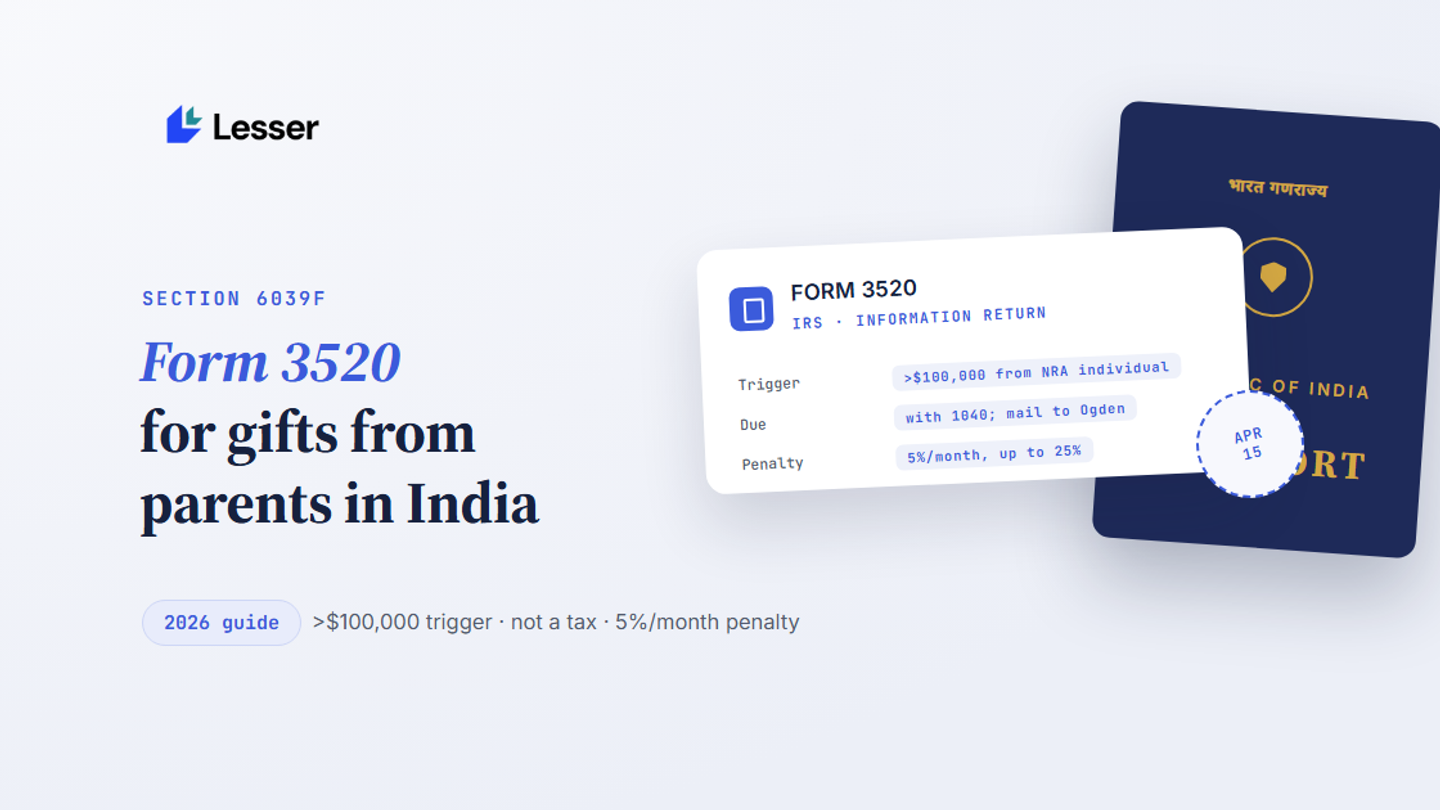
Quick answer: Form 3520 is a US information return that a US person files when they receive more than $100,000 in gifts or bequests during a tax year from a nonresident alien individual or a foreign estate — including parents in India. It is a reporting form, not a tax: a wire of ₹1 crore from your father is not US-taxable income to you. But the late-filing penalty under section 6039F is 5% of the gift per month, capped at 25%, so missing it is expensive. For gifts from foreign corporations or partnerships, the threshold is lower and inflation-adjusted every year (published in the annual Rev. Proc.). You file Form 3520 by your 1040 due date, mailed separately to the IRS center in Ogden.
Key takeaways
- Threshold: more than $100,000 in a tax year from a nonresident alien individual or foreign estate — aggregated with gifts from related foreign persons (Form 3520 instructions, p. 2).
- A gift from your parent in India is not US-taxable income; Form 3520 is "information" reporting, not a tax return (IRS: About Form 3520).
- The penalty for failing to report is "5% of the amount of such foreign gifts applies for each month for which the failure to report continues (not to exceed a total of 25%)" (Form 3520 instructions, p. 4).
- Due date: 15th day of the 4th month after your tax-year end (April 15 for calendar-year filers); if you extend your 1040 to October 15, the Form 3520 extension follows automatically (Form 3520 instructions, p. 3).
- You file Form 3520 separately from your 1040: by mail to the IRS center in Ogden, UT. Not an attachment to the return.
- The threshold for gifts from foreign corporations or partnerships is lower and set annually under section 6039F — check the current year's inflation-adjustment Rev. Proc. at irs.gov/InflationAdjustment (Form 3520 instructions, p. 2).
Who has to file Form 3520 for an Indian family gift?
The trigger is in Part IV of Form 3520. The instructions set the rule precisely: "You are a U.S. person who, during the current tax year, received… more than $100,000 from a nonresident alien individual or a foreign estate (including foreign persons related to that nonresident alien individual or foreign estate) that you treated as gifts or bequests" (Form 3520 instructions, p. 2).
Three pieces to that sentence:
- You are a US person. US citizens, green card holders, and US tax residents under the substantial presence test — the same definition the FBAR uses, essentially. If you are a nonresident alien, Form 3520 does not apply to you.
- $100,000 aggregate in one tax year. It is the whole year, not per gift. A $60,000 wire in March and a $45,000 wire in October from the same parent crosses the line.
- From a nonresident alien individual or foreign estate — including related foreign persons. This is the trap. If your mother wires you $70,000 and your father wires you another $70,000 in the same year, those are two related nonresident aliens and the aggregate is $140,000. You file.
Related persons are defined in sections 267(b) and 707(b)(1) and include spouses, parents, children, siblings, grandparents, and entities you (or they) control. For a classic Indian family gift — a flat sale in Hyderabad where both parents send you the proceeds, or a wedding gift from your parents and your in-laws — you aggregate.
Is a gift from my parents in India taxable in the US?
No. The IRS treats a gift from a nonresident alien individual as a gift under section 102, which excludes gifts from the recipient's gross income. Form 3520 is a reporting form; your parents' wire of ₹2 crore (roughly $240,000 at a 85 to the dollar rate) does not create US income tax for you.
Three nuances to keep in mind:
- Any income earned after you receive the money is yours. The $240,000 principal is not taxable, but the US interest it earns in your Chase account is ordinary interest income on your 1040.
- The gift tax in the US is on the donor, not the recipient. US gift tax does not apply to foreign donors who are not US persons; your parents owe no US tax. See IRS: Gifts from Foreign Person for the IRS summary.
- India has its own rules. Under section 56(2)(x) of the Indian Income-tax Act, gifts from "relatives" (defined broadly, including parents) are exempt from Indian tax on the recipient's side; your parents may still have Indian compliance to deal with when they send the money abroad.
Thresholds for the three types of foreign gift
| Source | 2026 threshold | Aggregation | Where it goes on Form 3520 |
|---|---|---|---|
| Nonresident alien individual or foreign estate (your Indian parents) | >$100,000 in the tax year | Yes, with related foreign persons | Part IV, lines 54a-c |
| Foreign corporations or foreign partnerships | Set annually under section 6039F; check current Rev. Proc. at irs.gov/InflationAdjustment | Yes, with related foreign persons | Part IV, line 55 |
| Foreign trusts (distributions) | Any amount | n/a | Part III, lines 24-30 |
The foreign-corporation threshold is inflation-adjusted every year under section 6039F and is in the five-figure range (far lower than the individual threshold). The Form 3520 instructions tell you where to look: "The threshold amount is available at IRS.gov/InflationAdjustment. Select the applicable tax year news release, then click on the Rev. Proc. link and search for section 6039F" (Form 3520 instructions, p. 2). Always verify the current year's figure before you decide you are under it.
Step by step: filing Form 3520 for an Indian family gift
Step 1. Add up every related-party gift for the year. List each wire you received, when, the USD value on the day it hit your US account, and the sender. Aggregate every related foreign person (parents, step-parents, siblings, grandparents). If the total exceeds $100,000, you file.
Step 2. Convert each gift to USD on the receipt date. Use the exchange rate on the day the money hit your account. The Treasury Reporting Rates of Exchange or your bank's conversion rate on the deposit is acceptable; keep a record of the method you used.
Step 3. Fill out Form 3520 page 1 and Part IV. On page 1, give your name, SSN or ITIN, address, and tax year. Check the box for Item B that identifies you as the recipient of a large gift. Skip Parts I, II, and III (those are for foreign trusts). Go straight to Part IV.
Step 4. Complete Part IV lines 54a-c. For each gift from a nonresident alien individual (your mother, your father) or foreign estate (if an estate was the technical source after a bequest), list the date, the USD amount, and a brief description of the gift. The instructions explicitly say you must identify each donor if the aggregate from related persons exceeds the threshold.
Step 5. Sign and date Form 3520 under penalties of perjury. Both spouses sign if filing jointly ("If you and your spouse are filing a joint income tax return for the current tax year, and you are both transferors, grantors, or beneficiaries of the same foreign trust, then you may file a joint Form 3520 for the same tax year" — Form 3520 instructions, p. 3). The joint-filing option is formal only for foreign-trust reporting; for a straight gift from parents, both of you file separate Forms 3520 if both are recipients.
Step 6. Mail the signed Form 3520 to Ogden. Form 3520 is NOT attached to your 1040. The instructions direct you to mail it to the Internal Revenue Service Center, P.O. Box 409101, Ogden, UT 84409. Keep certified-mail proof of posting.
Step 7. Keep documentation. Wire confirmations, bank statements showing the credit, your parents' Indian bank remittance advice (Form A2 or 15CA/15CB), and a one-paragraph memo explaining the family relationship. The reasonable-cause defense depends on this paper trail if the filing is ever questioned.
Due date and extensions
The default is April 15 for a calendar-year individual. The instructions say Form 3520 is "due on the 15th day of the 4th month following the end of such person's tax year for income tax purposes" and that "if a U.S. person is granted an extension of time to file an income tax return, Form 3520 is due no later than the 15th day of the 10th month" — October 15 (Form 3520 instructions, p. 3).
You do not file a separate Form 4868 for Form 3520. The extension you file for your 1040 (Form 4868) automatically extends Form 3520 to October 15. Keep a copy of the 4868 acceptance with your Form 3520 copy.
The penalty if you miss Form 3520
Under section 6039F, the penalty is "5% of the amount of such foreign gifts applies for each month for which the failure to report continues (not to exceed a total of 25%)" (Form 3520 instructions, p. 4).
For a $200,000 gift from parents that you forgot to report:
- Month 1 late: $10,000 penalty
- Month 3 late: $30,000
- Month 5 and beyond: capped at $50,000 (25%)
This is the single biggest reason to file on time, because the gift itself is not even taxable. You can pay a penalty approaching the dollar value of a car on a reporting form that owes no US tax.
Reasonable cause: "No penalty will be imposed if the taxpayer can demonstrate that the failure to comply was due to reasonable cause and not willful neglect" (Form 3520 instructions, p. 4). Common accepted reasons include a serious illness that made timely filing impossible, incorrect written advice from a tax professional, or a natural disaster. "I didn't know" is almost never accepted on its own.
Common NRI scenarios
Flat sale in India where parents send you the proceeds. Report under Part IV. If both parents sent money (even if from one joint account), aggregate them as related persons.
Inheritance after a parent's death. The inheritance comes from a foreign estate. The $100,000 threshold applies the same way. If the Indian estate is in probate for several years and distributions arrive in two tax years, you report in whichever tax year each exceeds $100,000.
Loan from parents. A genuine arm's-length loan with a written note, interest at the AFR, and a repayment schedule is not a gift and is not reportable. A "loan" with no documentation and no repayments is typically recharacterized as a gift by the IRS. If in doubt, document.
Wedding gift from parents and in-laws. Each nonresident alien donor is counted. Aggregate related donors (your parents between themselves; your in-laws between themselves). The two families are not related persons, so the two aggregates are separate — but each can trigger reporting independently if either exceeds $100,000.
For the US-residency rules that decide whether you are a US person who has to file at all, see our resident alien vs nonresident alien guide. For the related FBAR and Form 8938 reporting on your Indian bank accounts in general, see FBAR and Form 8938 for Indian accounts and the NRI first-year checklist.
FAQ
Does receiving a gift from my parents in India make me owe US tax?
No. A gift from a nonresident alien individual is excluded from the recipient's gross income under IRC section 102. Form 3520 is a reporting form, not a tax computation. Any interest or dividends earned afterwards on the money are of course taxable.
What exchange rate do I use for the gift?
The USD equivalent on the date of receipt. Use a verifiable source — the Treasury Reporting Rates of Exchange, your bank's conversion rate, or the published RBI rate for that date — and keep the record.
Is a $90,000 wire reportable?
Not on its own. But if you received other gifts from the same parent or related persons in the same tax year that push the aggregate over $100,000, you report. Count every related wire for the year before you decide.
Does the $100,000 threshold apply per donor or per recipient?
Per recipient, aggregating all related nonresident alien donors. "More than $100,000 from a nonresident alien individual or a foreign estate (including foreign persons related to that nonresident alien individual or foreign estate)" (Form 3520 instructions, p. 2).
What if the gift is property, not cash — like a flat in Mumbai?
A transfer of property from an NRA to a US person is still a gift. Report the FMV in USD on the date of transfer. For a flat, that is the Indian valuation plus any Indian stamp duty you did not pay, converted to USD.
Can I file Form 3520 together with my 1040?
No. The instructions direct you to mail Form 3520 separately to the IRS center in Ogden, UT, by the due date of your 1040 (plus any extension).
Will Form 3520 trigger an audit?
There is no public IRS statistic linking Form 3520 to higher audit rates for individual filers. The penalties for not filing are high enough that filing it on time is unambiguously the lower-risk path.
What about a gift from my uncle or a family friend?
A gift from any nonresident alien individual counts; "related" matters for the aggregation rule, not for whether a single gift above $100,000 is reportable. A $150,000 gift from an uncle (unrelated to your parents in the IRS's narrow definition of related persons) is reportable on its own.
Does GIFT City or an Indian trust change anything?
A gift from an Indian trust is a distribution from a foreign trust, reportable in Part III of Form 3520 with no $100,000 threshold — any distribution is reportable, and the penalty structure is harsher. Do not treat trust distributions as if they are "just gifts from Dad".