Form 6166 and Form 10F: claiming the India-US treaty rate on NRO interest (2026)

Lesser Tax
13 min read
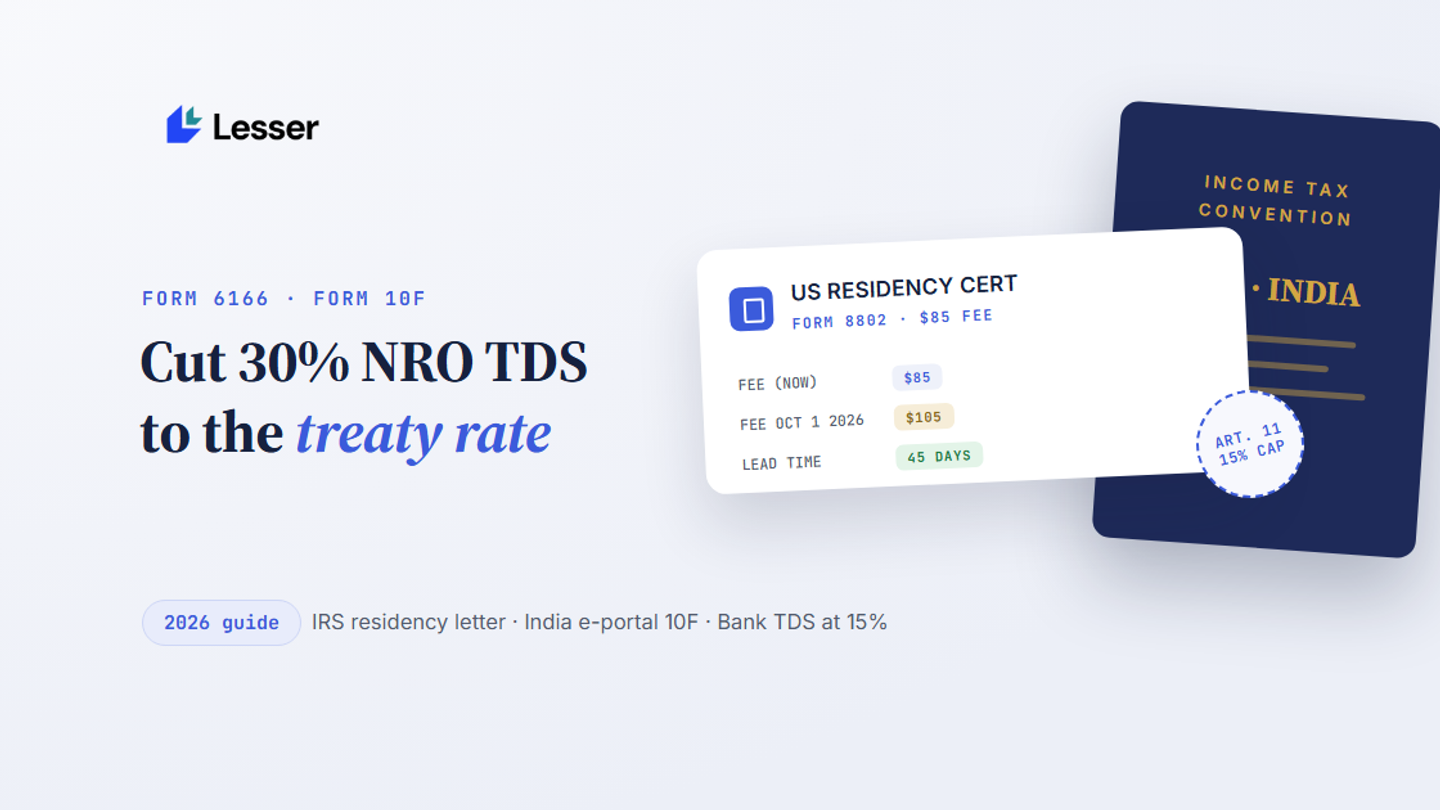
Quick answer: Form 6166 is a letter the IRS prints on US Treasury stationery certifying that you are a resident of the United States for income-tax purposes, and it is what your Indian NRO bank asks for before it will apply the India-US tax treaty rate on your interest. You request it on Form 8802 for an $85 user fee (rising to $105 on October 1, 2026), and the IRS says to apply at least 45 days before you need the certificate. In India you pair the Form 6166 with Form 10F on the income-tax portal and your PAN; your NRO branch then withholds at the treaty rate of 15% on interest instead of the 30% domestic rate. Form 6166 covers one calendar year, so if you want the treaty rate every year you file a new Form 8802 and a new Form 10F each year.
Key takeaways
- Form 6166 is the IRS certification of US tax residency; it is issued only on request, by filing Form 8802 (IRS: Form 6166).
- The user fee for an individual applicant is $85 per Form 8802 today, and the IRS has announced the fee rises to $105 on October 1, 2026 (Instructions for Form 8802; IRS: Form 6166).
- Mail Form 8802 at least 45 days before you need the Form 6166; the IRS contacts you after 30 days if there is a delay (Instructions for Form 8802).
- The India-US treaty caps Indian tax on interest paid to a US resident at 15% of the gross amount in general, or 10% if the interest is paid on a loan from a bank or similar financial institution (Article 11(2), treaty text).
- To claim the treaty rate in India, a non-resident needs a Tax Residency Certificate from the home country (Form 6166 for a US resident) plus Form 10F filed electronically on the Indian income-tax portal (Income Tax Department).
- Form 6166 cannot be used to substantiate that US taxes were paid for a foreign tax credit — it is only a residency certificate (About Form 8802).
What is Form 6166 and why does the NRO bank ask for it?
Form 6166 is a letter printed on US Department of Treasury stationery stating that the person or entity named "is a resident of the United States for purposes of the income tax laws of the United States". The IRS explains: "Many U.S. treaty partners require the IRS to certify that the person claiming treaty benefits is a resident of the United States for federal tax purposes. The IRS provides this residency certification on Form 6166, a letter of U.S. residency certification." (IRS: Form 6166).
The reason NRO account holders in the US need it is the India TDS default. Interest on an NRO account is Indian-source income to a non-resident, so Indian banks withhold tax under the Income-tax Act at the domestic rate. Only if you supply a Tax Residency Certificate from your home country and the related declarations will the bank apply the lower treaty rate under section 90 of the Indian Income-tax Act. For a US resident, that TRC is Form 6166.
The gap this closes is big. Without the treaty paperwork, Indian banks withhold at 30% (plus applicable surcharge and cess) on NRO interest. With Form 6166 plus Form 10F on file, the bank can withhold at the Article 11 treaty cap. See reporting India income on a US tax return for how the Indian interest and TDS feed back into Schedule B and the foreign tax credit on your US return.
What rate does the India-US treaty actually allow on NRO interest?
Article 11(2) of the India-US tax treaty states that interest arising in India and beneficially owned by a US resident "may also be taxed in" India, but "the tax so charged shall not exceed: a) 10 percent of the gross amount of the interest if such interest is paid on a loan granted by a bank carrying on a bona fide banking business or by a similar financial institution (including an insurance company); and b) 15 percent of the gross amount of the interest in all other cases" (treaty text).
For a typical NRO savings account or fixed deposit held by an Indian in the US, the depositor is the lender and the bank is the borrower, so interest on the deposit is "paid on a loan granted by a bank" — which puts the Article 11(2)(a) 10% rate in play. In practice, Indian banks and the India-side guidance commonly apply the 15% general cap on NRO interest withholding under Article 11(2)(b), and the India-side treatment of the "bank" subparagraph can be fact-dependent. Confirm the exact rate your branch will apply before you plan around it, and keep the Form 15CA/15CB and bank TDS certificate for your records.
The treaty does not touch the India filing side. You still may need to file an Indian return if your Indian-source income exceeds the basic exemption, and you still get credit on the US return under Article 25.
How do you get Form 6166 from the IRS?
You file Form 8802, Application for United States Residency Certification, which the IRS says is mandatory: "The Internal Revenue Service (IRS) procedure for requesting a certificate of residency (Form 6166) from the Philadelphia Accounts Management Center is the submission of Form 8802, Application for United States Residency Certification. Use of the Form 8802 is mandatory." (IRS: Form 6166).
Three practical pieces matter.
The user fee. The 8802 instructions say: "The user fee for a request by an individual applicant is $85 per Form 8802, regardless of the number of countries for which certification is requested or the number of tax year(s) to which the certification applies." (Instructions for Form 8802). The IRS has also announced that "User fees for Form 8802 increase from $85 to $105 for individual applicants and from $185 to $230 for business applicants starting Oct. 1, 2026." (IRS: Form 6166).
The 45-day lead time. The instructions tell you plainly: "You should mail your application, including full payment of the user fee, at least 45 days before the date you need to submit Form 6166. We will contact you after 30 days if there will be a delay in processing your application." (Instructions for Form 8802).
The current-year attestation. If you are requesting certification for a calendar year that is not yet filed (common — most people need the current year for their NRO bank), the IRS requires a penalties-of-perjury statement that you were a US resident for the prior year and will continue to be throughout the current tax year. The IRS gives the exact wording: "Taxpayer Name, (TIN) was a U.S. resident for 2008 and will continue to be throughout the current tax year." (IRS: Form 6166) — update the year to yours.
Payment is through Pay.gov with the Form 8802 attached: "As of Sept. 29, 2024, individual and business entity taxpayers applying for a United States Certification of Residency are required to upload a copy of Form 8802 application when making a payment via Pay.gov." (IRS: Form 6166). The IRS reminds you that "Applications uploaded to Pay.gov will not be processed. Taxpayers must submit their complete Form 8802 application to the United States Residency Certification function via mail or fax to be processed."
As of September 28, 2025, Form 8802 is also available via the IRS "Digital Mobile Adaptive Forms" workflow for individual applicants (About Form 8802).
What goes on Form 8802 for a typical NRO claim?
For an Indian on H1B, L1 or a green card asking the IRS to certify US residency so an Indian bank will apply the DTAA:
| Line on Form 8802 | What to enter |
|---|---|
| Applicant name and TIN | Your legal name and SSN (or ITIN) |
| Line 4 (type of applicant) | Individual |
| Line 5 (prior-year 1040 filed?) | Yes if you filed Form 1040 for the prior year; attach the penalties-of-perjury statement if not |
| Line 6 (certification year) | The calendar year you need — e.g., 2026 |
| Line 7 (treaty country) | India |
| Line 8 (tax period) | The calendar year on the certificate |
| Line 10 (purpose/type of income) | Income tax treaty; typically interest, Article 11 |
| Line 11 (number of certifications) | How many originals you need (banks often want one or two) |
Context sentence before this table: these are the lines Indians most often ask about; follow the full line-by-line instructions on the IRS site when you fill the form (Instructions for Form 8802).
The IRS cautions that "Form 8802 will not be considered complete and valid if the application is not signed and dated by an individual who has the authority to sign Form 8802." (IRS: Form 6166).
What is Form 10F and how does it fit with Form 6166?
Form 10F is an Indian income-tax form that a non-resident uses to supply the information the Indian tax authority needs to apply a treaty rate under section 90 of the Income-tax Act. You file it electronically on the Indian income-tax portal using your PAN login. It is not a substitute for the TRC — it supplements it. For a US resident the TRC is the IRS Form 6166 you already obtained.
The portal currently supports both the Income-tax Act, 1961 and the Income-tax Act, 2025 (Income Tax Department). Form names and slot numbers may differ between the two Acts, so confirm the live form name on the portal when you log in — the portal shows it under "e-File > Income Tax Forms".
Typical Form 10F fields:
| Field | What to enter |
|---|---|
| Status | Individual |
| Nationality | Indian citizen / US citizen as applicable |
| Country of tax residence | United States of America |
| TIN in country of residence | SSN or ITIN |
| Period of residence | The calendar year on your Form 6166 |
| Address in country of residence | Your US address, as on your tax return |
Context sentence before this table: the portal validates each field against your PAN, so use the same name spelling as on your PAN and your IRS record.
Once Form 10F is filed, you give your NRO bank: a copy of the Form 10F acknowledgement, your IRS Form 6166 for the same year, and a self-declaration that you are the beneficial owner of the interest and have no permanent establishment in India. The branch then switches your TDS on NRO interest to the treaty rate from the next interest credit onward.
When should you apply, and for which year?
For a US resident whose NRO interest accrues through the Indian financial year (April to March), the cleanest cadence is one Form 8802 and one Form 10F per calendar year, filed early enough to be in the bank's hands before the April interest credit.
| Timing step | What to do | Why |
|---|---|---|
| Jan-Feb (US calendar year starts) | File Form 8802 for the current calendar year | 45-day IRS lead time plus post delivery |
| On receipt of Form 6166 | File Form 10F on the India portal for the same year | Both documents must cover the same period |
| Within the Indian FY (by April) | Submit Form 6166 + Form 10F + self-declaration to the NRO branch | Bank applies treaty rate from the next interest credit |
Context sentence before this table: this cadence is designed around the IRS's 45-day lead time and India's financial-year start. The 2026 user-fee increase on October 1 is one more reason to file in Q1 rather than drift into Q4.
If you need Form 6166 for an earlier year as well — for example, to clean up a prior year's TDS — you can request additional certifications; each additional Form 8802 carries its own user fee (Instructions for Form 8802).
Does Form 6166 help me on my US return?
No, Form 6166 is for the India side only. The IRS is explicit: "You cannot use Form 6166 to substantiate that U.S. taxes were paid for purposes of claiming a foreign tax credit." (About Form 8802). On your US return, the NRO interest is still foreign-source income you report; the Indian tax actually withheld (ideally at the treaty rate) is what you claim as a credit on Form 1116, under the saving clause and credit mechanics discussed in the India-US tax treaty guide.
Keep three things each year, for both US and India audit trails:
- Form 6166 original (and any copies you gave to banks).
- Form 10F acknowledgement from the India portal.
- Bank TDS certificates (Form 16A) showing the rate actually applied, plus the interest certificates.
Where the broader picture matters, see reporting India income on a US tax return and FBAR + Form 8938 for Indian accounts; your NRO balances and interest flow through all three.
What goes wrong and how to avoid it
- Applying too late. The 45-day lead time is a minimum, not a target. Build in a buffer for mail and bank processing. The IRS says "We will contact you after 30 days if there will be a delay in processing your application." (Instructions for Form 8802).
- Missing the current-year perjury statement. If the certification year's return is not yet filed, the signed statement is mandatory (IRS: Form 6166).
- Name/PAN mismatch. The name on Form 6166 must match the name on your PAN record and on Form 10F. A middle-name expansion on one side causes rejections at the bank counter.
- One year off. A Form 6166 for 2025 does not cover an April 2026 interest credit paid in Indian financial year 2026-27. Match the calendar year.
- Expecting Form 6166 to help the US credit. It does not; the India TDS certificate does (About Form 8802).
FAQ
How long is Form 6166 valid?
Form 6166 certifies US residency for the calendar year listed on the certificate. Indian banks accept it for that year only, so a fresh Form 6166 is typically needed each year you want the treaty rate (IRS: Form 6166).
Can I get Form 6166 if I have not filed Form 1040 yet for the prior year?
Yes, with the IRS-required attestation. The IRS wording is: "Taxpayer Name, (TIN) was a U.S. resident for 2008 and will continue to be throughout the current tax year." signed under penalties of perjury (IRS: Form 6166). Replace the year with yours.
What is the user fee for Form 8802 after October 1, 2026?
The IRS has announced the user fee rises from $85 to $105 for individual applicants on October 1, 2026, and from $185 to $230 for business applicants (IRS: Form 6166).
Do I still need Form 10F if I give the bank Form 6166?
Yes. Form 6166 is the TRC; Form 10F is the India-side declaration that the Income-tax Act asks for in addition to the TRC. Confirm the live form name on the India e-file portal before downloading, since the portal now supports both the Income-tax Act, 1961 and the Income-tax Act, 2025 (Income Tax Department).
Can I use Form 6166 on my US tax return?
No. The IRS states: "You cannot use Form 6166 to substantiate that U.S. taxes were paid for purposes of claiming a foreign tax credit." (About Form 8802). It is only a certificate of US residency for foreign treaty use.
Does the treaty rate apply to NRE interest as well?
Interest on NRE accounts is exempt from Indian tax under domestic law for persons resident outside India under FEMA, so the treaty rate question usually does not arise for NRE interest. The Form 6166 + Form 10F workflow matters mainly for NRO interest, which is Indian-source and otherwise withheld at the domestic rate.
What if my branch still withholds at 30% after I submit the papers?
Document the submission date, follow up with the branch, and consider filing an Indian return claiming a refund of the excess TDS at year end. On the US side, you still claim the Indian tax actually withheld as a Form 1116 credit; the paper trail from your bank is what matters.