
Lesser Tax
6 min read
Quick answer: If the combined highest balance across your Indian accounts (NRE, NRO, FDs, PPF, demat, Indian mutual funds, cash-value LIC) crossed $10,000 on any single day of the calendar year, you file an FBAR. FBAR is FinCEN Form 114, filed online through the BSA E-Filing System, not with your 1040 and not with the IRS. The deadline is April 15 following the year reported, with an automatic extension to October 15. No fee, no registration for individuals. Miss it and the civil penalty can reach $10,000 per non-willful violation (adjusted for inflation), far more if the violation is willful.
Key takeaways
- The FBAR trigger is "aggregate value of the foreign financial accounts exceeds $10,000 at any time during the calendar year": one day over the line is enough (FinCEN).
- The form is FinCEN Form 114, filed through the BSA E-Filing System, not attached to your tax return.
- Due date is April 15, with an automatic extension to October 15; you do not request the extension (IRS).
- Civil penalty for a non-willful violation is "Up to the amount in 31 CFR 1010.821" (statutory base $10,000, adjusted for inflation); willful violations can reach the greater of the inflation-adjusted amount or "50% of the amount in the account at the time of the violation" (IRS Pub 5569, pp. 8-9).
- The FBAR is separate from Form 8938 on your 1040; the Form 8938 thresholds for individuals living in the US start at $50,000 (IRS). You can owe one, both, or neither.
Want an expert to handle this? Get your NRI taxes done right
What does "aggregate over $10,000, even for a day" actually mean?
It means you add up the highest balance each Indian account hit during the year, and if the total crosses $10,000, even if that peak lasted a single day, you file. The regulation says "exceeds $10,000 at any time during the calendar year" (FinCEN). There is no averaging and no year-end snapshot test.
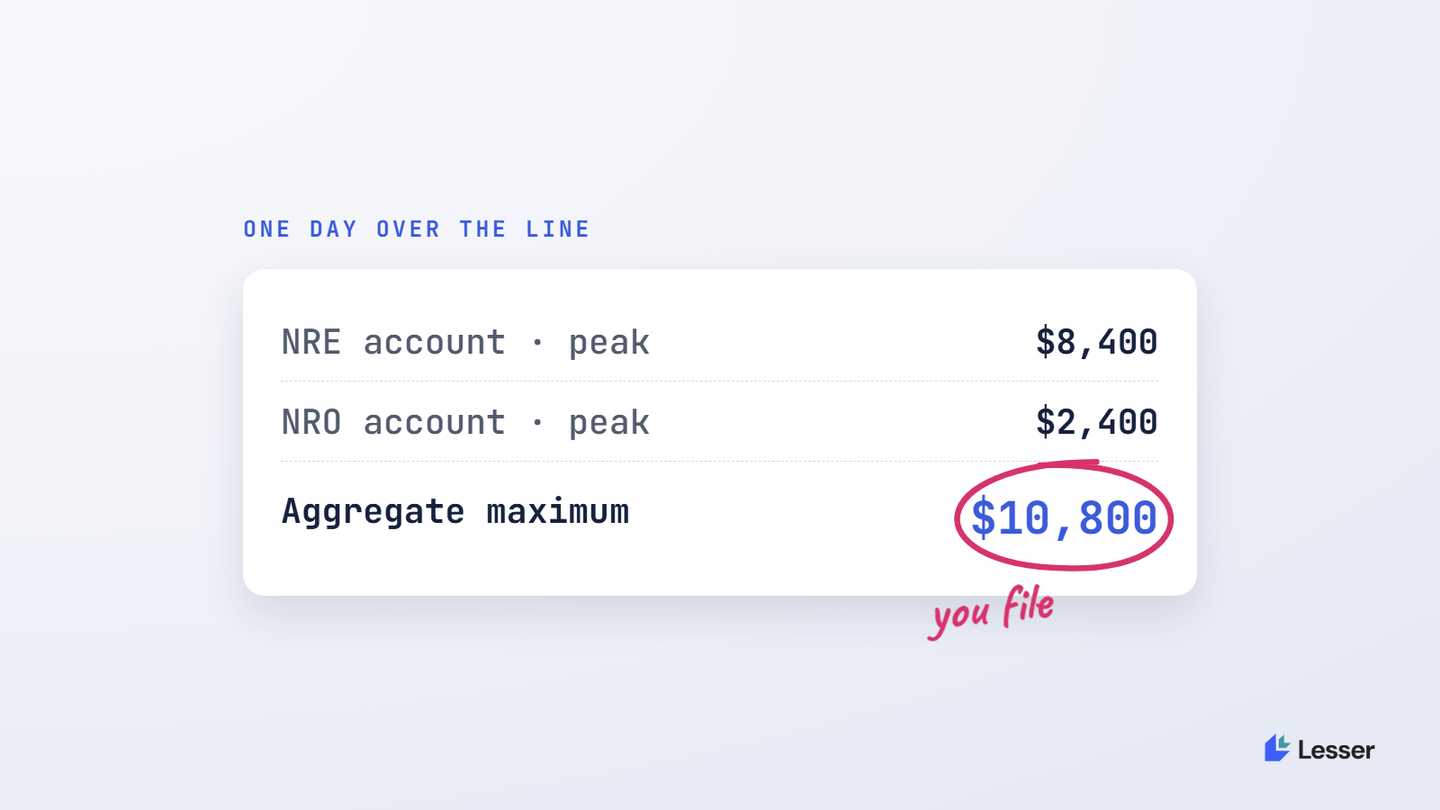
A common Hyderabad example: your parents transfer ₹7 lakh (about $8,400) into your NRE account on October 2 for a property booking, and you already have ₹2 lakh (~$2,400) sitting in an NRO account from rent. The NRE account alone is under $10,000. Added together, your "aggregate maximum" is roughly $10,800. You file.
IRS Publication 5569 gives the identical worked logic: "Kristin must report accounts A, B and C because the aggregate value of the accounts is over $10,000. It doesn't matter that no single account exceeded $10,000." (IRS Pub 5569).
Which Indian accounts count?
Most of them. FinCEN's definition of a "foreign financial account" is broad enough that NRE savings, NRO savings, fixed deposits, PPF, EPF with a foreign branch, demat accounts, Indian mutual fund folios and cash-value LIC policies all fall inside. Real estate and physical gold are not accounts, so they do not count. Jewellery in a bank locker is not an account either.
| Indian holding | Counts for FBAR? |
|---|---|
| NRE / NRO savings | Yes |
| Fixed deposits (FDs), including sweep FDs | Yes |
| PPF (Public Provident Fund) | Yes |
| EPF held by an Indian bank or trustee | Depends on how it is held; confirm with a CPA |
| Demat / brokerage account | Yes |
| Indian mutual fund folio | Yes |
| LIC policy with cash / surrender value | Yes |
| Flat in Hyderabad / Bengaluru | No (not a financial account) |
| Physical gold or jewellery | No |
Context before deciding: if you hold any of the "yes" rows and the total crossed $10,000 for even a day, you have an FBAR to file. The next question is whether you also need Form 8938: different form, different threshold, different place of filing.
Is this the same as Form 8938?
No. They look similar and feel redundant, but they are not the same.
| FBAR (FinCEN 114) | Form 8938 | |
|---|---|---|
| Who collects it | Treasury's FinCEN | IRS |
| Where it goes | BSA E-Filing System | Attached to your 1040 |
| Threshold (US-based single filer) | $10,000 aggregate at any point | $50,000 year-end or $75,000 any time ([IRS](https://www.irs.gov/businesses/comparison-of-form-8938-and-fbar-requirements)) |
| Covers signature authority? | Yes | Mostly no |
| Deadline | April 15, auto-extended to October 15 | Due with your 1040 |
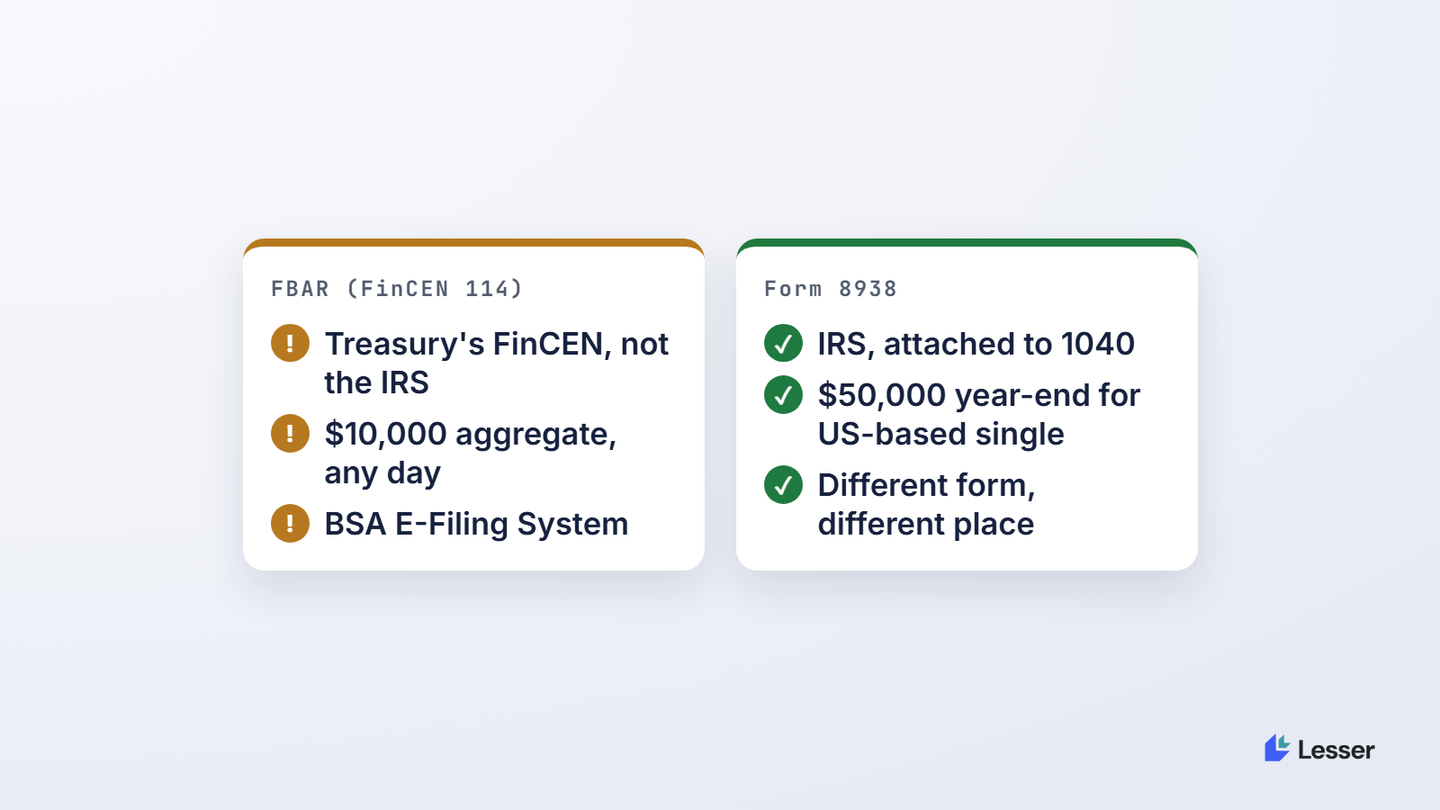
The practical answer most H-1B and L-1 readers land on: once your NRE/NRO/FD/mutual fund balances cross $10,000 you owe an FBAR; you only owe 8938 once things grow to $50,000. We cover 8938 in the deep guide on FBAR and Form 8938 for Indian accounts.
What is the penalty if you forget?
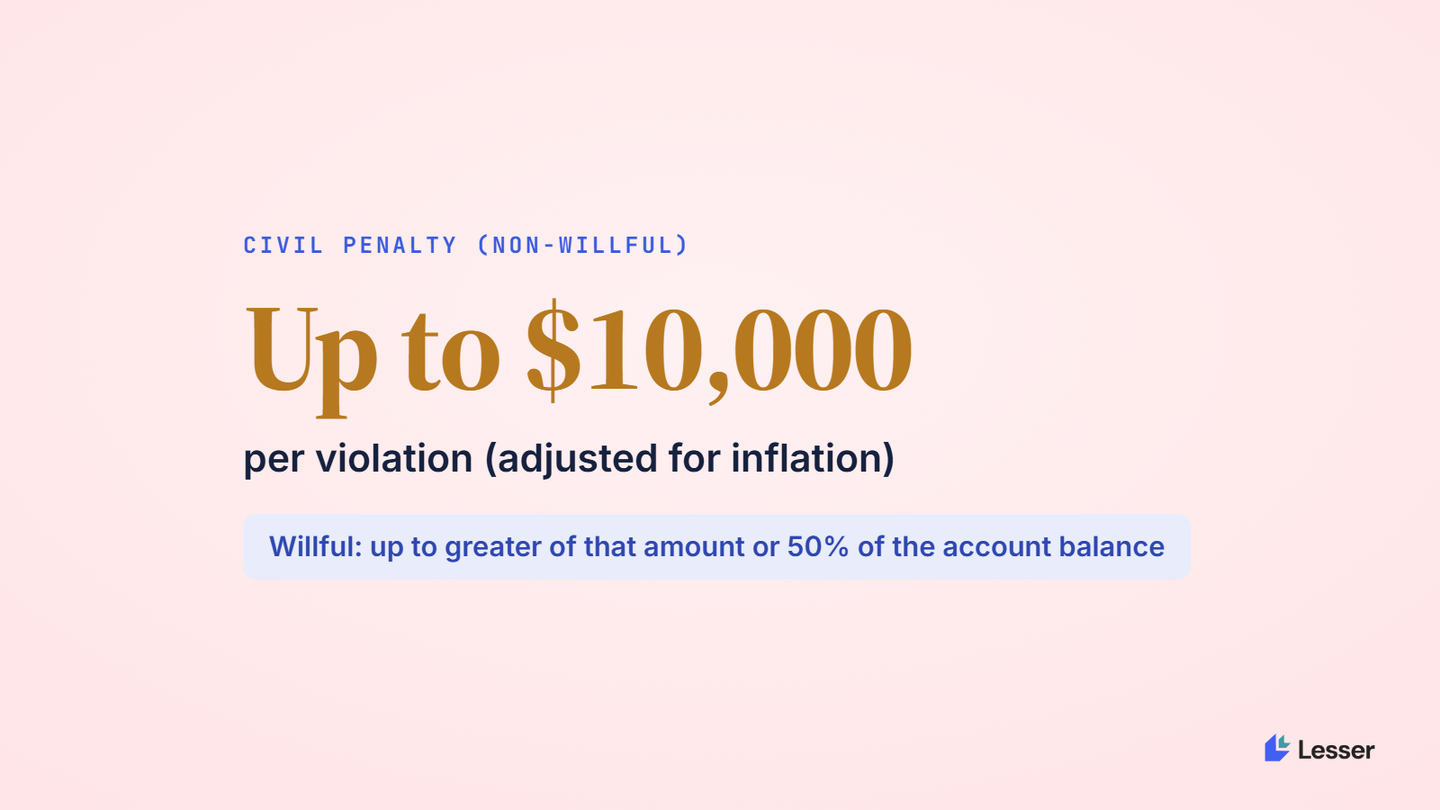
The civil non-willful penalty is "Up to the amount in 31 CFR 1010.821". The statute set that base at $10,000 per violation and FinCEN adjusts it upwards for inflation each year (IRS Pub 5569, p. 8). Willful violations are much worse: "Up to the greater of: the amount in 31 CFR 1010.821, or 50% of the amount in the account at the time of the violation" (IRS Pub 5569, p. 9).
Two things worth knowing before you panic:
- "If they properly report the foreign financial account on a late-filed FBAR, and the IRS determines the FBAR violation was due to reasonable cause, no penalty will be imposed." (IRS Pub 5569, p. 8). There is a specific late-filing path in BSA E-Filing where you explain why.
- If you have missed several years, the IRS has structured programs: the Streamlined Filing Compliance Procedures for non-willful cases, and the Delinquent International Information Return Submission Procedures. Which path fits depends on whether the omission was non-willful and whether you lived outside the US for the years at issue; check the current IRS FBAR options page before you file anything.
If you have missed years, read our note on delinquent FBARs for prior years before filing anything, and the full step-by-step for FinCEN 114 when you are ready to file the current year.
What does this mean for your taxes?
Three concrete steps, in order:
- Pull every Indian statement (NRE, NRO, FDs, PPF, demat, mutual funds, LIC with cash value) and find the single highest balance each account hit during the calendar year.
- Convert each maximum to USD using the Treasury Reporting Rates of Exchange for 31 December of that year (the FBAR instructions require this specific rate).
- If the total of those USD maxima crosses $10,000, open the BSA E-Filing System, file FinCEN Form 114 by April 15 (October 15 with the automatic extension), and keep the acknowledgement.
The FBAR is a disclosure form; it does not create any US tax on the balances themselves. Interest earned inside those accounts is still reported on your 1040, and reporting India income on your US return covers that separately.