
Lesser Tax
8 min read
Quick answer: Your pay schedule is how often you are paid: weekly (52 checks a year), biweekly (26), semi-monthly (24) or monthly (12). It changes the size of each paycheck and when FICA stops for the year, but not the total tax you owe. Biweekly schedules produce two three-paycheck months a year; semi-monthly schedules never do. The IRS calls the schedule your "payroll period," and uses it to figure federal withholding on each check.
Key takeaways
- Biweekly pay means 26 checks a year; semi-monthly means 24 (IRS Pub 15-T, 2026).
- A three-paycheck month is a calendar accident: on a biweekly schedule, two months a year contain three paydays; semi-monthly never has three.
- The pay-period tables in Pub 15-T annualize each check to figure withholding, so a three-check month does not raise your annual tax (IRS Pub 15-T).
- 2026 Social Security tax of 6.2% stops at the wage base of $184,500 at one employer; Medicare at 1.45% has no cap (IRS Pub 15, 2026).
- Most US states let employers pay semi-monthly; California and a few others require more frequent paydays (US DOL: state payday requirements).
Want an expert to handle this? Get your NRI taxes done right
What is a pay period, and why does the IRS care?
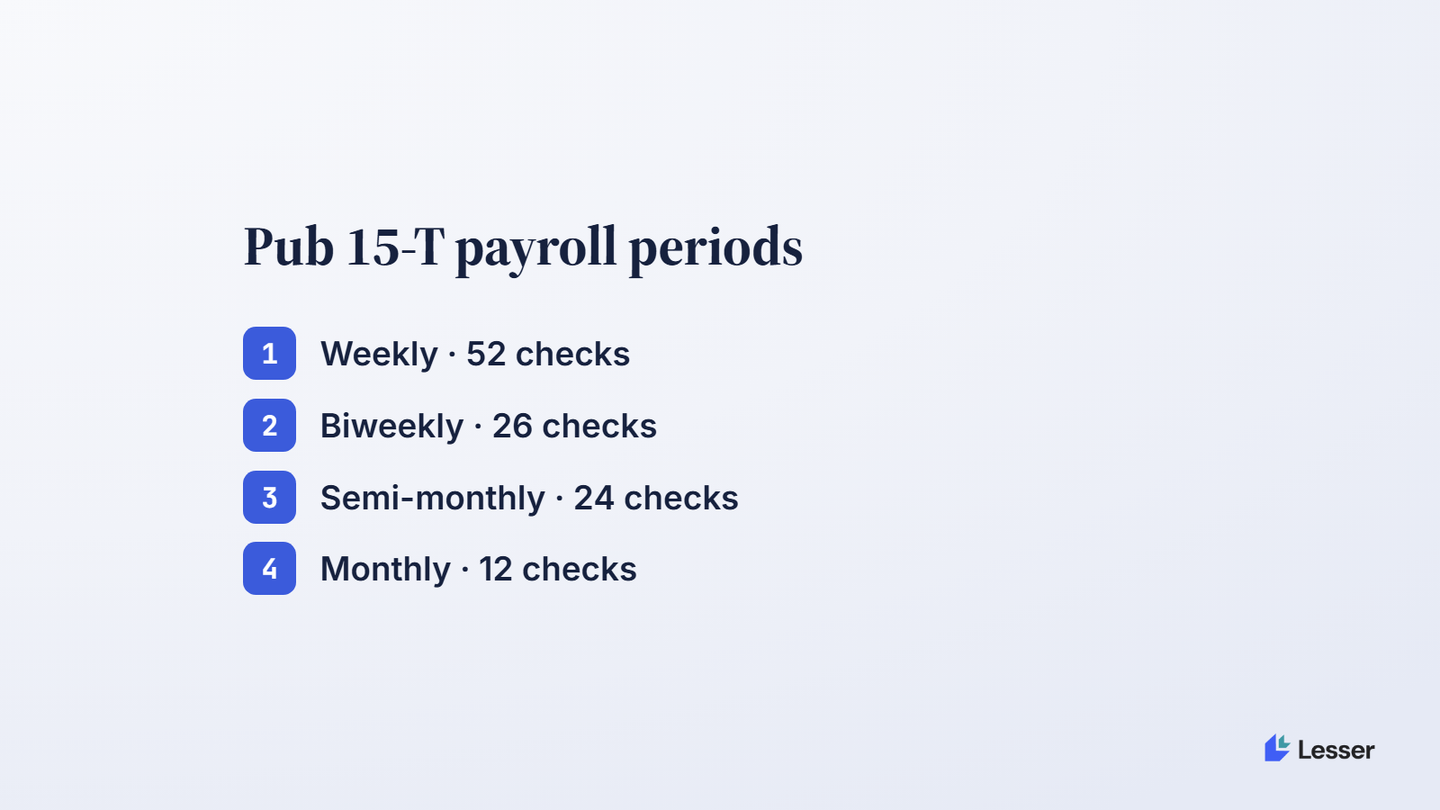
A pay period is how often your employer pays you. The IRS Publication 15-T 2026 tables are organized by "payroll period" (weekly, biweekly, semimonthly, monthly) because employers must annualize each paycheck to calculate federal withholding on it. So the schedule directly sets the arithmetic on every paystub.
In practice, four schedules cover almost all US tech jobs:
| Schedule | Checks per year | How often |
|---|---|---|
| Weekly | 52 | Every week, usually Friday |
| Biweekly | 26 | Every other week |
| Semi-monthly | 24 | Twice a month (e.g. 15th and last day) |
| Monthly | 12 | Once a month |
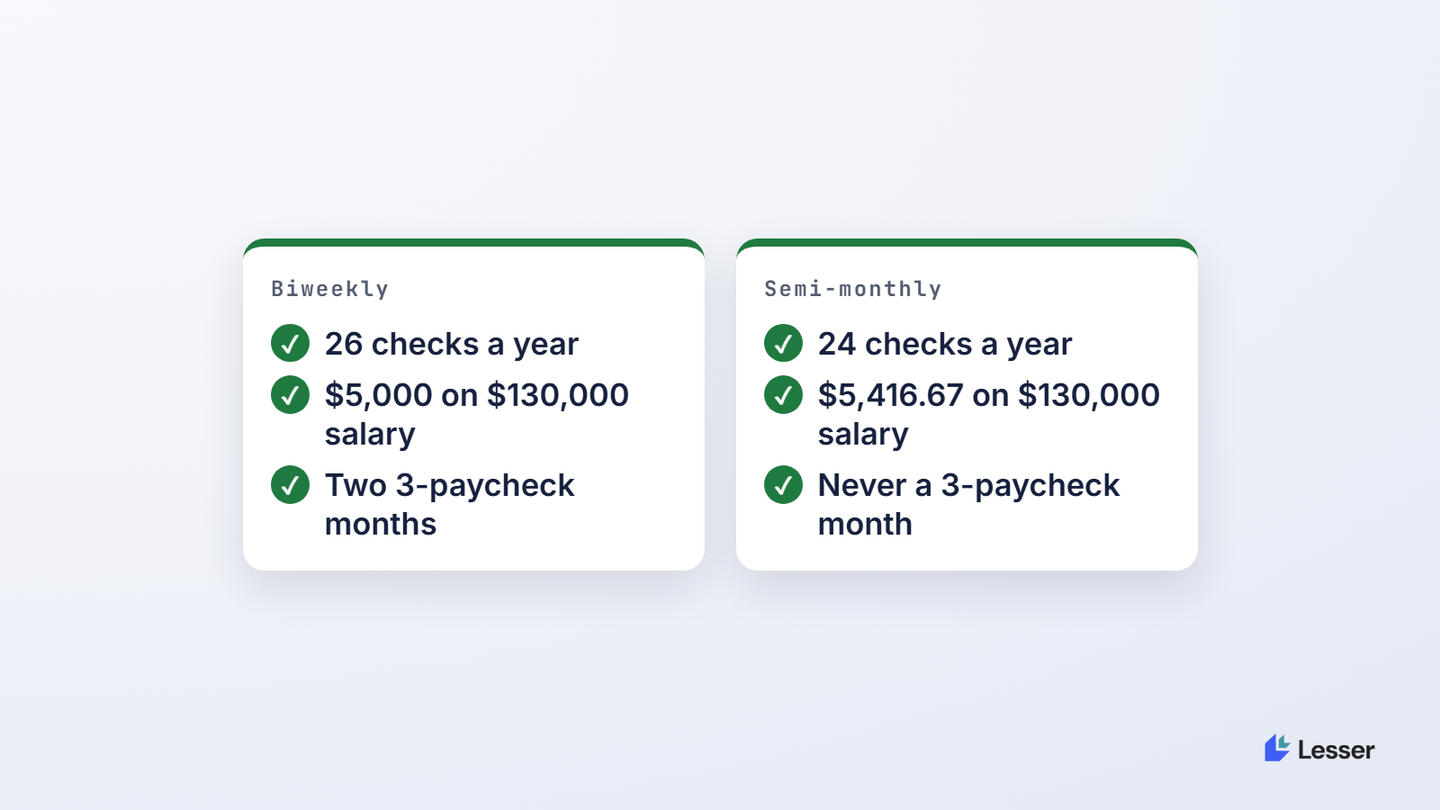
A $130,000 salary becomes $2,500.00 per week, $5,000.00 per biweekly check, $5,416.67 per semi-monthly check, or $10,833.33 per monthly check. Same salary, different slice.
Is biweekly the same as semi-monthly?
No. Biweekly pays every 14 days (26 checks a year); semi-monthly pays twice a month on fixed dates (24 checks). The two are almost the same in dollar terms, but biweekly produces two three-paycheck months a year and semi-monthly never does.
Why: a biweekly year is 26 × 14 = 364 days, so the schedule drifts forward by one or two days each year. Twice a year, three paydays fall inside the same calendar month. Semi-monthly is anchored to dates (say, the 15th and the last day), so it always lands twice per month, no matter what.
The withholding tables are separate. Pub 15-T publishes different percentage-method tables for biweekly and semimonthly payroll periods, because each table annualizes the check differently (× 26 vs × 24).
What is a "three-paycheck month" and does it change my tax?
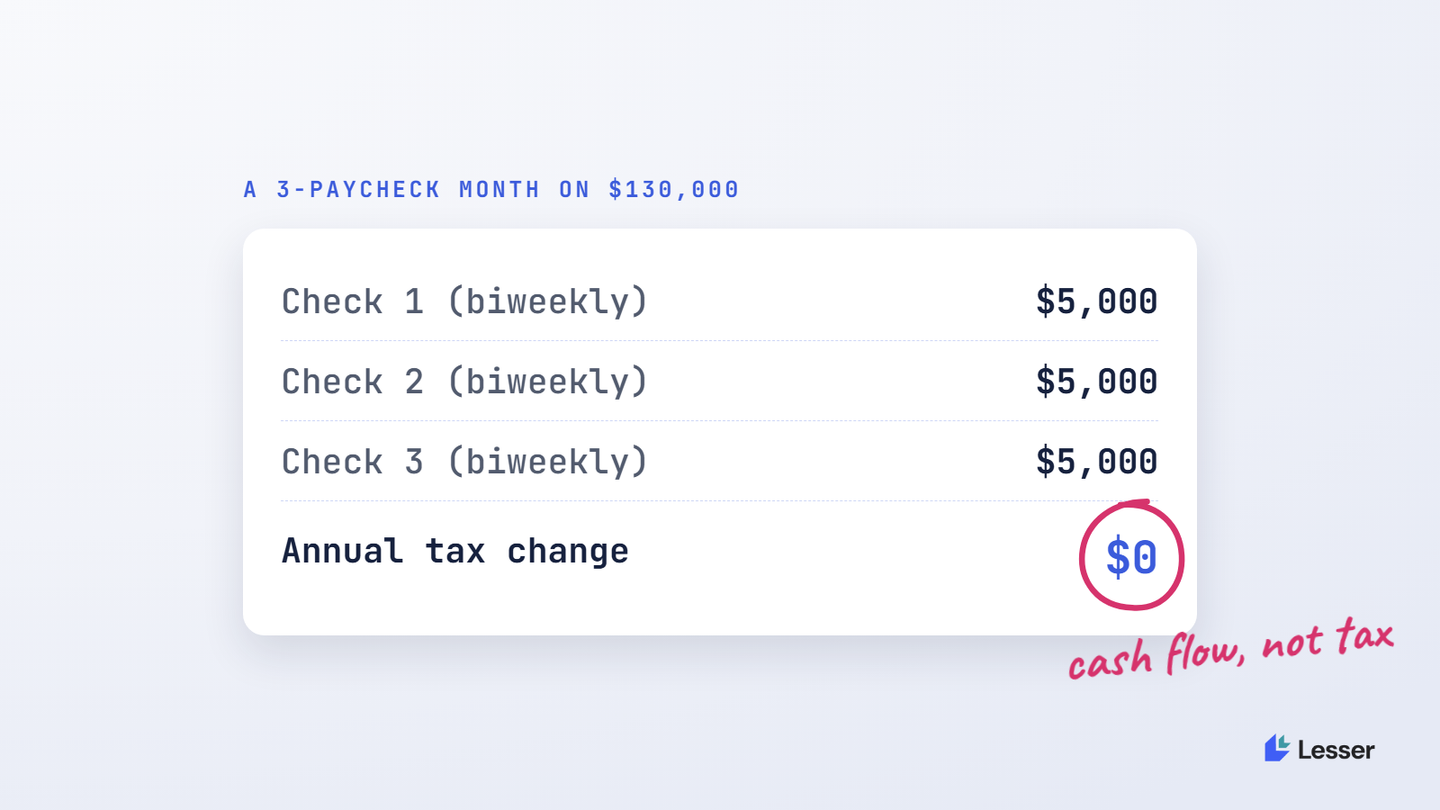
A three-paycheck month is a month where your biweekly schedule lands three paydays instead of the usual two. For most biweekly employees paid on Fridays, there are two such months each year; the exact months depend on when your first payday of the year falls. Common 2026 examples for a Friday biweekly schedule are January and July, but check your own calendar.
It does not change your total federal income tax for the year. Pub 15-T annualizes each check and figures withholding from that annualized amount, so each individual check is withheld as if it were a normal paycheck. The IRS: employers use the pay period count (52, 26, 24 or 12) to annualize wages for the withholding tables. Your Form 1040 settles the real tax in April against your annual wages, not the number of paydays.
What a three-paycheck month does change:
- Cash flow. You get an extra paycheck in that month. Rent, groceries and SIP debits are already covered; the third check is extra.
- FICA timing (only if you are over the Social Security wage base). Social Security stops at $184,500 of wages at one employer in 2026; the third check in a month that pushes you over the cap has no Social Security withheld on the slice above it.
- 401(k) contribution hits. If you set a flat per-paycheck 401(k) amount (not a percentage), you contribute 26 or 24 times, not 12. A flat $1,000/check × 26 = $26,000 a year; if you want to max the 2026 $24,500 elective deferral limit, your per-check contribution has to match.
Does a weekly or monthly schedule change my withholding?
Only per-check, not annual. Each Pub 15-T payroll period table annualizes the paycheck: a weekly check times 52, a monthly check times 12. So the same annual salary pulls out roughly the same total federal tax over the year, whether your employer pays weekly or monthly.
Two things that genuinely do change with schedule:
- Social Security wage base timing. On a monthly schedule, you hit the $184,500 cap later in the year than on a weekly schedule, because each check is bigger and crosses the line in one step. The total Social Security tax for the year is the same.
- Cash flow and float. Weekly smooths your income across 52 weeks; monthly means you wait 4-5 weeks between paychecks. Most Indian tech hires in the US coming from a monthly Indian salary find biweekly or semi-monthly easier to budget, because rent and bills land on predictable dates near paydays.
| Schedule | 2026 checks | Three-paycheck months | Where it's common in US tech |
|---|---|---|---|
| Weekly | 52 | n/a (five-paycheck months instead) | Hourly roles, some contractors |
| Biweekly | 26 | Two per year | Most salaried tech employers |
| Semi-monthly | 24 | Never | Finance-heavy employers, some F500 |
| Monthly | 12 | Never | Startups, some executive pay |
Can my US employer choose any pay schedule?
Mostly yes, but not entirely. Federal law sets no minimum pay frequency. State laws do. The US Department of Labor publishes a state-by-state table ("Minimum Paydays"): California requires at least semi-monthly for most private employees, New York requires weekly for manual workers and semi-monthly for most others, and many states set semi-monthly or biweekly as the floor.
Offer-letter language matters too. "Annual salary of $130,000 paid biweekly" means $5,000 before taxes every two weeks. "Paid semi-monthly" on the same salary means $5,416.67 twice a month. Double-check the schedule your offer letter actually commits to; some H-1B transfers accidentally switch schedules when they change employers.
What does this mean for your taxes?
Your pay schedule changes the size of each paycheck and the shape of your cash flow, not your annual tax bill. Two things to actually do:
- Set your W-4 to your annual situation, not your pay period. Your 2026 Form W-4 is what tells your employer how much federal tax to withhold on each check. Withhold too little and you owe in April (and may face an underpayment penalty). Withhold too much and you give the IRS an interest-free loan. If you have RSUs, a working spouse, or started mid-year, use the IRS Tax Withholding Estimator.
- Set your 401(k) as a percentage, not a flat dollar amount. A percentage scales with every paycheck (including three-paycheck months); a flat amount can either leave contribution room on the table or overshoot the $24,500 limit for 2026.
For the mechanics of each line on the paystub, see our deep guide: Where your paycheck goes: federal, state, FICA and the taxes you don't see. For Indians on H-1B wondering how FICA, state tax and India income interact in filing season, start with the NRI tax checklist and RSU taxes for H-1B holders.
FAQ
Is a three-paycheck month "free money"?
No. It is the same annual salary spread across 26 (not 24) checks. The surplus feel comes from monthly bills (rent, insurance) landing twice in those months instead of three times, so the third check has no fixed outflow attached.
Will my employer withhold more tax in a three-paycheck month?
No more than normal. Pub 15-T annualizes each biweekly check × 26 to figure withholding, so each of the three paychecks is withheld like any other biweekly check. The annual total is the same.
Does semi-monthly pay make my tax higher than biweekly?
No. The IRS pay-period tables produce the same annual withholding for the same salary. The per-check amount is slightly larger on semi-monthly ($5,416.67 vs $5,000 on $130,000) because it's spread across 24 checks instead of 26.
Can I ask my employer to change from biweekly to semi-monthly?
Generally not individually. Pay schedule is set by payroll policy for a whole employee class, and must comply with state minimum-payday law.
My H-1B transfer switched me from biweekly to semi-monthly mid-year. Will FICA restart?
Yes. Social Security has a per-employer wage base. Your new employer withholds 6.2% from the first dollar, even if your previous employer had already taken Social Security to the $184,500 2026 cap. You claim the excess back on your Form 1040 as "Excess social security tax withheld." See our H-1B transfer and two W-2s guide for how we file this.