
Lesser Tax
7 min read
Quick answer: Indian law doesn't let you hold two citizenships, so becoming a US citizen automatically ends your Indian citizenship. OCI (Overseas Citizen of India) is a lifetime visa, not a second citizenship. In the weeks after the oath you have three jobs: surrender your Indian passport and get a renunciation certificate, apply for a fresh OCI card, and recheck how you report your Indian bank accounts to the US because the FBAR and Form 8938 rules are the same for you now as they were as a green card holder.
Key takeaways
- You are a "US person" for tax from the day you took the oath. US citizens are "subject to tax on worldwide income from all sources" (IRS, US Citizens and Resident Aliens Abroad).
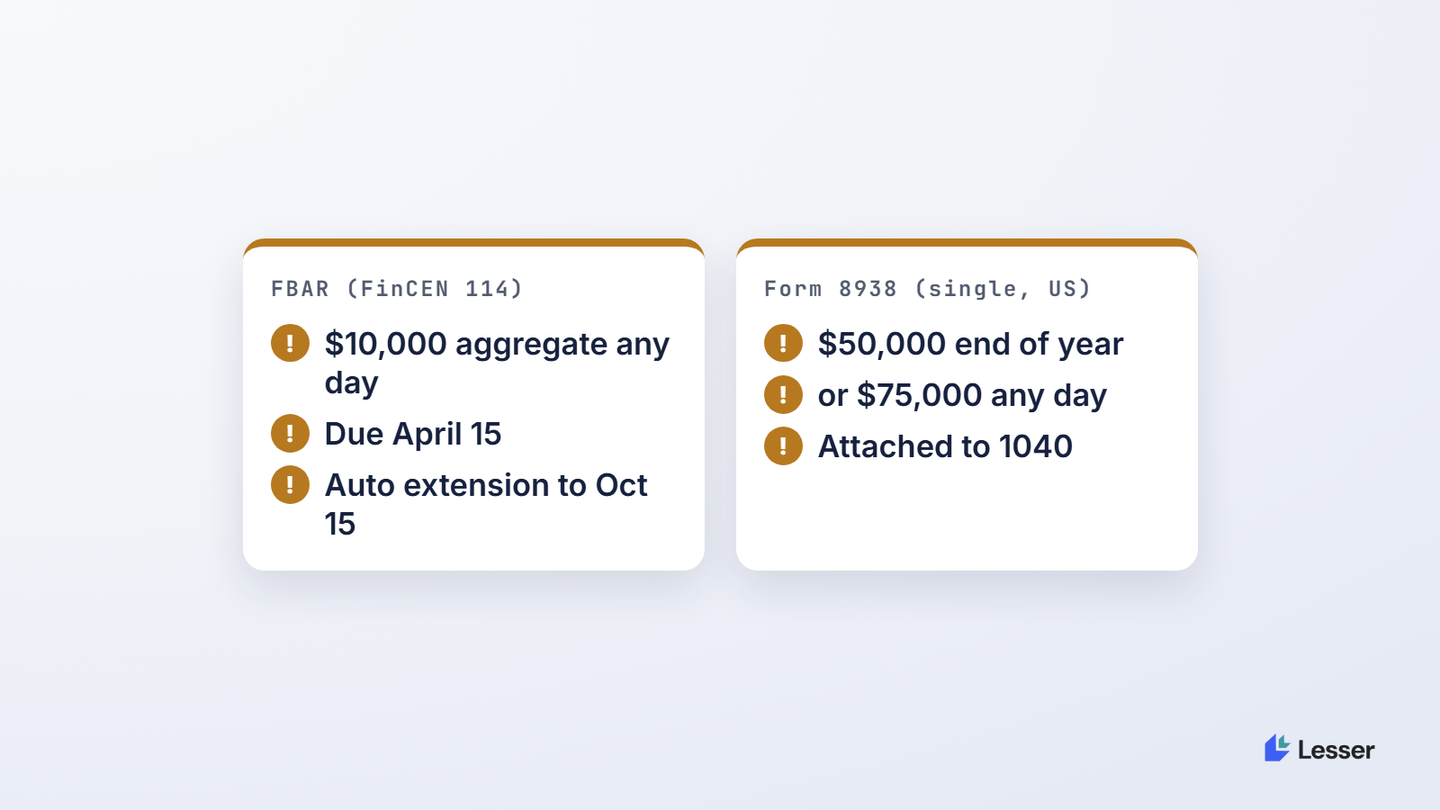
- FBAR still applies: a US person with foreign financial accounts whose "aggregate value… exceeds $10,000 at any time during the calendar year" must file FinCEN 114 by April 15, with an automatic extension to October 15 (FinCEN, Report of Foreign Bank and Financial Accounts).
- Form 8938 still applies at the same thresholds as before: $50,000 end of year or $75,000 any day (single, living in the US); $100,000 end of year or $150,000 any day (married filing jointly, living in the US) (IRS, Comparison of Form 8938 and FBAR Requirements).
- Indian citizenship ends by operation of law when you acquire US citizenship. Your Indian passport has to be surrendered and the renunciation certificate collected before you can be issued an OCI.
- OCI is a travel document, not a nationality. You need it to visit India without a visa; you also need to update it after a new US passport (see the deep page below).
Want an expert to handle this? Renew your Indian passport with Lesser Tax
Why does becoming a US citizen end your Indian citizenship?
India does not allow dual citizenship. The Ministry of External Affairs' OCI page states that "The Constitution of India does not allow holding Indian citizenship and citizenship of a foreign country simultaneously." Taking the US oath therefore ends your status as an Indian citizen. What the Indian government requires, after the fact, is that you surrender your Indian passport and collect a renunciation certificate (also called a surrender certificate). That certificate is the document every later Indian service — OCI, PAN updates, property transactions — will ask you for.
The order matters:
- Oath of allegiance (US citizenship starts).
- Apply for the renunciation / surrender certificate at your jurisdictional Indian consulate (via VFS Global in the US) and hand in your Indian passport.
- Apply for a fresh OCI card using your US passport and the renunciation certificate.
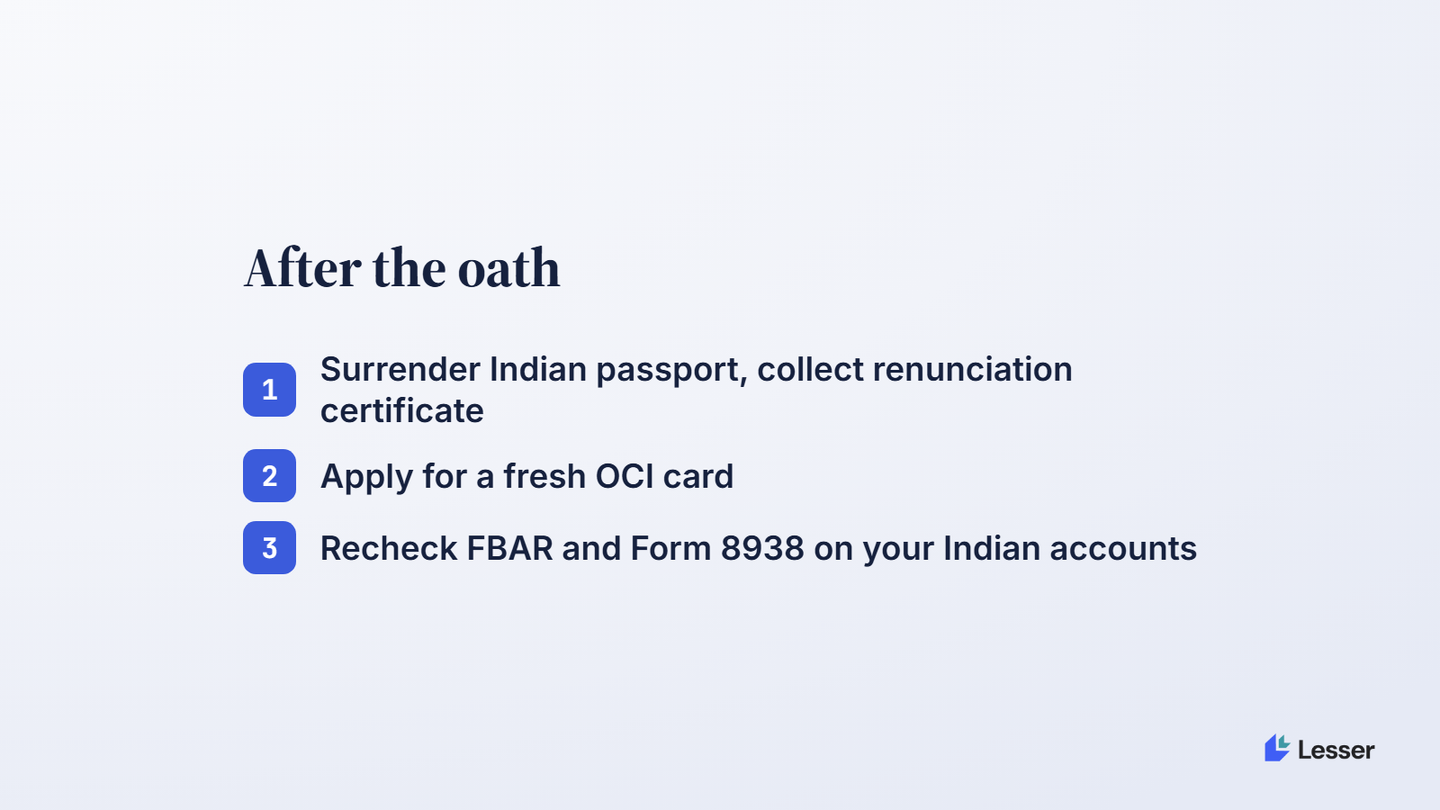
Most people apply for the OCI immediately after they get the renunciation certificate back, because without an OCI you need a visitor visa to go to India.
What happens to your Indian passport?
Your Indian passport is no longer a travel document the moment you become a US citizen. Travelling on it after that — even if it hasn't expired — is a problem at both ends. Indian consulates in the US (through VFS Global) run a "Renunciation of Indian Citizenship and Surrender of Indian Passport" service that cancels the booklet and issues the renunciation certificate.
Keep in mind:
- You hand in the original Indian passport. The consulate stamps it "Cancelled" and returns it along with the renunciation certificate — keep both forever.
- The certificate is what later OCI and property paperwork references, not the cancelled passport.
- Fees and timelines depend on when you naturalised and the consulate's current schedule. Our deep guide on the surrender process keeps those numbers current: Surrender Indian passport after US citizenship.
What is an OCI card and do you need one?
OCI (Overseas Citizen of India) is a lifetime multi-entry visa for people of Indian origin who hold a foreign passport. It is not citizenship. It lets you:
- Travel to India without applying for a visa each time.
- Stay in India for as long as you like.
- Have parity with Non-Resident Indians (NRIs) in economic, financial and educational matters, except that OCI holders cannot buy agricultural land, plantation or farmhouse property (MEA, Overseas Citizenship of India Scheme).
- Open and operate NRO and NRE bank accounts.
What it does not give you:
- Voting rights, government jobs, or the ability to buy agricultural land.
- Automatic entry while the OCI card is out of date relative to your current US passport.
That last one bites a lot of first-time naturalised citizens. Your OCI must be re-issued after a new US passport in certain cases, and the airline can refuse boarding if the two don't match. The deep page on this is here: OCI update after a new passport.
What does this mean for your taxes?
Nothing about your US tax position changed on the oath date. Resident aliens (green card holders) and US citizens have the same obligations.
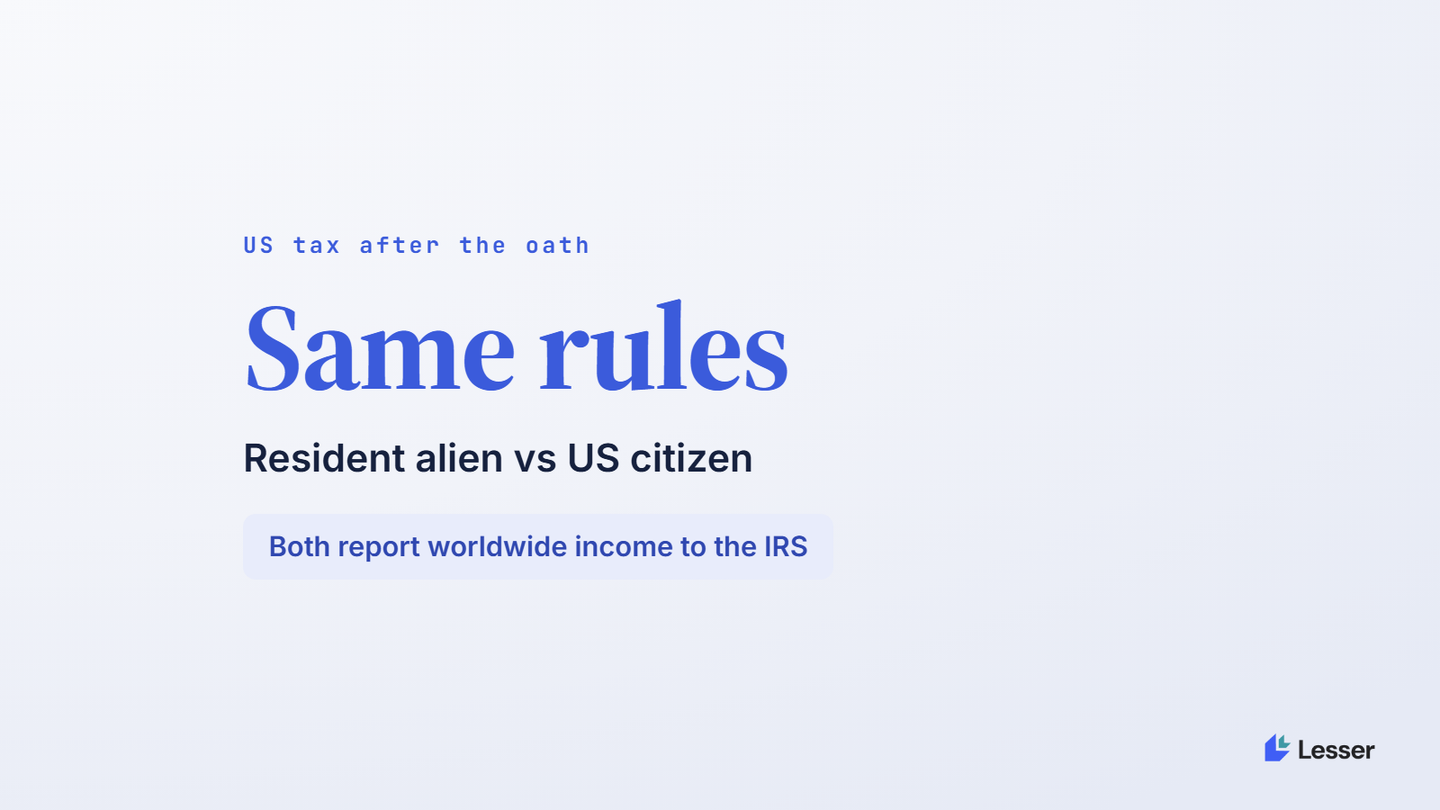
The IRS puts it plainly: "the rules for filing income, estate, and gift tax returns and paying estimated tax are generally the same whether you are in the United States or abroad," and both groups are "subject to tax on worldwide income from all sources" (IRS, US Citizens and Resident Aliens Abroad).
What that looks like in practice:
| Thing you report | Rule after US citizenship | Primary source |
|---|---|---|
| Interest on NRE and NRO deposits | Fully taxable on your US return (even though NRE is tax-free in India) | IRS worldwide-income rule |
| Indian mutual funds | Usually PFIC — Form 8621 territory | IRS Form 8621 instructions |
| Rental income from the Hyderabad flat | US-taxable; foreign tax credit for Indian tax paid | IRS Form 1116 |
| Indian bank accounts aggregating over $10,000 any day of the year | FBAR (FinCEN 114) | FinCEN FBAR page |
| Specified foreign financial assets over the 8938 thresholds | Form 8938 with your 1040 | IRS Form 8938 vs FBAR |
If any Indian account aggregated above $10,000 at any point in the year, you file an FBAR. If your specified foreign financial assets crossed $50,000 at year end or $75,000 any day (single, living in the US) — or $100,000 / $150,000 jointly — you also file Form 8938. One does not replace the other.
Our deep page on both forms, with worked examples using NRE and NRO balances, is here: FBAR and Form 8938 for Indian accounts.
Should you tell your Indian banks about the citizenship change?
Yes, and soon. Your NRE and NRO status with Indian banks is tied to your residency and citizenship. Banks ask for a copy of the US passport, the renunciation certificate, and OCI card as part of their KYC refresh. If you don't update them, the bank can freeze or re-classify the account — which is messier than just filing the update.
Resident Indian savings accounts, if you still had any from before you moved, should have already been converted to NRO. Walk through each account and confirm it's NRE or NRO (not resident) and that the bank has your current US address and tax ID.
FAQ
Does becoming a US citizen trigger exit tax from India?
No. India does not have an exit tax on citizens leaving or renouncing. The exit-tax rules that matter to you are on the US side if you ever renounce US citizenship later. India does tax residents on worldwide income — but by the time you take the oath you are almost certainly already a non-resident Indian (NRI) for Indian tax, which means only Indian-source income is taxable in India.
Do my NRE deposits stay tax-free in India after US citizenship?
Interest on NRE deposits remains exempt from Indian tax so long as you qualify as a person resident outside India under FEMA. US citizenship doesn't change that. It is still fully taxable on your US return — US citizens are taxed on worldwide income.
When do I actually have to surrender the Indian passport?
There is no US-side deadline. The Indian side expects it to be done, and later services (OCI, PAN updates, property paperwork) will ask for the renunciation certificate. Most people do it in the first few months after the oath so the OCI application can start.
Does OCI replace citizenship?
No. OCI is a lifetime multi-entry visa plus parity with NRIs in economic, financial and educational matters. It is not Indian citizenship. OCI holders cannot vote in India, hold a public employment post, or buy agricultural land, plantation or farmhouse property.
I had Indian income this year, pre-oath and post-oath. How do I file in the US?
If you were already a US resident alien for tax before the oath, the whole year is a resident-alien year and nothing on the US side changes on the oath date — you file a regular 1040 for the full year and report worldwide income. If this is also a move year or dual-status year, the mechanics change; see our dual-status return guide.