
Lesser Tax
7 min read
Quick answer: A wash sale is a sale of stock at a loss where you acquired substantially identical stock within 30 days before or after the sale. RSU vesting is an acquisition. If a tranche of your employer RSUs vests inside that 61-day window around a loss sale of the same stock, the loss is disallowed under IRC Section 1091. The disallowed loss is not permanent — it moves into the basis of the vested shares — but it is deferred. What is left of your net capital loss for the year is capped at $3,000 against ordinary income ($1,500 if married filing separately), with the rest carried forward.
Want an expert to handle this? Plan your equity taxes with a CPA
Situations you'll recognise
- You sold Nvidia / Meta / Snowflake RSU shares in October at a loss to harvest, and your Q4 RSU tranche vested the next Wednesday.
- Your broker's 1099-B shows a loss, but TurboTax or Lesser's software flags it as a wash sale and your "tax savings" vanished.
- Vests are monthly (common at Amazon, Google, Meta), so every loss sale from the same account is inside a wash-sale window somewhere.
- You held two lots — one from a 2024 vest at $120, one from a 2025 vest at $280. You sold the 2024 lot at a loss while the 2025 lot was still held, and another tranche vested the same week.
- You moved broker accounts and the receiving broker lost the wash-sale basis adjustment.
- You expected to deduct a $18,000 loss against your W-2 wages and found out the deduction tops out at $3,000.
Why this happens
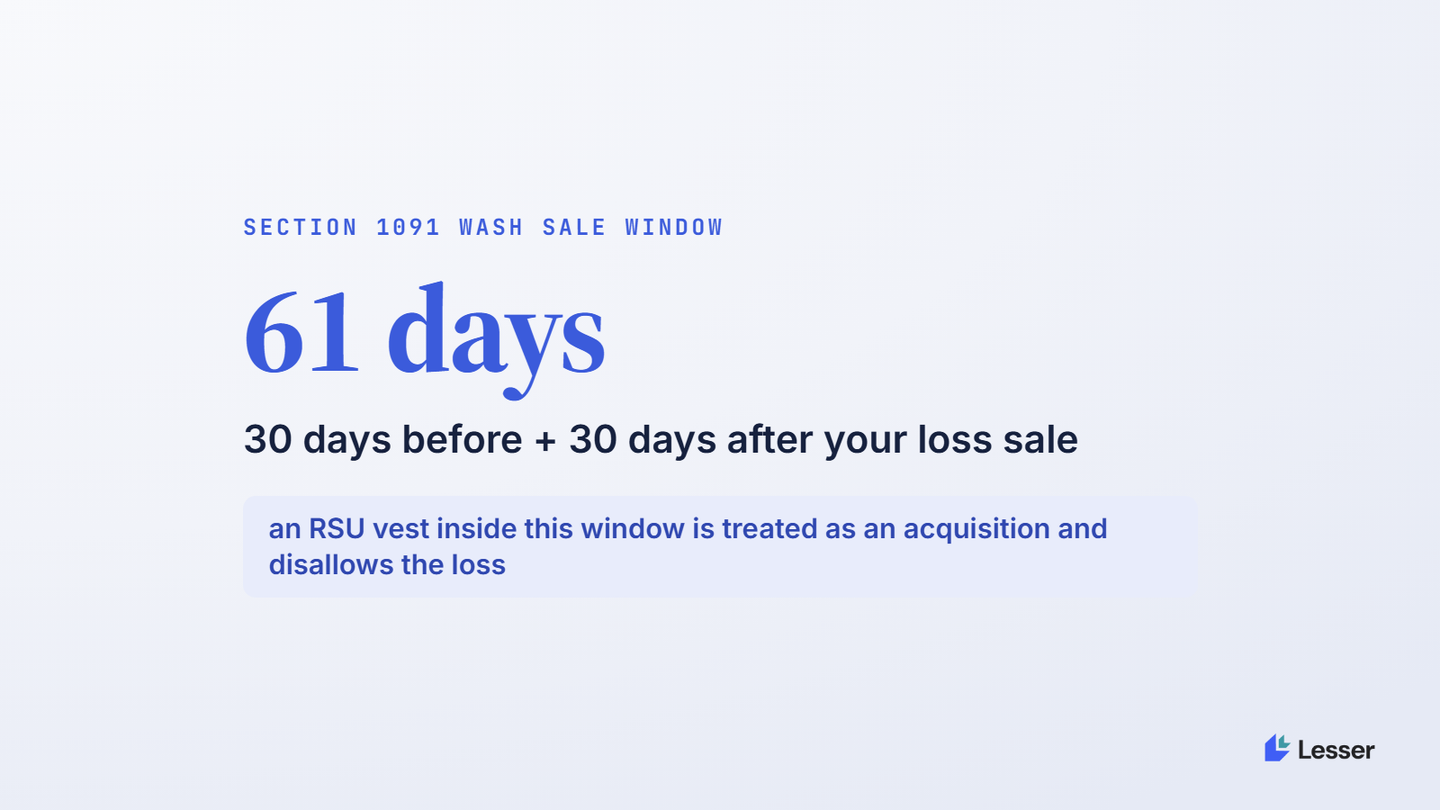
The wash sale rule is Section 1091 of the Internal Revenue Code. Section 1091(a) says: "In the case of any loss claimed to have been sustained from any sale or other disposition of shares of stock or securities where it appears that, within a period beginning 30 days before the date of such sale or disposition and ending 30 days after such date, the taxpayer has acquired (by purchase or by an exchange on which the entire amount of gain or loss was recognized by law), or has entered into a contract or option so to acquire, substantially identical stock or securities, then no deduction shall be allowed under section 165 unless the taxpayer is a dealer in stock or securities..." (IRS Rev. Rul. 2008-5 quotes the statute in full).
Three things in that sentence do the damage:
- "Acquired" is read broadly, and most practitioners treat RSU vesting as an acquisition. Section 1091 covers acquisition "by purchase or by an exchange" and anything else that gives you substantially identical stock. IRS Publication 550 opens the rule plainly: "A wash sale occurs when you sell or trade stock or securities at a loss and within 30 days before or after the sale you:" (buy, acquire, or enter into a contract to acquire substantially identical stock). The IRS has not issued a published ruling that is specifically about RSU vesting under Section 1091 — but Rev. Rul. 2008-5 shows the net reaches further than a plain market buy: a purchase inside your own IRA counts as you "acquiring" the stock. The conservative position every major broker reports under — and the one Lesser's CPAs use — is that an RSU vest in your own name is an acquisition inside the 61-day window.
- "Substantially identical" means the same employer stock. Your 2024 RSU lot and your 2025 RSU lot of the same ticker are substantially identical shares.
- The 61-day window is 30 days before AND 30 days after. Monthly vesters are inside a wash sale window on both ends almost every month.
The loss is not permanently gone — it is postponed. Publication 550 says it directly: "If your loss was disallowed because of the wash sale rules, add the disallowed loss to the cost of the new stock or securities (except in (4) above). The result is your basis in the new stock or securities. This adjustment postpones the loss deduction until the disposition of the new stock or securities. Your holding period for the new stock or securities includes the holding period of the stock or securities sold." You get the deduction when you sell those replacement shares, not now.
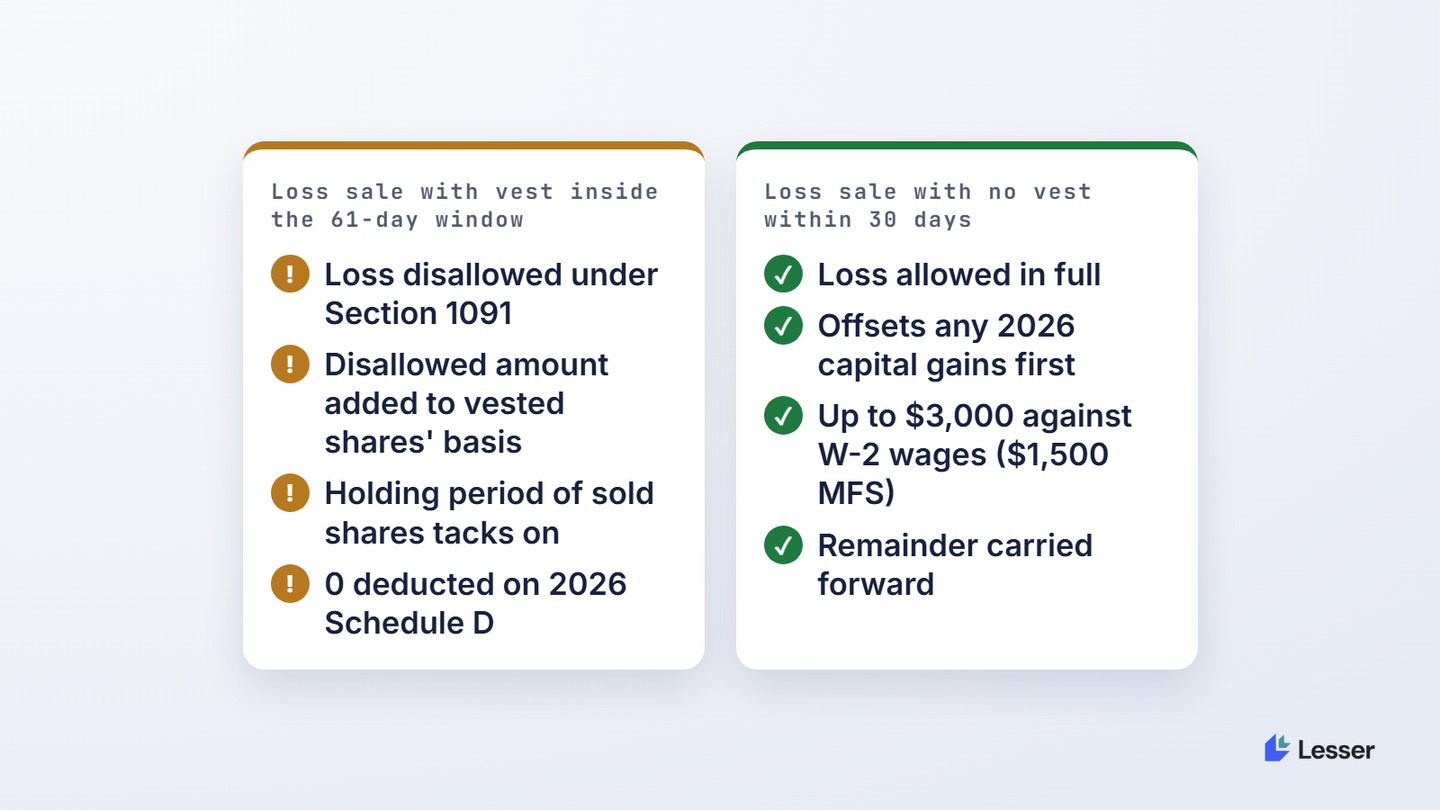
Whatever loss survives this is still capped. IRS Topic 409 states that "the amount of the excess loss that you can claim to lower your income is the lesser of $3,000 ($1,500 if married filing separately)" against ordinary income in a year. Anything above that carries forward.
A real example
Priya is on H-1B at a public tech company. Her RSU vests are quarterly: 300 shares on the 1st of February, May, August and November. Each vest is reported on her W-2 at the FMV on the vest date, and that FMV is her basis in those shares (see our RSU taxes on H-1B guide).
- August 1, 2026 vest: 300 shares at $280 FMV. W-2 includes $84,000 ordinary income. Her basis in those shares is $280/share.
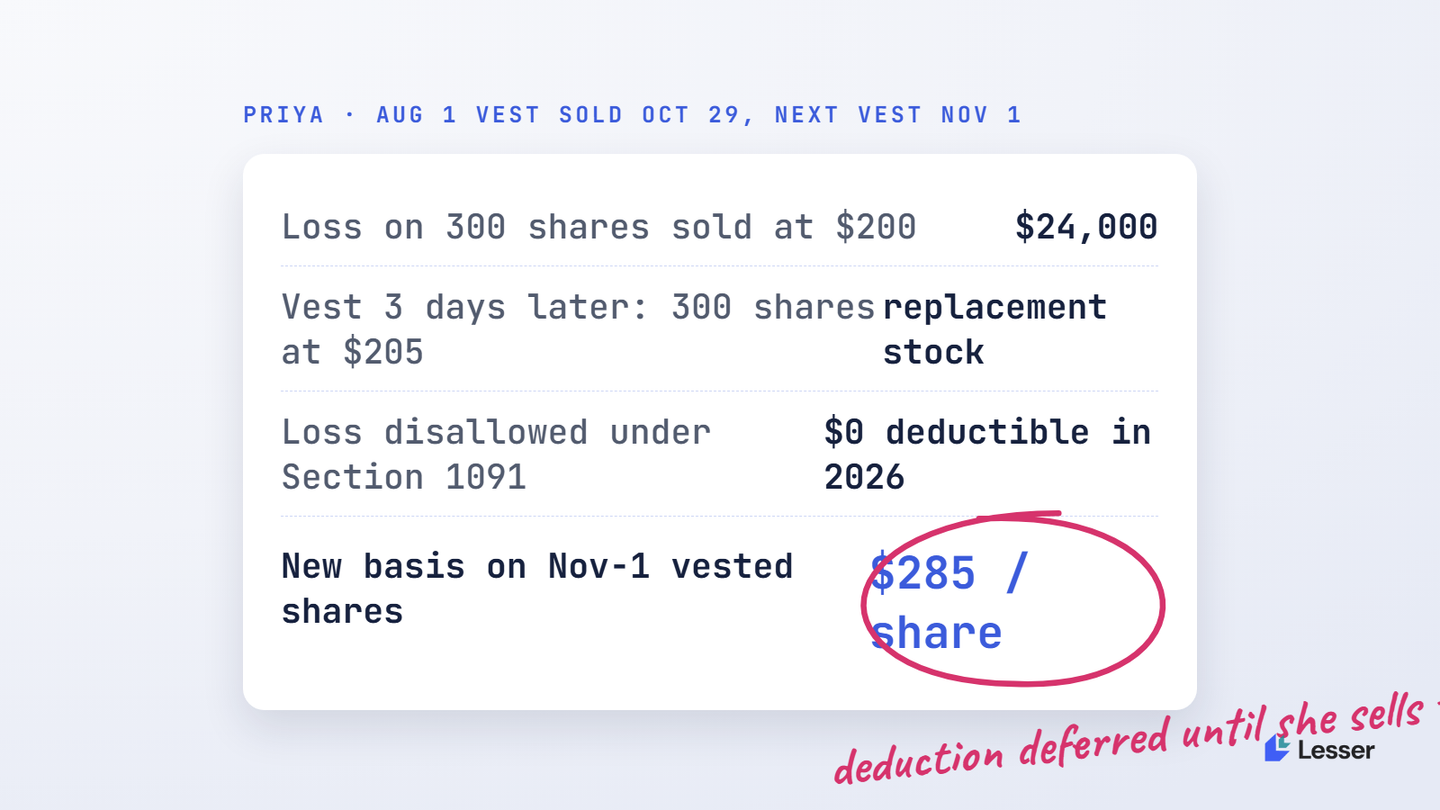
- The stock drops to $200 by late October. Priya sells all 300 August shares on October 29, 2026 for $200 — a $24,000 realised loss.
- November 1, 2026, her next tranche vests: 300 shares at $205 FMV. That is three days after her loss sale, well inside the 30-day window.
Section 1091 disallows the loss on 300 shares that were replaced within 30 days — all of them. The $24,000 disallowed loss is added to the basis of the November-1 vested shares: new basis is $205 (the FMV) + $80/share ($24,000 ÷ 300) = $285/share. Priya will realise this loss only when she sells the November tranche. Her 2026 Schedule D shows zero deductible loss from this trade. On the broker's 1099-B the disallowed amount appears in Box 1g (Wash sale loss disallowed); on Form 8949 Priya enters code "W" in column (f) and the disallowed amount as a positive number in column (g).
If instead she had sold the 300 shares on November 10 and had no further vest until February, the loss would be allowed. $24,000 of net capital loss, offset against any 2026 capital gains she has, then $3,000 against her W-2 wages, then $21,000 carried forward to 2027 and beyond. The $3,000 limit is annual, not one-time.
What getting it right gives you
- A real deduction, not a deferred one. Timing a loss sale outside every vest window turns a disallowed wash sale into a usable capital loss.
- A clean 1099-B. Brokers (Fidelity, ETRADE, Charles Schwab, Morgan Stanley at Work) report wash sales on your account but can't see vests at other brokers. If your RSUs vest at ETRADE and you sell shares at Robinhood, no broker will catch the wash sale; you still owe the adjustment on Form 8949. Keeping all RSU activity at one broker reduces this risk.
- Fewer surprises on April 15. Each $10,000 of long-term loss above $3,000 that you expected to use this year, but can't, is roughly $2,000–$3,700 of extra federal tax owed depending on your bracket.
A clean pattern that works: look at your vest calendar for the next 60 days before you sell at a loss. If a vest falls inside the window on either side, either wait, or sell only the lot sizes you can absorb into basis without regret.
What's next
If the wash sale happens anyway and you later sell the replacement shares at a gain, that gain is reduced by the basis step-up — you get the deferred loss back then. We cover the mechanics of the move-year sale in Selling RSUs when moving back to India. For employees with ISOs instead of RSUs, the Section 1091 wash sale rule still applies, but the AMT basis is tracked separately; see ISO AMT when leaving the US.
Further reading
- Deep guide: RSU taxes on H-1B (2026)
- Related: ESPP and 83(b) election for visa holders · NSOs on an H-1B, exercise and after moving back
- When US software gets equity comp wrong: NRI tax: CPA vs TurboTax
- Offer: Lesser handles the Schedule D + Form 8949 basis adjustments for RSU-heavy returns every season — see how Lesser works for NRIs.