
Lesser Tax
7 min read
Quick answer: An H-1B transfer is a tax event, not just an immigration one. Each employer withholds federal income tax, Social Security and Medicare as if it is your only job, so after a mid-year change you often have two W-2s, two state lines, under-withheld federal tax, and if your combined wages passed the 2026 Social Security wage base of $184,500, overpaid Social Security that you claim back on your Form 1040. RSUs that vested at the old employer stay on the old employer's W-2 and were already withheld at the 22% supplemental flat rate.
Key takeaways
- An H-1B transfer is a new H-1B petition under AC21 portability; the 6-year clock does not reset and FICA withholding does not stop (IRS: FICA for H-1B).
- Each employer withholds federal income tax using the W-4 you filed with them, as if that job were your only job (IRS: Tax withholding).
- The 2026 Social Security wage base is $184,500 per employer; if you earned over that across two employers, you overpaid Social Security and claim the excess on your Form 1040 (IRS Topic 608).
- Medicare has no cap and the 0.9% Additional Medicare Tax starts at $200,000 of wages at a single employer (IRS Topic 751).
- RSUs that vested at the old employer are on the old employer's W-2 and were withheld at the 22% federal supplemental rate (IRS Pub 15).
Want an expert to handle this? Plan your equity taxes with a CPA
Is "H-1B transfer" even the right word?
Not really. The USCIS mechanism is AC21 portability: your new employer files a fresh H-1B petition, and you may start working for them once USCIS receives it. Your old H-1B stays legally valid; nothing is physically moved. For taxes, what matters is that you now have two US employers in one calendar year, and that creates two W-2s in January.
Why is my first paycheck at the new job withheld more (or less) than I expected?
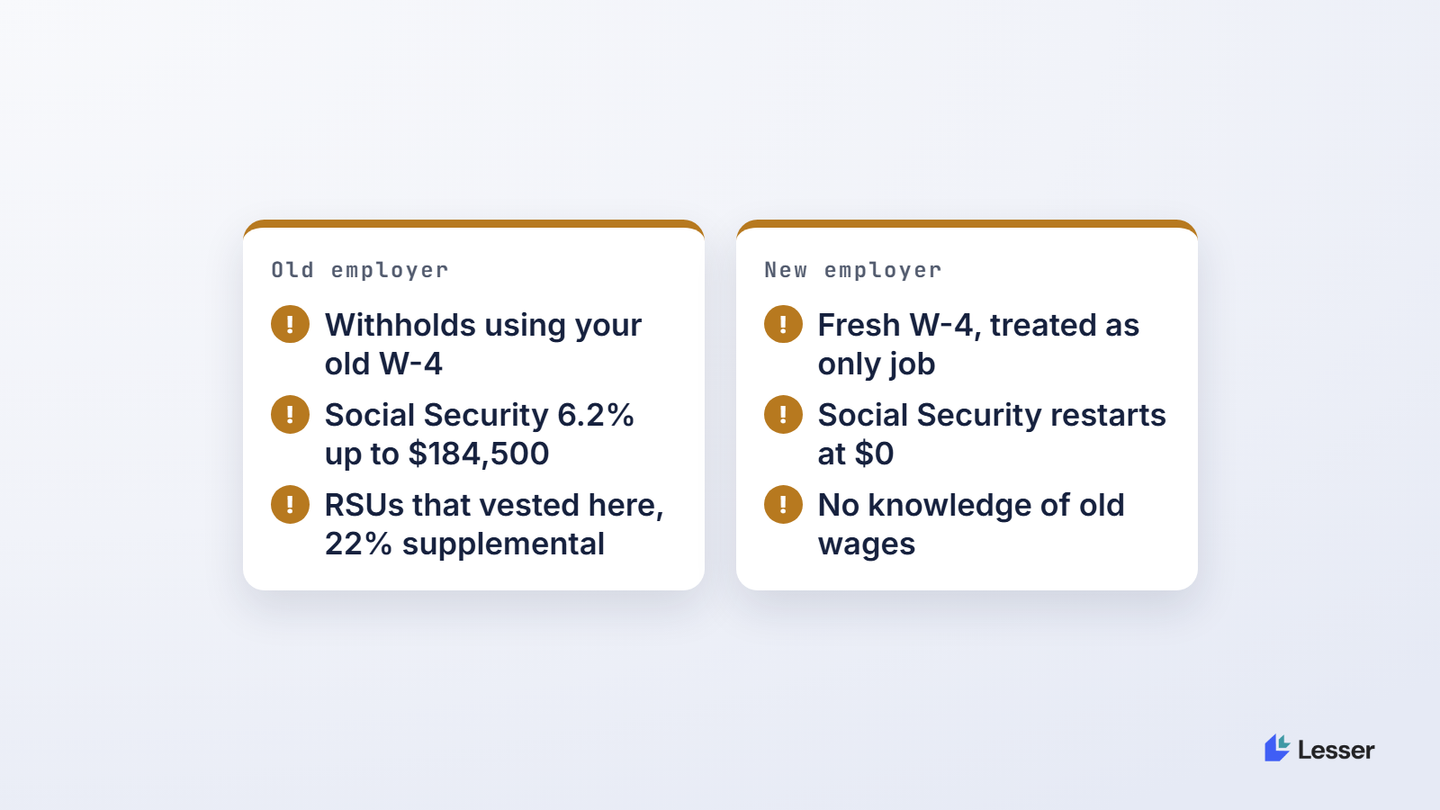
Because the new employer treats you as a fresh hire. They use the W-4 you filled out on day one at the new company, with no knowledge of what you earned at the old one. The IRS: "You pay the tax as you earn or receive income during the year" (IRS: Tax withholding) and lists a job change as a reason to review your W-4: "You or your spouse start or stop working or start or stop a second job" (same page).
Two common patterns on an H-1B transfer:
- Under-withholding. You jumped a bracket mid-year. Each employer taxed your wages at the lower bracket for their slice, so the combined withholding is below what the full-year total actually owes. The gap shows up on your 1040 as a balance due.
- Over-withholding of Social Security. Each employer starts your Social Security tax at $0 and runs it up to the 2026 wage base of $184,500. If your combined wages crossed that line, you paid Social Security on wages above the base.
What happens to FICA when I change H-1B employers?
FICA keeps coming out. The IRS: "There are no FICA tax exclusions for H-1B employees working for a United States employer for services performed in the United States" (IRS: FICA for H-1B). The 2026 rates (IRS Topic 751):
- Social Security: 6.2% of wages up to the 2026 wage base of $184,500.
- Medicare: 1.45% of all wages, no cap.
- Additional Medicare Tax: 0.9% once a single employer pays you more than $200,000 in a calendar year.
The IRS confirms each employer withholds independently: "An employer is required to begin withholding Additional Medicare tax in the pay period in which it pays wages in excess of $200,000 to an employee" (same source). That phrasing matters: your new employer does not know your YTD wages at the old one, so Social Security restarts at $0.
| Scenario | Social Security withheld | Can you claim excess? |
|---|---|---|
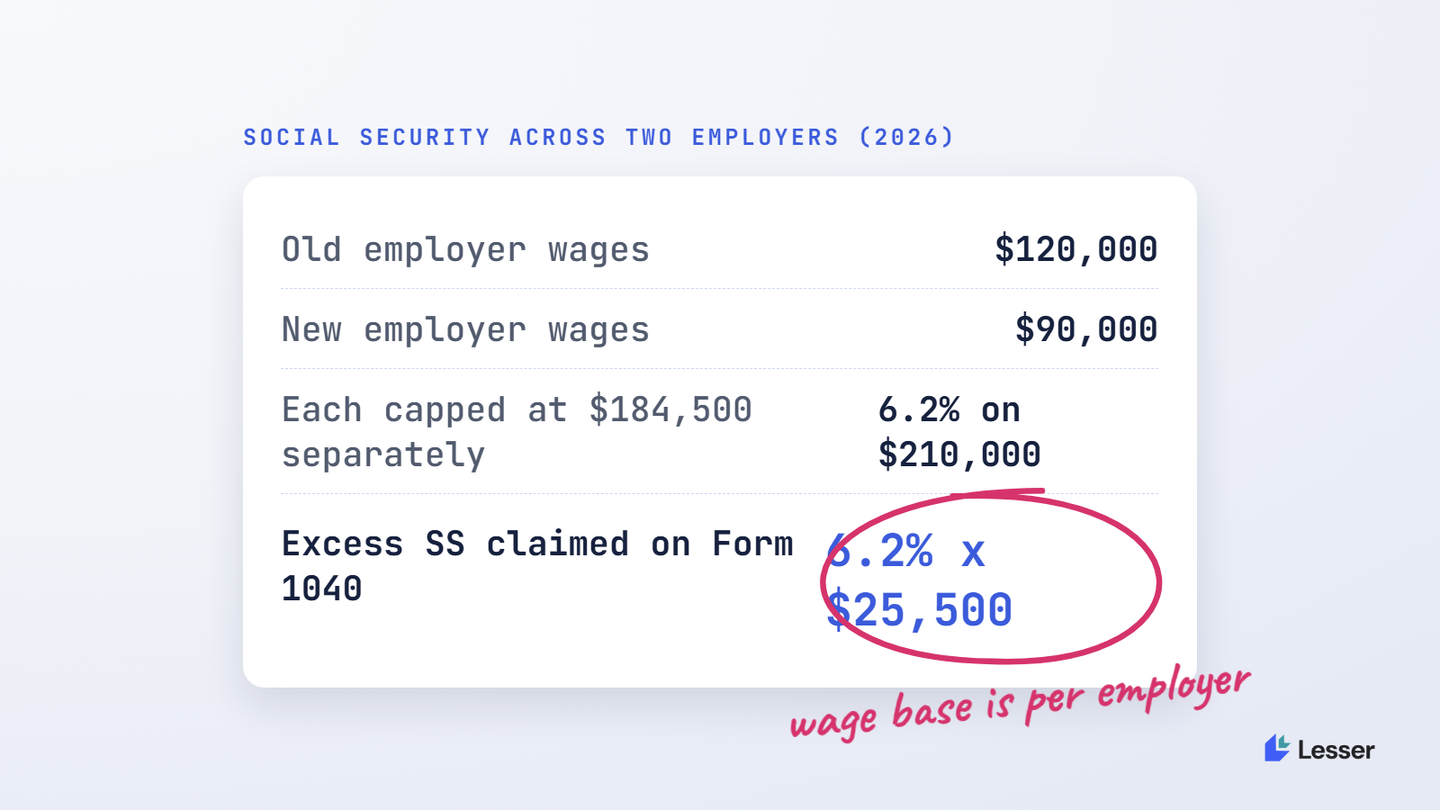
| Old employer wages $120,000, new employer wages $90,000 | 6.2% on $210,000 combined | Yes, on wages above $184,500 ([IRS Topic 608](https://www.irs.gov/taxtopics/tc608)) |
| Old employer wages $80,000, new employer wages $80,000 | 6.2% on $160,000 | No, under the base |
| One employer wages $220,000 | Capped at $184,500 by that employer | No, already capped |
What about the RSUs that vested at my old employer?
RSUs are taxed as wages on the vest date. The grant date and your current employer do not matter for the tax; what matters is who paid the vest.
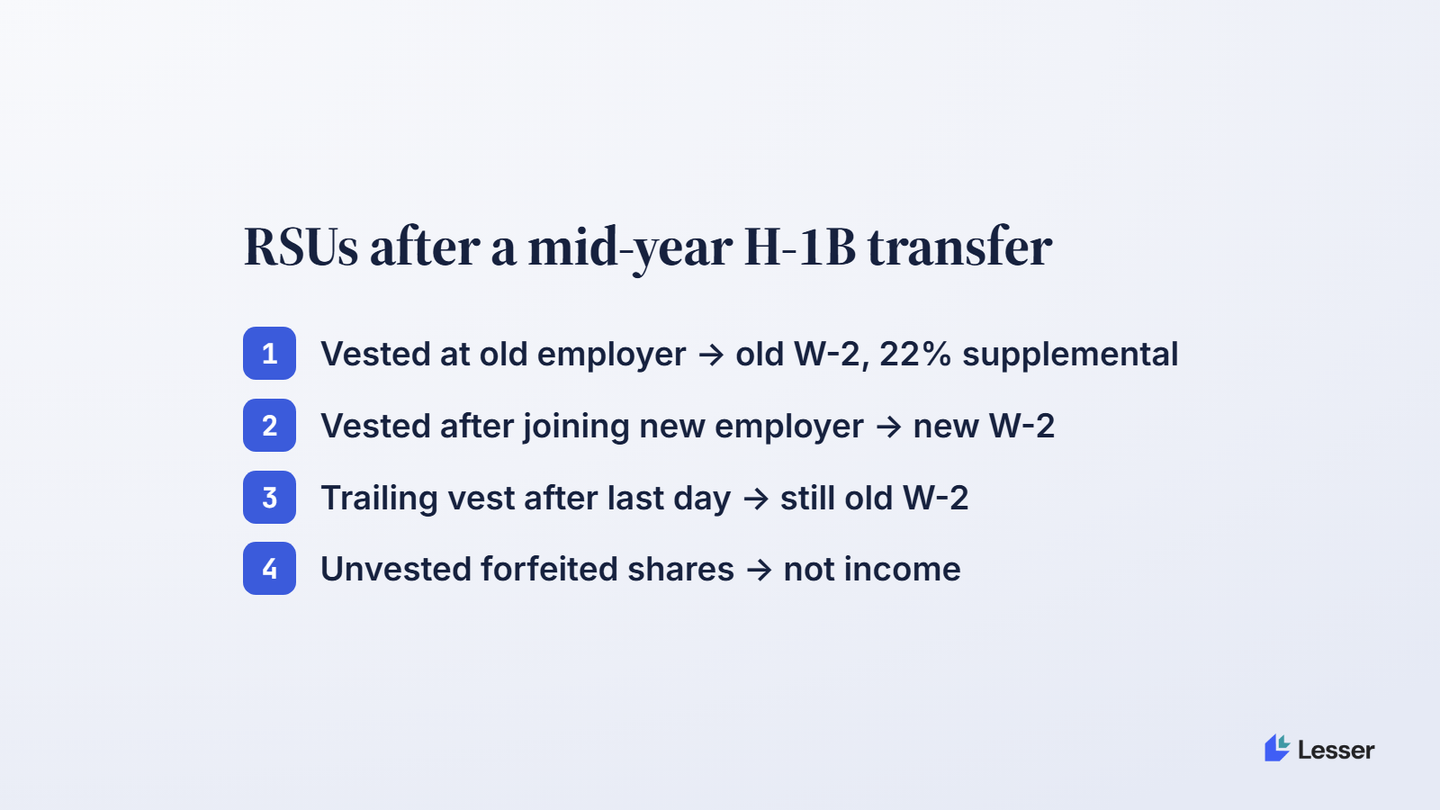
- If the RSUs vested while you were still at the old company, they are on the old employer's W-2 (Box 1 and Box 3/5 within the FICA caps for that year). Federal withholding was done at the IRS supplemental flat rate: "The withholding rate on supplemental wages remains 22% (37% if supplemental wages paid to an employee during the calendar year exceed $1 million)" (IRS Pub 15).
- If vested RSUs you held are now sold, that is a Form 8949 / Schedule D event, separate from the W-2.
- Unvested RSUs you forfeited by leaving are not income. There is no deduction either; you simply never received them.
- "Trailing" RSUs that vest after your last day because of a severance or retention clause are still the old employer's wages for US tax, even if the money arrives in your bank after you join the new company.
The deeper walk-through on vest vs sale, double-reporting on the 1099-B, and the W-4 reset is here: RSU taxes on H-1B (2026).
What does this mean for your taxes?
In January you receive two W-2s, one from each employer. The real tax for the year is calculated on your Form 1040; what came out of your paychecks is only a prepayment. Three things to do when the W-2s arrive:
- Add Box 1 across both W-2s and compare the total against the 2026 single-filer brackets (Rev. Proc. 2025-32) and the $16,100 standard deduction. If your combined withholding came up short, that difference is what you owe in April. To avoid repeating this next year, file a new W-4 with your current employer that accounts for the full-year income (IRS: Tax withholding).
- Add Box 4 (Social Security tax withheld). If the sum is more than 6.2% × $184,500 = $11,439, you overpaid. The IRS: "If you had more than one employer and too much Social Security tax or tier 1 RRTA tax withheld, you may be able to claim the excess as a credit against your income tax on your income tax return" (IRS Topic 608). The excess goes on Schedule 3.
- Reconcile Medicare and state. If together you earned over $200,000 but no single employer crossed $200,000, no 0.9% Additional Medicare was withheld; it is settled on Form 8959 with your 1040. If you worked in two states mid-year, expect a part-year resident return in each.
For Indians on H-1B this is also the moment to pull the India side together: NRE/NRO interest, FDs, ESPP and any India rent all land on the same 1040. The first-year list: NRI tax checklist (USA). The equity walk-through: RSU taxes on H-1B (2026).
FAQ
Does my H-1B 6-year clock reset when I transfer?
No. The old H-1B time counts toward the 6-year maximum; the new employer's petition continues the same clock. This is immigration, not tax, but it is the first question people ask.
I earned $120,000 at my old employer and $90,000 at my new one. Did I overpay Social Security?
Yes. Each employer withheld 6.2% up to their own cap, so you paid Social Security on the full $210,000. You claim back 6.2% of the amount over $184,500 as "excess social security tax" on Schedule 3 (IRS Topic 608).
An RSU grant vested the week after I joined the new company; whose W-2 is it on?
The company that was your employer on the vest date. If you vested after your last day at the old company (a trailing vest from unused notice or severance), the old employer still runs the payroll and the wages appear on their W-2.
Do I need to tell my new employer I was on H-1B at the old job?
For taxes, no, there is no special H-1B W-4 question. FICA is withheld on an H-1B transfer from the first paycheck (IRS: FICA for H-1B).