
Lesser Tax
12 min read
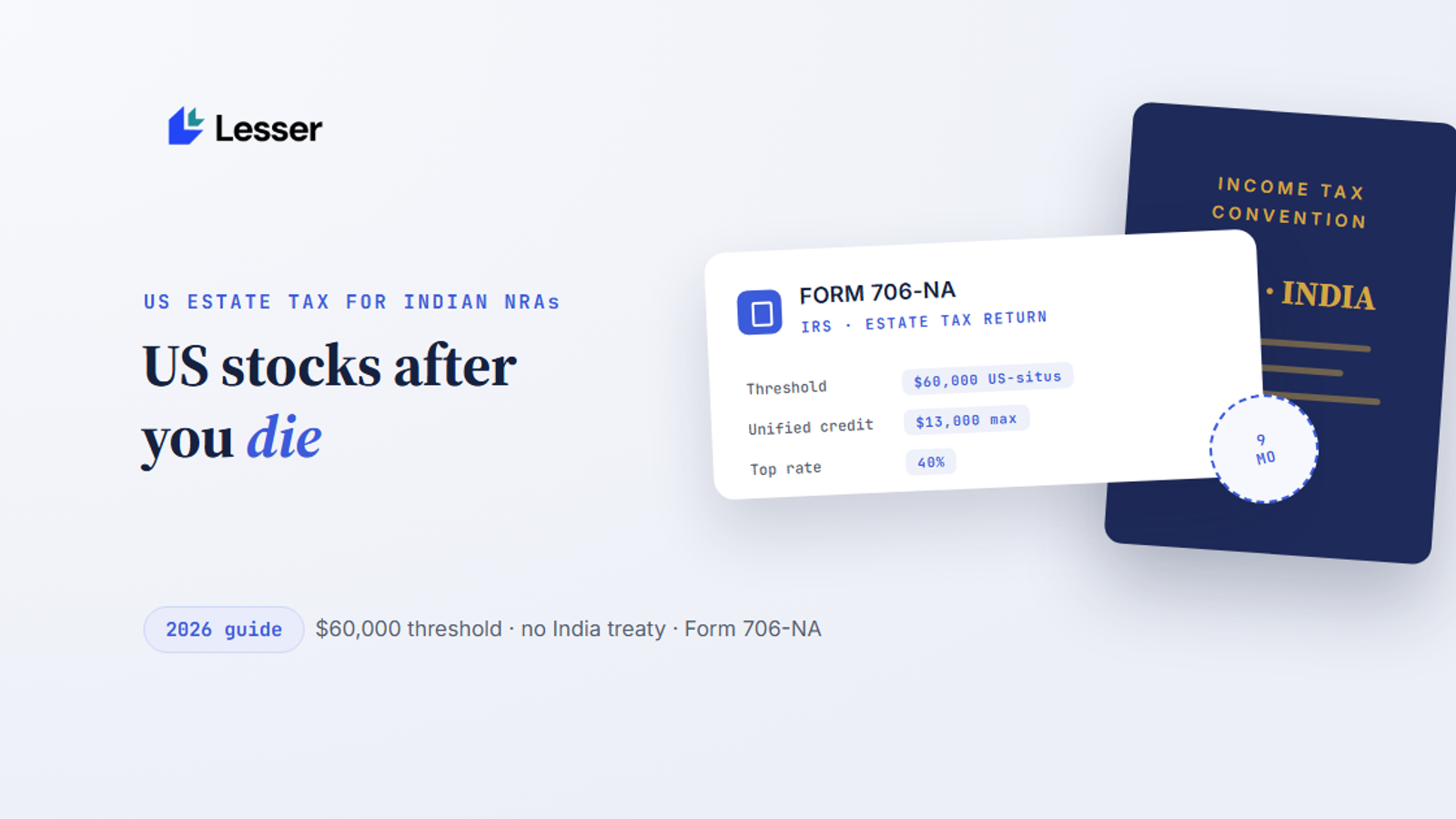
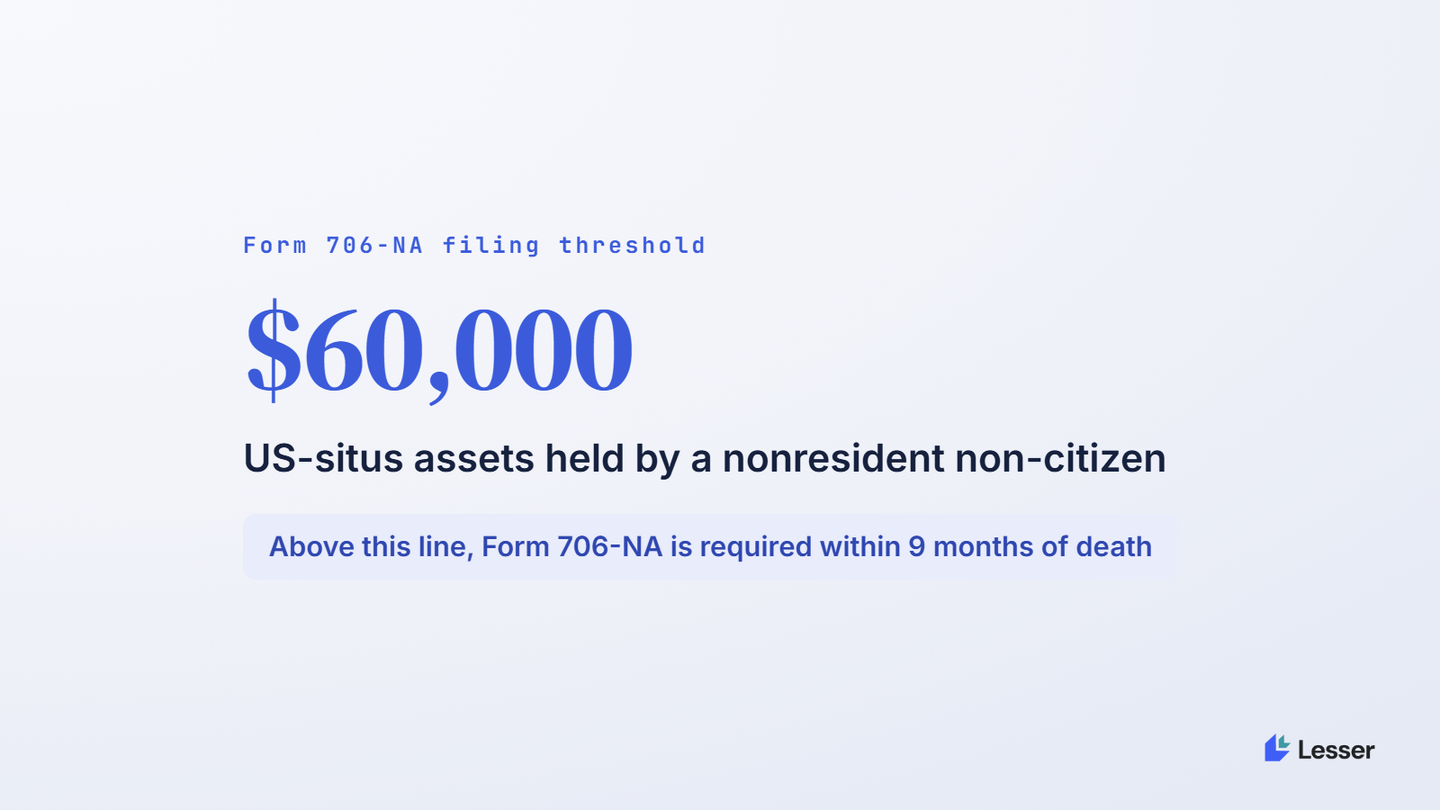
Quick answer: If you are an Indian citizen living in India (or anywhere outside the US) and you die owning US stocks, US real estate, or other US-situated assets worth more than $60,000, your estate must file Form 706-NA within 9 months of the date of death. Form 706-NA is the US federal estate tax return for a nonresident, non-citizen decedent. Only $60,000 of US-situs assets is sheltered by the $13,000 unified credit; everything above that is taxed on a schedule topping out at 40%. India has no estate tax treaty with the US, so there is no treaty relief to lower the bill. US citizens and US-domiciled residents get a $15,000,000 exclusion in 2026; nonresident non-citizens do not.
Key takeaways
- The filing threshold is $60,000 of gross US-situated assets (plus adjusted taxable gifts), not the $15M that applies to US citizens (IRS, Instructions for Form 706-NA (Rev. September 2025)).
- US stocks are US-situs no matter where the brokerage or share certificates sit: "Stock of corporations organized in or under U.S. law is property located in the United States" (IRS 706-NA instructions).
- The unified credit for a nonresident non-citizen decedent is capped at $13,000, which is what shelters the first $60,000 (IRS 706-NA instructions).
- The India-US tax treaty does not cover estate tax. India is not on the IRS list of estate-tax treaty countries (IRS 706-NA instructions).
- The top federal estate tax rate is 40%, applied under Table A to the taxable amount over $1,000,000 (IRS, Instructions for Form 706).
- Form 706-NA is due 9 months after the date of death; Form 4768 gets an automatic 6-month extension (IRS 706-NA instructions).
Want an expert to handle this? Get your NRI taxes done right
Who does the $60,000 US estate tax rule actually apply to?
It applies to a decedent who was neither a US citizen nor a US domiciliary at death. The IRS directs: "File Form 706-NA for estates of nonresident noncitizens of the United States if the date of death value of the decedent's U.S.-situated assets, together with the gift tax specific exemption and the amount of adjusted taxable gifts, exceeds the filing threshold of $60,000."
In plain terms: if you are an Indian citizen on an H1B or L1 who returns to India and dies holding US brokerage stocks, or if you are a parent in Hyderabad who bought Apple and Microsoft shares through a US brokerage, Form 706-NA is the return your executor files. The $15,000,000 basic exclusion that applies to US citizens and US-domiciled residents in 2026 is not available to you.
Domicile is a facts-and-circumstances test, not a visa test. Someone on a long-term H1B who intends to settle in the US might be treated as US-domiciled for estate tax purposes while still being a nonresident for income tax purposes. If you have moved to India permanently, surrendered the green card, or never had one, the nonresident rules apply. If you are unsure which side of the line you sit on, that is a judgment call to make with a CPA before you plan around the $60,000 number.
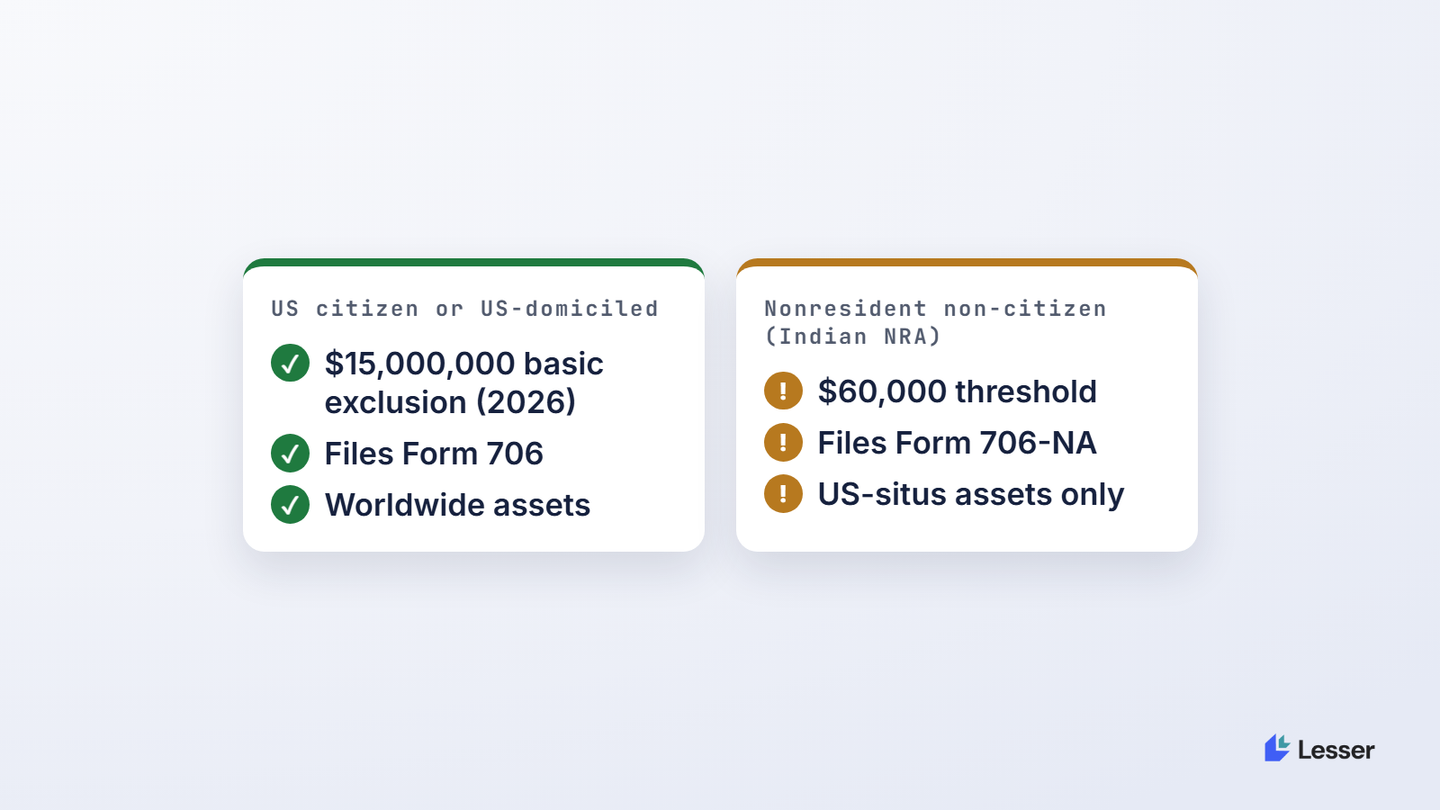
| Decedent type | US estate tax exemption (2026) | Source |
|---|---|---|
| US citizen or US-domiciled resident | $15,000,000 basic exclusion | [IRS 706 Instructions](https://www.irs.gov/instructions/i706) |
| Nonresident, non-citizen (NRA) | $60,000 (via $13,000 unified credit) | [IRS 706-NA Instructions](https://www.irs.gov/instructions/i706na) |
Which of my US assets are "US-situs"?
Situs is the technical word for "located in the US for estate tax purposes." Only US-situs assets go on Form 706-NA. The 706-NA instructions set the rules and open with: "Unless a treaty provides otherwise (see Death Tax Treaties, earlier), use the following rules to determine whether assets are located in the United States."
The ones that matter most to Indian NRIs:
- US stocks. US-situs. The 706-NA instructions say: "Generally, no matter where stock certificates are physically located, stock of corporations organized in or under U.S. law is property located in the United States." Apple, Microsoft, Amazon, Tesla, your old company's RSUs that vested while you were on H1B – all US-situs, whether you hold them at Fidelity, Charles Schwab, or an Indian NRE-linked US brokerage.
- US real estate. US-situs. "Real estate and tangible personal property are located in the United States if they are physically located there." The Austin rental, the Jersey City condo, the Bay Area house – all in.
- Tangible personal property physically in the US. Furniture, cars, art kept in the US on the date of death. US-situs.
- Life insurance on the decedent's own life. Not US-situs. The 706-NA instructions state: "Proceeds of insurance policies on the decedent's life are property located outside the United States."
- Certain US bank deposits. Deposits with a US bank that are not effectively connected with a US trade or business are generally treated as located outside the US for estate tax (a different rule from income tax). This is the one asset class that the Code gives nonresidents a break on.
- Debt obligations. Treated as US-situs when owed by US persons or US entities, per the Internal Revenue Manual: "Deposits with a U.S. branch of a foreign corporation that is engaged in the commercial banking business are treated as property located in the United States" (IRM 4.25.4).
If the brokerage account title is "Fidelity, in trust for" or similar, situs still follows the underlying asset. ETFs listed on US exchanges and sponsored by US companies are generally US-situs. A UK/Ireland-domiciled ETF holding the same S&P 500 is not US-situs – which is why the Reddit and Blind community discussions often mention Ireland-domiciled ETFs on the London Stock Exchange as a workaround (community discussion, not an official source).

Does the India-US tax treaty save me?
No. The 706-NA instructions list every country whose treaty modifies US estate tax situs rules: "Australia, Ireland, Austria, Italy, Canada, Japan, Denmark, Netherlands, Finland, South Africa, France, Switzerland, Germany, United Kingdom, Greece." India is not on that list.
The India-US DTAA covers income tax (and we have a full guide on how to use it), not estate or inheritance tax. India itself has no inheritance tax, so there is no credit on the Indian side to offset the US bill. The $60,000 threshold is the number you plan around.
How much estate tax would actually be owed?
Form 706-NA uses the same unified rate schedule – Table A in the 706 instructions – that applies to US citizen estates, but the only credit a nonresident gets is a flat $13,000 unified credit. The 706-NA instructions put it plainly: "In general, the maximum unified credit is $13,000."
That $13,000 credit cancels the tentative tax on exactly $60,000 of estate. Everything above $60,000 is taxed at the Table A marginal rate for that bracket. The top rate from the Form 706 instructions is "40%" and applies to the "taxable amount over $1,000,000."
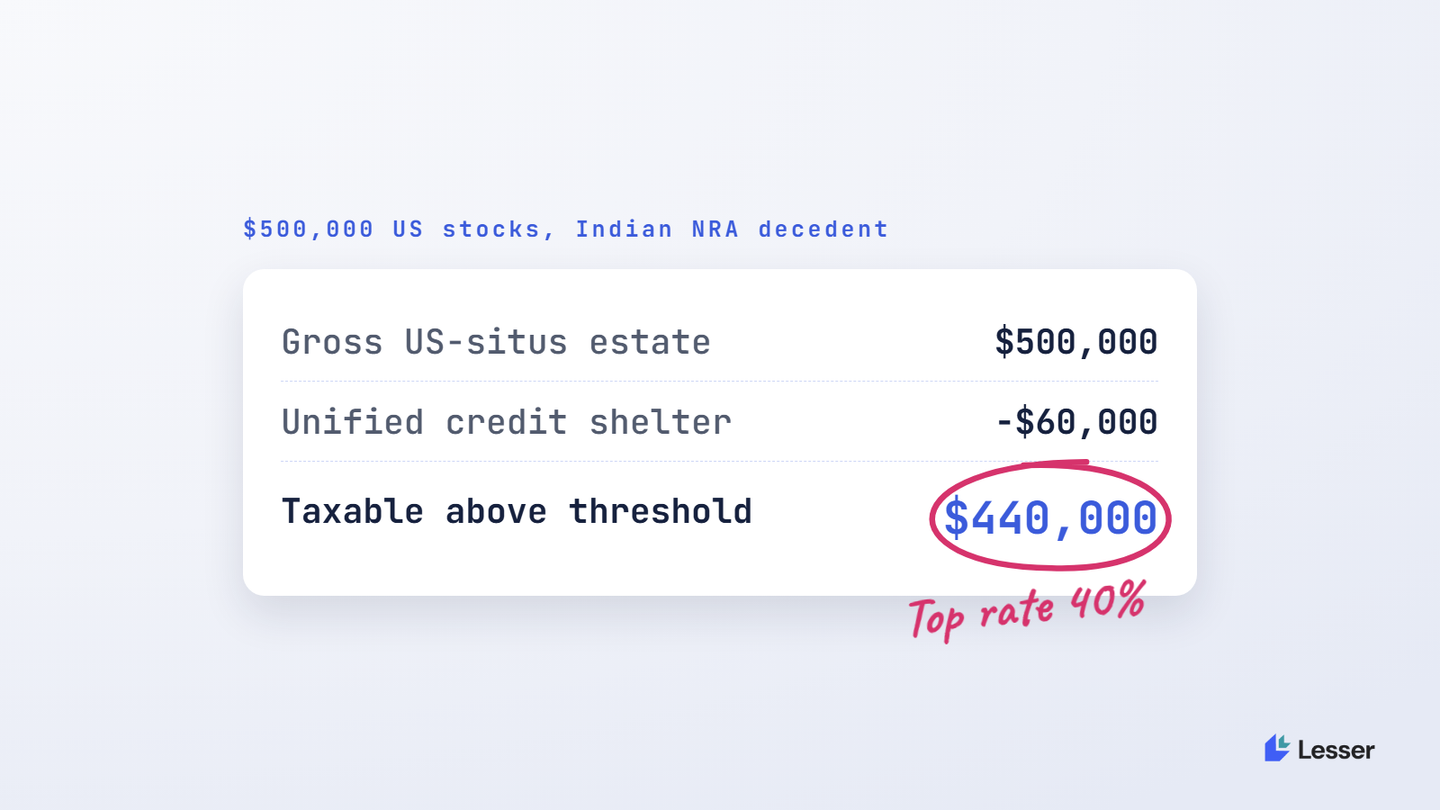
Worked example. Priya is an Indian citizen who worked in the US on H1B for 7 years, returned to Bengaluru in 2024, and kept a US Schwab brokerage with $500,000 of US stocks (vested RSUs plus S&P 500 ETFs). She dies in 2026 while domiciled in India. Her US-situs gross estate is $500,000 (the stocks). After the $13,000 unified credit, the tentative tax on the first $60,000 is wiped out and tax is calculated on the remaining $440,000 at Table A rates. The marginal rates up to that bracket are the same ones US citizens pay above the exclusion. Her executor must still file Form 706-NA because the gross US-situs estate exceeds $60,000, even if deductions, debts, or a charitable bequest reduce the final tax to zero.
If Priya had instead held $500,000 of Indian mutual funds, Indian equities, or an Ireland-domiciled S&P 500 ETF, there would be no US-situs asset at all and no Form 706-NA.
When does Form 706-NA have to be filed, and by whom?
Within 9 months of the date of death. The 706-NA instructions state: "File Form 706-NA within 9 months after the date of death unless an extension of time to file was granted." For an automatic 6-month extension of the filing deadline, the executor files Form 4768: "use Form 4768, Application for Extension of Time To File a Return and/or Pay U.S. Estate (and Generation-Skipping Transfer) Taxes, to apply for an automatic 6-month extension of time to file."
Who files it? Normally the executor. But Indian families usually don't have a US probate executor the day a parent dies in Chennai. The 706-NA instructions cover that: "If no executor is appointed, qualified, and acting in the United States, every person in actual or constructive possession of any of the decedent's property is considered an executor." In practice, this is the spouse, child, or sibling who contacts the US brokerage after the death. The brokerage will typically freeze the account and require a federal transfer certificate (IRS Form 5173) before releasing the assets to heirs – and the IRS only issues that certificate after the estate's filing position has been reviewed.
How do heirs actually get the US stocks released?
Three documents tend to decide this: a certified death certificate, letters testamentary (or an Indian probate order recognised by the US brokerage's legal team), and – for US-situs assets above the threshold – an IRS transfer certificate. The brokerage will not transfer the shares to the Indian heir's name or liquidate them without something that proves the US estate tax position has been handled. For small accounts, some brokerages release funds under internal limits without a transfer certificate; above the $60,000 line this is rare.
Heirs who want to move the shares into their own US brokerage account need to open one as a nonresident alien, which usually requires a W-8BEN and often a US tax identification number. Heirs who liquidate immediately pay no US capital gains tax (the step-up in basis to date-of-death value still applies to a nonresident's US stocks under IRC §1014) but will typically report the sale in India at the stepped-up basis.
What can you do about the $60,000 trap before it hits?
A few options the community discussions on Blind and Reddit mention are grounded in the situs rules above (community discussion, not an official source):
- Hold US-exposure through non-US funds. Ireland and Luxembourg-domiciled ETFs track the same US indices and are not US-situs; your Indian broker, GIFT City account, or UK-regulated broker can hold them.
- Keep US-brokerage holdings under the $60,000 line per nonresident holder. For a couple, this is a planning number per person, not per family.
- Life insurance on the Indian NRA's own life sits outside US situs (706-NA instructions: "Proceeds of insurance policies on the decedent's life are property located outside the United States"), so a term policy can fund the estate tax from a non-US asset.
- Joint tenancy with a US-citizen spouse does not solve the problem for most couples – a special "qualified domestic trust" (QDOT) is needed to defer the tax on transfers to a non-citizen surviving spouse. That is a specialist's area; expect to involve a US estate attorney.
None of this is a reason to avoid US stocks. It is a reason to count what you hold and know which side of $60,000 you are on.
FAQ
Does the $60,000 threshold apply per heir or per decedent?
Per decedent. It is a US-estate-level threshold measured against the gross value of the decedent's US-situated assets on the date of death (IRS 706-NA instructions). Splitting the inheritance among three children does not divide the $60,000.
If I only own US ETFs and index funds in a US brokerage, are those US-situs?
Yes, if they are organized in or under US law. The IRS rule is: "stock of corporations organized in or under U.S. law is property located in the United States." A US-listed, US-domiciled ETF (for example an S&P 500 ETF sponsored by a US fund company) is a US-situs asset. A UK or Ireland-domiciled ETF is not.
I'm on H1B in the US. Does this $60,000 rule apply to me?
Possibly not – it depends on domicile, not visa. If you are living in the US with the intent to stay, the IRS may treat you as US-domiciled, in which case the $15,000,000 basic exclusion for 2026 applies and you file Form 706, not 706-NA. If you plan to return to India, you may be the nonresident the 706-NA rules target. See our guide on resident alien vs nonresident alien for the income-tax side, and plan domicile separately with a CPA.
What if the Indian decedent held both US stocks and Indian assets?
Only the US-situs assets go on Form 706-NA. Indian bank accounts, Indian mutual funds, Indian real estate and Indian equities are outside the US estate tax net. The gross estate on 706-NA is the US-situs piece only.
Is there any US tax owed by the Indian heir on receiving the inherited US stocks?
There is no US income tax on receipt of an inheritance. The US-situs tax, if any, is on the decedent's estate. A US-person heir does have to report large foreign gifts and bequests above threshold on Form 3520; an Indian heir in India has no US filing on receipt. The decedent's estate return (706-NA) is separate.
Can I use the India-US tax treaty to lower this?
No. The 706-NA instructions list treaty countries and India is not among them. The India-US DTAA covers income taxes, not estate or inheritance taxes.
What happens if the estate just doesn't file Form 706-NA?
Two consequences. First, the US brokerage will not release the US stocks to the heirs until it has a transfer certificate; without a filed 706-NA, that certificate is not forthcoming. Second, late-filing and late-payment penalties and interest accrue from the original 9-month deadline unless an extension was timely filed on Form 4768.