
Lesser Tax
7 min read
Quick answer: Sending money to your parents in India every month is a gift from you — the person in the US — to them. The gift is not US income to anybody and it is not deductible on your 1040. US gift tax only matters if what you send one parent in a calendar year exceeds the annual exclusion ($19,000 per recipient for 2025 and 2026); above that, you file Form 709, but you still owe no gift tax unless your lifetime total crosses the federal exemption. India does not tax the money in your parents' hands because gifts from children to parents are exempt as gifts from a "relative". A monthly $1,000 wire ($12,000 a year) sits well under every US and Indian threshold — no form on either side.
Key takeaways
- A gift to your parents is not deductible on your US tax return. "You cannot deduct the value of gifts you make (other than gifts that are deductible charitable contributions)." (IRS gift tax FAQs)
- The 2025 and 2026 annual gift tax exclusion is $19,000 per recipient. Up to that amount per parent per calendar year, no US gift return is required. (IRS gift tax FAQs)
- Above $19,000 to a single parent in a year, you file Form 709 (US gift tax return). You usually still owe no gift tax — the excess just uses part of your lifetime exemption. The donor pays any gift tax, not the recipient. (IRS gift tax FAQs)
- Form 3520 is for money flowing the other way (parents in India sending you more than $100,000 in a year). It does not apply to money you send them. (IRS: Gifts from Foreign Person)
- In India, gifts from a child to a parent are gifts from a "relative" and are exempt in the parent's hands under section 56(2)(x) of the Income-tax Act, so your parents owe no Indian tax on the money itself (interest or rent they earn with it is a separate question).
Want an expert to handle this? Get your NRI taxes done right
Is sending money to my parents in India tax deductible in the US?
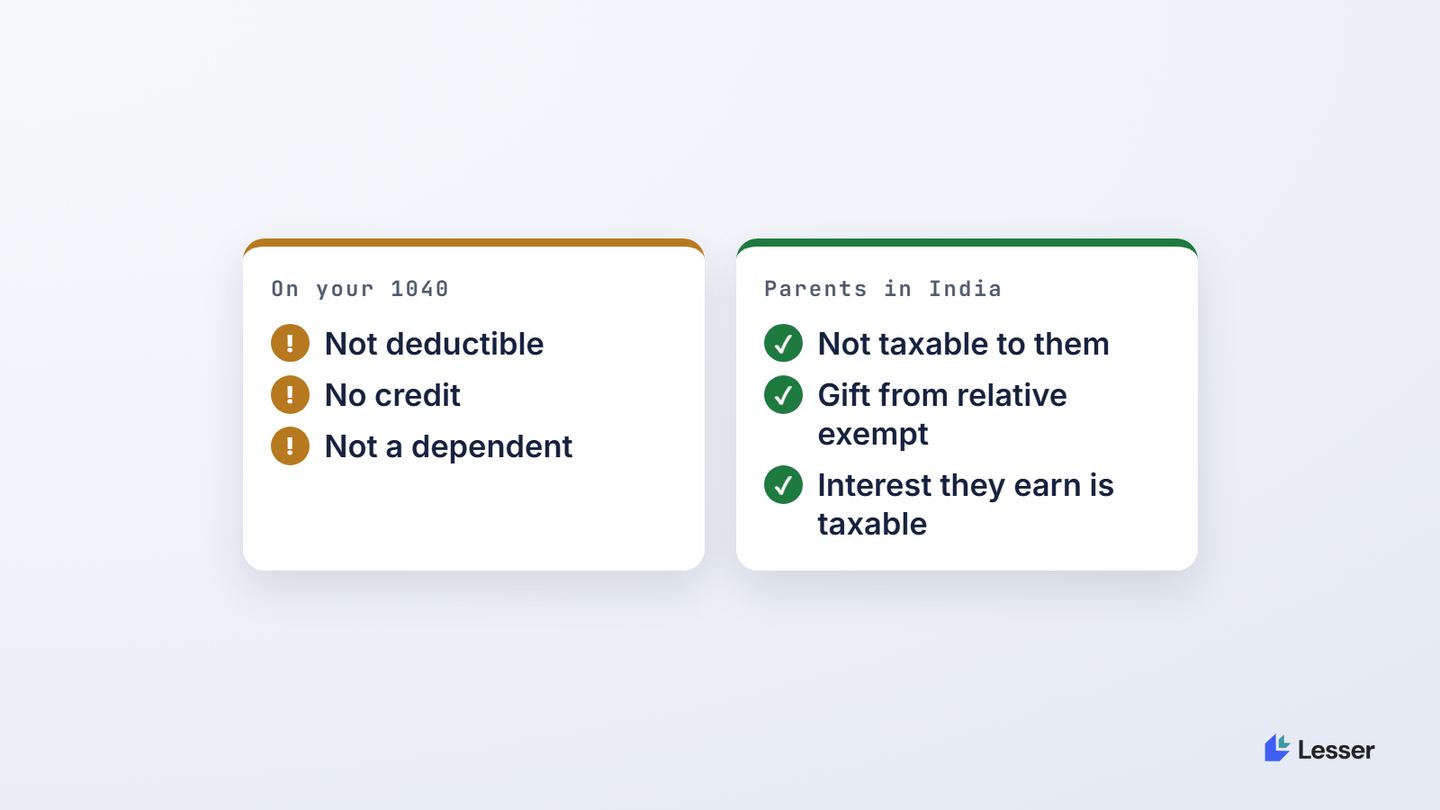
No. The IRS is explicit: "You cannot deduct the value of gifts you make (other than gifts that are deductible charitable contributions)" (IRS gift tax FAQs). A monthly wire to your parents does not reduce your taxable income, does not generate a charitable deduction, and does not appear on your 1040.
You cannot claim your parents as dependents either, in almost every case. A qualifying relative generally must be a US citizen, US national, US resident alien, or resident of Canada or Mexico. Parents living in India do not meet the residency test, so you cannot claim them even if you provide more than half their support.
Is the money taxable to anyone?
Usually not. Three pieces:
- To you (donor): the US does not tax a gift you make. The gift tax, where it exists, is on the donor — but it only kicks in when a gift to one person in a calendar year exceeds the annual exclusion, $19,000 per recipient for 2025 and 2026 (IRS gift tax FAQs). "The donor is generally responsible for paying the gift tax."
- To your parents in India: under section 56(2)(x) of the Income-tax Act, a gift from a "relative" (which includes a child) is exempt in the recipient's hands, with no upper cap. Any interest or rent they earn with the money is taxable in India in the normal way.
- To your parents in the US: nothing. Your parents are not US persons, and a gift is not income to the recipient under IRC section 102.

When does the gift trigger US reporting?
Three lines matter:
| Line | What triggers | Form |
|---|---|---|
| More than **$19,000 to one parent in a calendar year** | Annual gift tax exclusion exceeded | Form 709 — usually no tax, uses lifetime exemption |
| **$10,000** across all your foreign accounts at any point | FBAR | FinCEN Form 114 |
| Foreign assets over $50,000 single / $100,000 joint (last day) or $75,000 / $150,000 (any time) | Form 8938 | Attached to Form 1040 |
The gift itself only touches the first row. FBAR and Form 8938 apply only if the money sits in an Indian account that is in your name or jointly held with you. If you wire from Chase direct to your father's SBI account that you do not own or sign on, FBAR and 8938 are not your concern for that transfer. See FBAR and Form 8938 for Indian accounts.
$19,000 is per recipient, not per family. $19,000 to Mom and $19,000 to Dad in the same calendar year is fine with no gift return. A married couple can "split" gifts to double that per parent — but gift splitting requires both spouses to file their own Form 709 to make the election, even though no tax is due.
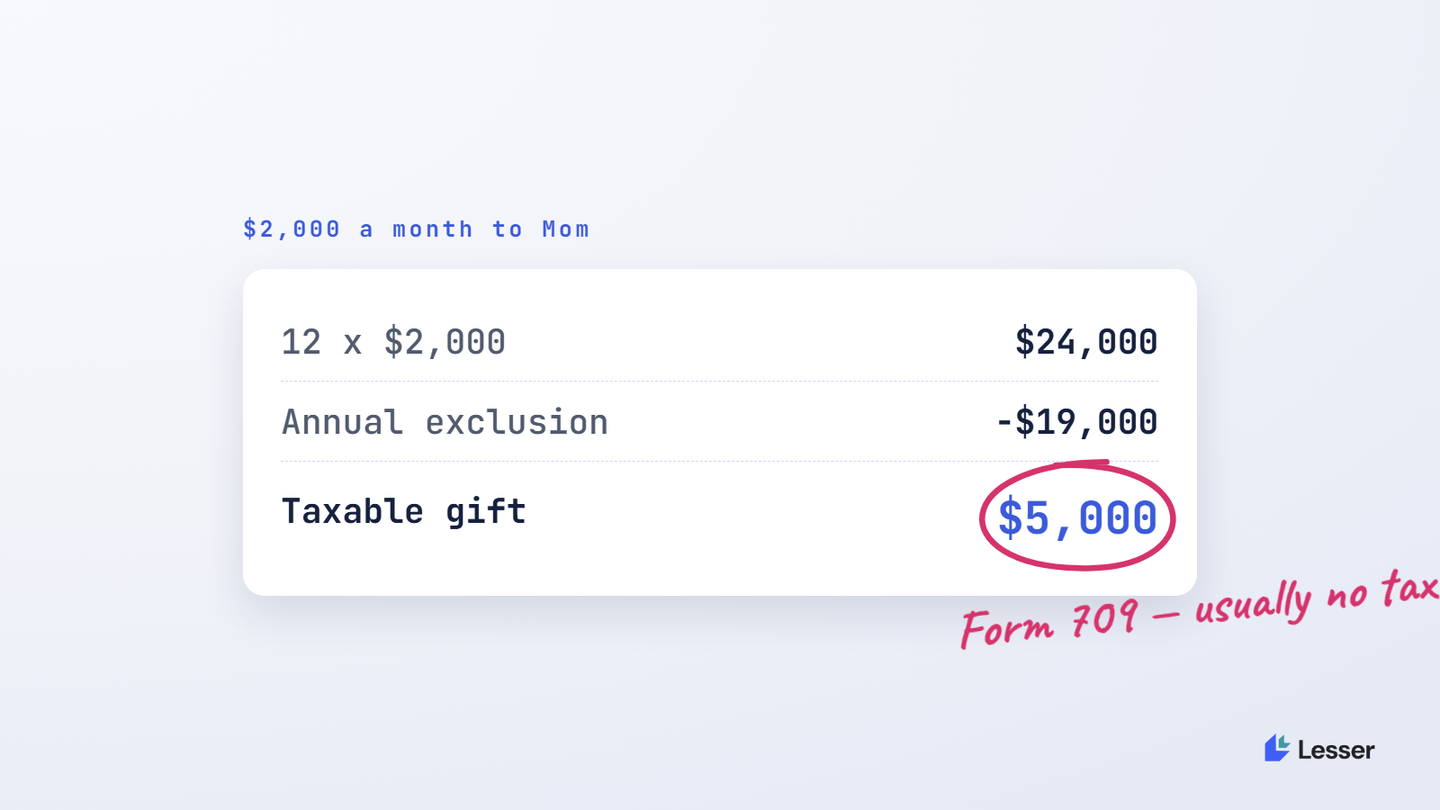
I send $2,000 a month to my mother — do I file a gift tax return?
Yes. $24,000 to one recipient in a year is $5,000 over the $19,000 exclusion, so Form 709 is due. You usually owe no gift tax: the $5,000 just reduces your lifetime gift and estate tax exemption, which for 2026 is $15,000,000 at the federal level. Form 709 is due April 15 of the year after the gift, and extends automatically with your 1040 extension.
Does Form 3520 apply when I send money to my parents?
No. Form 3520 goes the other way — US persons who receive more than $100,000 in a year from a nonresident alien individual or foreign estate (IRS: Gifts from Foreign Person). Money you send to parents in India is a Form 709 question, not Form 3520. The simple test:
- Money in from an Indian relative, over $100,000/year → Form 3520.
- Money out to an Indian relative, over $19,000/year → Form 709.
If your parents also sent you money this year, see the deep guide: Form 3520 for gifts and inheritance from parents in India.
Does the Indian LRS limit apply to me?
No. The RBI's Liberalised Remittance Scheme caps remittances out of India by Indian residents at USD 250,000 per financial year (RBI LRS FAQs). It applies to your parents sending money abroad, not to you sending money into India. Your US bank's wire limits and the sending service's KYC checks (Wise, Remitly, Xoom) still apply. Keep the wire confirmation — if a bank or tax authority ever asks years later, that one record is the entire paper trail.
What does this mean for your taxes?
- Not deductible. The monthly wire does not reduce your US taxable income.
- Stay under $19,000 per parent per calendar year and no US gift return is required. Above that, Form 709 is due, usually with no tax owed.
- Form 709 is money going out; Form 3520 is money coming in. Different forms, different thresholds.
If you are close to the $19,000 line this year, or hold joint Indian accounts with your parents, this is the planning Lesser's CPAs do every spring: Lesser for NRIs and the India tax filing service.
FAQ
Can I claim my parents in India as dependents on my US tax return?
Almost never. A qualifying relative must be a US citizen, US national, US resident alien, or resident of Canada or Mexico. Parents who live in India do not meet the residency test, even if you provide more than half their support.
Is $500 a month to my parents reportable in the US?
No. $500 a month is $6,000 a year — well under the $19,000 per-recipient annual exclusion. No Form 709, no Form 3520, nothing on your 1040.
Does Wise / Remitly report my remittances to the IRS?
Transfers of $10,000 or more may be reported by the sending institution under Bank Secrecy Act rules. That is a bank reporting obligation, not a tax trigger for you — the gift tax question is still the $19,000-per-recipient line.
Can my spouse and I together send $38,000 a year to my mother without filing anything?
Only if each spouse's own gifts to Mom stay within their own $19,000 exclusion. If one spouse writes the whole $38,000 wire, you need Form 709 (filed by both spouses) to make the gift-splitting election, even though no tax is due.
What if my parent later gives me the money back?
Each direction is a separate transfer for US purposes. If more than $100,000 comes back from one parent (or related parents combined) in a year, Form 3520 applies to the inbound side.