
Lesser Tax
14 min read
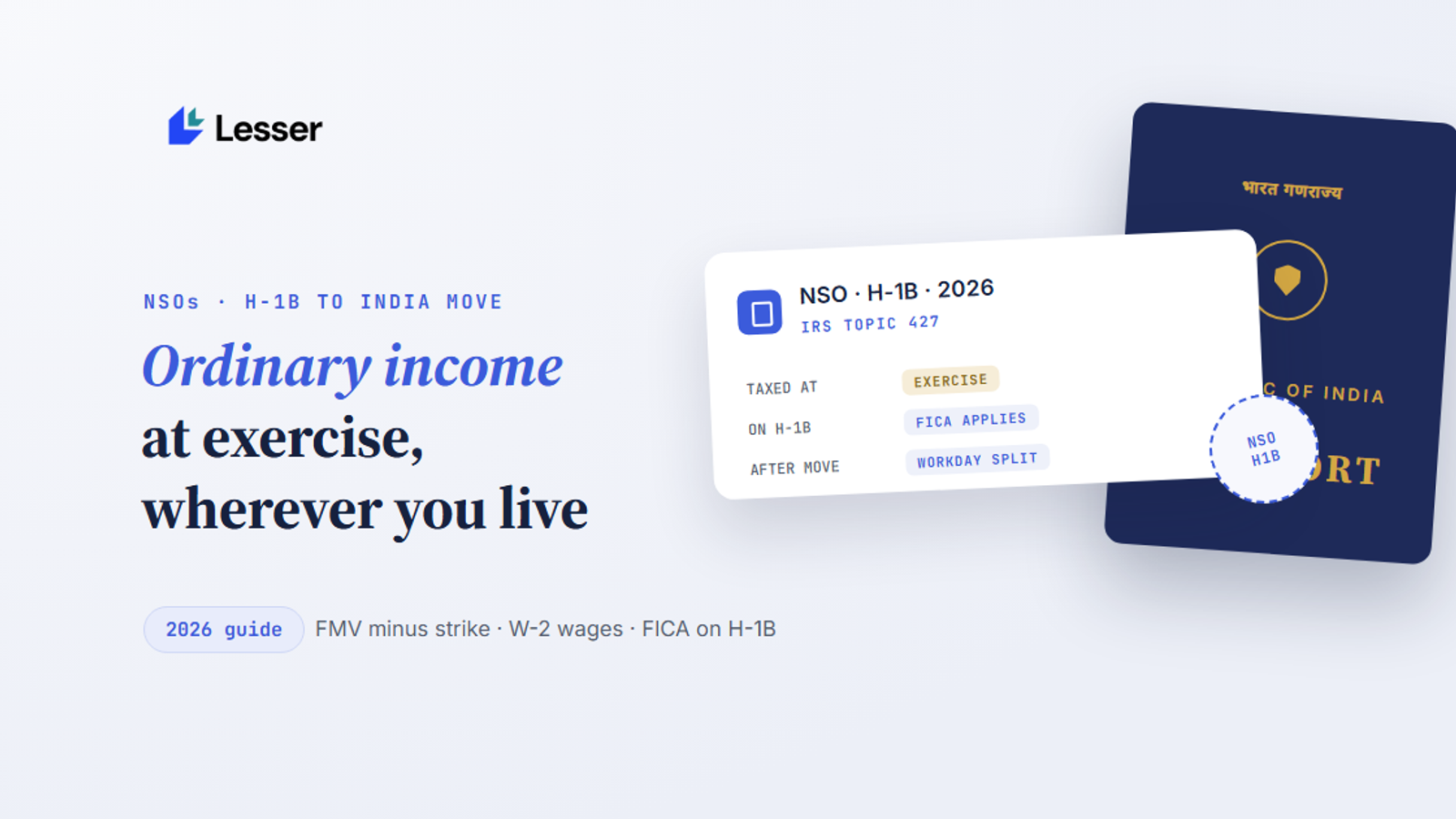
Quick answer: Non-qualified stock options (NSOs or NQSOs) do not trigger US tax at grant. They trigger ordinary income tax at exercise, equal to the FMV of the stock on the exercise date minus the strike price you paid. On an H-1B that income shows up on your W-2 as wages, subject to federal income tax, Social Security and Medicare, and your state's income tax. If you exercise after moving back to India, the spread earned over your US workdays stays US-source and the US taxes it; India will also tax you on it once you are tax-resident there, and you clear the double tax by claiming foreign tax credit on one side under Article 25 of the US-India treaty. The sale after exercise is a separate event: capital gain or loss over your exercise-date FMV basis.
Key takeaways
- "For nonstatutory options without a readily determinable fair market value, there's no taxable event when the option is granted but you must include in income the fair market value of the stock received on exercise, less the amount paid, when you exercise the option" (IRS Topic 427).
- NSO exercise income on an H-1B is W-2 wages: income tax withheld, plus Social Security and Medicare, because H-1B wages are "subject to Social Security/Medicare taxes for services performed by them within the United States" (IRS: Aliens employed in the US).
- US residency for a tax year is set by the substantial presence test: at least 31 days this year plus 183 counted days over the current and prior two years (IRS SPT).
- A move year is usually dual-status: resident for part of the year, nonresident for part. "A dual status individual must file a dual status return as described in Publication 519" (IRS dual-status).
- "If you paid or accrued foreign taxes to a foreign country or U.S. possession and are subject to U.S. tax on the same income, you may be able to take either a credit or an itemized deduction" (IRS Foreign Tax Credit).
What an NSO actually is, and why it is not an ISO
A non-qualified stock option (NSO, also called NQSO) is the plain-vanilla employer stock option. The IRS defines its tax trigger directly: "For nonstatutory options without a readily determinable fair market value, there's no taxable event when the option is granted but you must include in income the fair market value of the stock received on exercise, less the amount paid, when you exercise the option" (Topic 427). That exercise-date spread is ordinary compensation income.
ISOs (incentive stock options) are the opposite: no regular income tax at exercise, AMT consequences at exercise, and long-term capital gain treatment on the whole spread if you hold two years from grant and one year from exercise. Most startups grant ISOs to US employees up to the $100,000 annual vesting limit and NSOs above it. If you joined after the $100k ISO bucket was used, your options are NSOs by default. If your plan says "NSO" on the grant agreement, there is no ISO election to make — it is contract, not choice.
| NSO | ISO | |
|---|---|---|
| Taxable at grant | No | No |
| Taxable at exercise (regular tax) | Yes — ordinary income on FMV minus strike | No |
| AMT at exercise | No | Yes — spread is AMT preference |
| Payroll tax at exercise | Yes — FICA (Social Security + Medicare) | No |
| Who can hold them | Anyone (employees, contractors, directors) | Only W-2 employees |
| Tax at sale | Capital gain/loss over exercise FMV | Capital gain/loss over strike (if holding period met) |
For the AMT and holding-period side of ISOs, see our ISO AMT when leaving the US guide; this page is only about NSOs.
What exercising NSOs on an H-1B actually costs
On exercise day your employer will do two things. First, it adds the spread (FMV × shares, minus strike × shares) to your W-2 Box 1 as wages. Second, it withholds. The default supplemental federal rate on W-2 supplemental wages is 22% for amounts up to $1 million and 37% above. On top of that it withholds Social Security (up to the annual wage base), Medicare (1.45%, plus the 0.9% Additional Medicare for wages over $200,000), and your state income tax.
The reason FICA applies is specific to your visa. The IRS page on aliens employed in the US states: "Wages paid to nonresident aliens employed within the United States by an American or foreign employer, in general, are subject to Social Security/Medicare taxes for services performed by them within the United States, with certain exceptions based on their nonimmigrant status" (IRS). H-1B is not on the exemption list. F-1/OPT, J-1, and a few others are, which is why first-year F-1-to-H-1B transitions see a FICA shift mid-year.
Worked example. You are on H-1B earning $185,000 base salary in California. You exercise 10,000 NSOs with a strike of $4 when the stock trades at $38. Spread = 10,000 × ($38 − $4) = $340,000 of ordinary income.
- Federal supplemental withholding at 22% on the first $1M of supplemental wages for the year: $340,000 × 22% = $74,800. But your marginal rate at $185k base + $340k spread is 35%, so the 22% withholding is not enough — you will owe more at filing.
- Social Security 2026 wage base: $184,500, so your $185k base salary just about reaches the cap. On the exercise spread, Social Security withholding is zero once you have hit the cap through regular wages.
- Medicare 1.45% on all $340,000 = $4,930. Additional 0.9% on the amount over $200,000 of total wages = at least $4,725 more.
- California withholding on supplemental wages is 10.23% for stock options = $34,782.
Your realised tax at filing time: roughly 35% federal + 2.35% Medicare + 9.3-13.3% California marginal. On a $340k spread you should mentally reserve 45-50% of the spread for taxes. The withholding will cover maybe 32-35% of that — the balance comes out of your April cheque or your Q4 estimated payment.
The basis in the shares after exercise is the exercise-date FMV ($38), not the strike. If you sell at $45 one year later, the gain is $7 × 10,000 = $70,000, long-term capital gain, taxed at 15%/20% federal plus state. If you sell on the same day as exercise (a "cashless exercise"), the capital gain/loss is near zero because sale price ≈ exercise-date FMV.
When FMV is "readily determinable" and why startups almost never trigger that
Topic 427 draws a sharp line based on whether the option itself has a readily determinable FMV. "If an option is actively traded on an established market, you can readily determine the fair market value of the option" (Topic 427). Private company options are not traded on an exchange, so they are "options without a readily determinable fair market value" and fall under the exercise-date rule. Public company options granted to employees also usually fall here because the grant is restricted and non-transferable, which breaks the "actively traded" condition.
The practical point: if you work at a startup, the only taxable event on NSOs is exercise (and then sale). There is no grant-date income to worry about.
Section 83(b) and NSOs: usually not relevant, sometimes a trap
The 83(b) election applies to transfers of restricted property, including early-exercised NSOs where the shares are subject to vesting. The election says "tax me now on the current spread, not later as it vests." For NSOs that are vested when exercised, 83(b) is irrelevant — you have already crystallised the spread. For NSOs on unvested stock (an "early exercise"), 83(b) within 30 days starts the capital-gain holding period and pins the ordinary income to today's spread.
Early exercising while on H-1B carries a specific risk: if you leave the US before the shares vest, your employer may repurchase the unvested shares at the lower of cost or FMV, and the 83(b) election you filed does not get undone. See our ESPP and 83(b) election guide for the mechanics; the same rules apply to NSO early exercise.
The move year: dual-status filing
The year you move back to India you are usually dual-status: a US resident for part of the year, a nonresident for the remaining part. The IRS puts it: "A dual status individual must file a dual status return as described in Publication 519, U.S. Tax Guide for Aliens" (IRS dual-status). You file one return — a 1040 covering the US-resident period and a 1040-NR cover for the US-source-only nonresident period — and you lose the standard deduction for that year (dual-status filers use itemised).
Residency ends on the "residency termination date," which for most H-1B leavers is the last day of presence in the US in that year, if they can establish a closer connection to India for the rest of the year and are not US-resident the following year. If you fly out July 1 and do not come back that calendar year, you are a US resident through roughly July 1 and a nonresident after.
What that means for an exercise:
- Exercise before the residency termination date: full US tax as a resident. All the ordinary income on the spread flows to the 1040 side.
- Exercise after the residency termination date, before December 31: you are a nonresident for US tax purposes on the exercise date, but the compensation is still US-source to the extent it was earned over US workdays. The IRS sources NSO compensation based on where you worked during the vesting period (Regs. §1.861-4). This usually produces a US/foreign allocation.
The allocation is the piece most people get wrong.
Sourcing: the US/India split after you move
If you were granted NSOs in Year 1, vested them over four years while in the US, and exercised them in Year 5 after moving back to India, the spread is still mostly US-source. The IRS treats compensatory stock option income as earned ratably over the vesting period (grant to vest). If 100% of your workdays in that vesting window were in the US, 100% of the spread is US-source compensation, even if you are a nonresident on exercise day.
Walk through two scenarios:
Scenario A — grant/vest/exercise all while US-resident, then move: Grant Jan 2022, vest schedule Jan 2023-Jan 2026, you exercised Dec 2026 while still in the US. 100% US-source. You pay US ordinary income tax on the full spread. The move does not matter for sourcing.
Scenario B — grant and vest in the US, exercise after moving back to India in July 2027: Grant Jan 2024, 4-year vest ending Jan 2028, you move July 2027 and exercise in September 2027 to raise cash. All vesting-period workdays through June 2027 were in the US; July onwards you worked from Bengaluru. For the tranche vesting between July 2027 and January 2028 (post-move), part of the vesting period was in India. The option income for that tranche sources partly to India (India workdays) and partly to the US (US workdays). For the fully-vested tranches already in your hand before you moved, 100% US-source.
The US still taxes the US-source portion. Your employer should withhold on it as a 1040-NR filer; realistically, many payroll systems get this wrong and over-withhold. You reconcile on the 1040-NR, Schedule NEC or on the dual-status return.
India taxes based on your residential status in the India tax year of exercise. If you have become a Resident and Ordinarily Resident (ROR) by the time you exercise, India taxes your worldwide income, including the entire NSO spread. If you are Resident but Not Ordinarily Resident (RNOR), India generally does not tax foreign-source income unless it is received in India or arises from an India-connected business. The India-side rules on ROR/RNOR are detailed; see our RNOR status guide for how long you have before you flip to ROR.
Double tax relief comes from the US-India treaty (Article 25 - Relief from Double Taxation) and from each country's foreign tax credit mechanism. On the US side: "If you paid or accrued foreign taxes to a foreign country or U.S. possession and are subject to U.S. tax on the same income, you may be able to take either a credit or an itemized deduction" (IRS FTC). You claim the credit on Form 1116. On the India side, you claim credit on Form 67. The practical rule: tax the income first in the source country, then take credit in the residence country for the source-country tax paid.
The sale: capital gain, and where it is sourced
Selling the shares after exercise is a separate taxable event. Your basis is the exercise-date FMV (the amount already taxed as ordinary income). Gain or loss between then and the sale is capital gain or loss.
Sourcing of capital gain on sale of stock is different from compensation. For US tax purposes, capital gain on stock is generally sourced to the seller's country of residence on the sale date. So if you exercise before moving (US-resident at exercise, basis set at FMV, you own the shares) and then sell after you have moved to India (now nonresident for US tax), the capital gain is generally not US-taxable — it is India-source for US purposes and India-taxable under India's capital gains rules on foreign shares. There are specific exceptions (US real property interests, effectively connected gains); plain employer-stock gain usually is not caught.
For the specifics of selling RSUs after you move back, which uses a related but distinct allocation, see our sell RSUs moving back to India guide.
State tax after you leave
Most US states follow the federal sourcing rule for employer compensation and will tax the state-workday portion of your NSO spread even if you exercise after you moved out of the state. California is the aggressive end of this spectrum and uses a workday allocation back to your California service period. New York applies a 90-day rule for certain non-residents. Even if you flew to India in July and your federal 1040 is dual-status, your state return may still owe tax on a slice of a December exercise.
How we handle this at Lesser
For an H-1B holder exercising NSOs during US residency, the Lesser work is one return (1040 as US resident, Schedule B/D for any sale, Form 8938 if you also have India accounts over threshold), with pre-exercise modelling to show the all-in rate before you click "exercise." For a dual-status move year, it is a 1040 + 1040-NR dual-status return plus the Form 67 credit coordination on the India side the following year. If you have NSOs on the table and are deciding when to exercise relative to a planned move, this is work our team models before you touch the button: see how Lesser works for NRIs and our full flat-fee services.
FAQ
Do I pay tax on NSOs when they vest?
No. NSO income is triggered at exercise, not vesting. Vesting without exercise is not a taxable event. (RSUs are the opposite: tax at vest.)
Can I defer NSO tax by not exercising?
Yes, until the options expire. The trade-off is risk: if the stock price drops below your strike, your options are worthless. If it rises, your spread (and tax bill) grow. There is no 83(i) deferral for public-company NSOs; the Section 83(i) private-company deferral is narrow and has strict issuer requirements.
Will my employer withhold enough federal tax on exercise?
Usually not, if your spread is large. The 22% supplemental rate applies up to $1M of supplemental wages per year; your actual marginal rate at $300k+ of combined income is 32-37%. Plan for a top-up at filing time or make a Q4 estimated payment.
What happens if I exercise after my last US workday?
You are still liable for US tax on the US-source portion of the spread, allocated by workdays during the vesting period. If 100% of vesting-period workdays were in the US, the entire spread is US-source and taxable in the US even though you exercise from Bengaluru.
Can I claim foreign tax credit for US tax on my India return?
Yes, if India taxes you on the same income. You file Form 67 before your India return and the credit flows through on Schedule FSI/TR of the ITR. Keep the US 1040 and the W-2 as backup.
Do I need to file Form 8938 or FBAR because of the shares?
Employer shares held in a US brokerage are not foreign financial assets, so no 8938 or FBAR trigger from the shares alone. If your sale proceeds move to an Indian bank account that pushes you over the FBAR $10,000 aggregate threshold, that India account is reportable. See our FBAR and Form 8938 for Indian accounts guide.
Can my employer let me exercise early (before vesting)?
Only if the plan allows "early exercise." If it does, you buy unvested shares and typically file an 83(b) election within 30 days to pin the ordinary income to today's spread. This is a specific decision with specific risks, especially on H-1B — do not file an 83(b) without modelling the exit case.