
Lesser Tax
12 min read
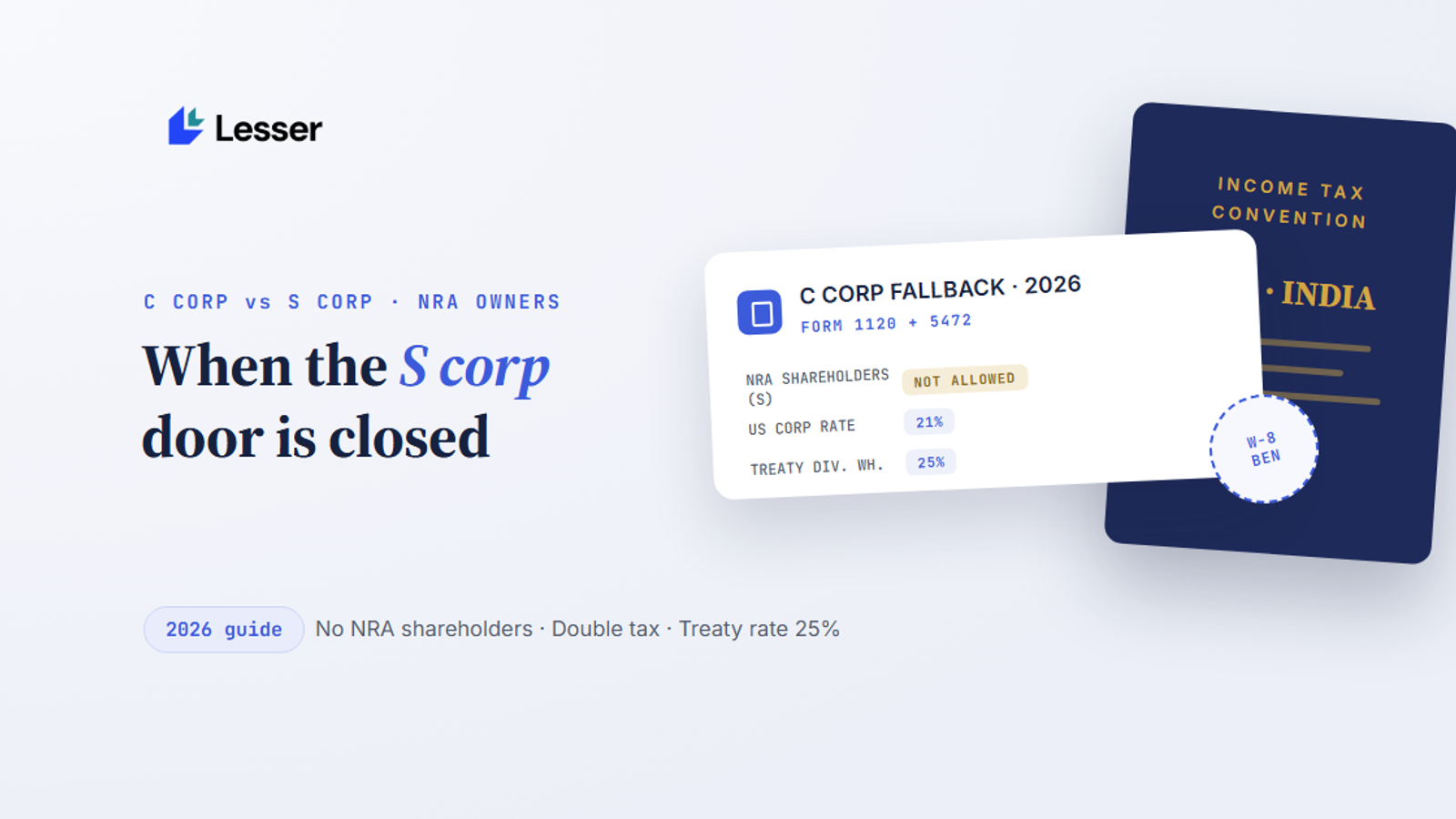
Quick answer: C corp vs S corp is a federal tax election question, not a state entity question. An S corporation is a corporation (or an LLC taxed as one) that elects pass-through treatment under section 1362(a). The IRS requires that an S corporation have "no nonresident alien shareholders (other than as potential current beneficiaries of an ESBT)," per the Form 2553 instructions, so if any shareholder is a nonresident alien — a non-US-citizen who does not hold a green card and has not met the Substantial Presence Test for the tax year — the S election is not available and the entity defaults to a C corporation. The C corp pays its own federal income tax at 21%, then distributions to the nonresident shareholder are dividends subject to a 30% US withholding tax under section 1441 (reduced to 25% under Article 10 of the US-India treaty for Indian residents).
Key takeaways
- The S corporation shareholder test is strict: "no nonresident alien shareholders (other than as potential current beneficiaries of an ESBT)" (Instructions for Form 2553).
- Only "individuals, estates, exempt organizations, or certain trusts" qualify as S corporation shareholders (IRS: S corporations) — not partnerships, not other corporations, and specifically not an Indian HUF or private limited company.
- A C corporation has no such restriction. The IRS page is explicit: "In forming a corporation, prospective shareholders exchange money, property, or both, for the corporation's capital stock" (IRS: Forming a corporation). Nonresident aliens can be C corp shareholders.
- "The profit of a corporation is taxed to the corporation when earned, and then is taxed to the shareholders when distributed as dividends. This creates a double tax" (IRS: Forming a corporation). That is the price of the C corp fallback.
- Federal C corp rate: 21% flat, under section 11(b).
- US dividend withholding on payments to a nonresident alien is 30% under section 1441, reduced to 25% for dividends paid to Indian tax residents under Article 10 of the US-India tax treaty (US-India treaty). The payer withholds; the shareholder reports on Form 1040-NR.
- A single-shareholder US C corporation whose owner is an Indian resident must file Form 5472 and a pro-forma Form 1120 if it is a 25%-foreign-owned reportable entity (section 6038A).
- A C corporation that becomes profitable and then wants S status later can elect, but only once every US-person test is met for every shareholder; a mid-year change in shareholder status does not retroactively qualify.
What is the difference between a C corp and an S corp?
Both are corporations under state law. The federal income-tax difference is the election. A corporation that does nothing is a C corporation: it is "a separate taxpaying entity" that "conducts business, realizes net income or loss, pays taxes and distributes profits to shareholders" (IRS: Forming a corporation).
A corporation that files Form 2553 and meets the small-business-corporation tests becomes an S corporation: it files Form 1120-S and reports pass-through items to shareholders on Schedule K-1. Shareholders then pay individual income tax on their share of corporate income and losses. "S corporations are corporations that elect to pass corporate income, losses, deductions, and credits through to their shareholders for federal tax purposes" (IRS: S corporations).
Who can own an S corporation?
Section 1361 and the Form 2553 instructions define the eligible shareholders tightly:
- Only "individuals, estates, exempt organizations, or certain trusts" are allowed. The IRS S corporations page says shareholders "may not be partnerships, corporations or non-resident alien shareholders" (IRS: S corporations).
- No more than 100 shareholders. Spouses count as one, and in some cases family members can be grouped under section 1361(c)(1)(B) (Instructions for Form 2553).
- One class of stock.
- The corporation must have "no nonresident alien shareholders (other than as potential current beneficiaries of an ESBT)" (Instructions for Form 2553).
The nonresident alien bar is the one that matters here. The IRS defines a nonresident alien as "an alien who has not passed the green card test or the substantial presence test" (IRS: Nonresident aliens). For Indians, this covers:
- Any person living in India with no US green card and no US physical presence;
- An H-1B holder in the arrival year who has not yet met the Substantial Presence Test;
- An F-1 or J-1 student in the first five calendar years, during the student exemption from counting days;
- A former US resident who moved back to India and lost resident status.
Any one of those as a shareholder blocks the S election from the start, and the appearance of one on the cap table terminates an existing S election.
When is a C corp the right answer for Indian owners?
Three fact patterns at Lesser recur:
- A US startup with a cofounder still in India (or on F-1 in the exempt period). The Indian cofounder is a nonresident alien. The company cannot be an S corp while the Indian cofounder holds stock, so a C corp is the default.
- A US company planning to raise institutional venture capital. US VC funds are typically partnerships (not eligible S corp shareholders), and foreign LPs would also break S status. Delaware C corps are the structure institutional funds expect.
- An Indian parent holding a US subsidiary. An Indian private limited company (or an LLP, or an HUF) is not an "individual" and not in the eligible shareholder list; the US subsidiary must be a C corp.
The pass-through savings of an S corp are not available in these patterns. The analysis then shifts to the C corp's own trade-offs.
What's the C corp tax hit?
Two layers.
Entity-level tax. The C corporation pays federal income tax at a flat 21% on taxable income (section 11(b)). State corporate income tax stacks on top: Delaware's franchise is based on authorized shares, not income (for most startups the Alternative Franchise method caps at a few thousand dollars) but a Delaware corporation that has operations in California pays California's 8.84% corporate rate on California-source income.
Shareholder-level tax on distributions. When the C corp distributes earnings as a dividend to a shareholder, the shareholder pays tax. For a nonresident alien shareholder, the US tax is withheld at source: section 1441 imposes a 30% withholding on US-source dividends paid to a nonresident alien, which the payer sends to the IRS on Form 1042. The nonresident shareholder reports the gross dividend on Form 1040-NR and claims credit for the withholding.
The US-India treaty cuts this. Article 10 of the US-India treaty sets the maximum rate at 25% for dividends paid to residents of the other country where the recipient is the beneficial owner (US-India Income Tax Treaty, Article 10). To claim the treaty rate, the Indian resident shareholder gives the US payer a Form W-8BEN that cites Article 10, and the US payer withholds 25% instead of 30%. India then taxes the same dividend as income in India; the Indian resident claims a foreign tax credit for the US tax under section 90 of the Income-tax Act.
| C corporation | S corporation | |
|---|---|---|
| Federal entity tax | 21% on taxable income (section 11(b)) | None at entity level |
| Shareholder tax on profits | Only when distributed as a dividend | Each year on K-1 share, whether distributed or not |
| Dividend withholding on NRA shareholder | 30% under section 1441, 25% under US-India treaty Article 10 | N/A — NRA cannot be a shareholder |
| Allowed shareholders | Any — individuals, foreign persons, trusts, corporations | Individuals, estates, specified exempt orgs, specified trusts |
| Shareholder cap | None | 100 |
| Loss pass-through to shareholders | No | Yes (subject to basis, at-risk, passive loss rules) |
What is the double tax and how big is it in practice?
The IRS language is "This creates a double tax" (IRS: Forming a corporation). To put rough numbers on it for an Indian-resident sole shareholder of a US C corp distributing all its earnings:
- Pre-tax earnings at the C corp: $100.
- Federal corporate tax: 21% = $21. Earnings available to distribute: $79.
- Dividend withholding under US-India treaty: 25% of $79 = $19.75. Net to shareholder: $59.25.
- India tax: the shareholder reports the gross dividend, pays Indian tax at the applicable slab (highest 30% plus surcharge/cess), and claims a foreign tax credit for the $19.75 US tax. If the Indian liability on $79 is $24.57 (31.1% effective at the top slab with cess), the net Indian tax after FTC is $24.57 − $19.75 = $4.82.
- Combined US+India after FTC: $21 + $19.75 + $4.82 = $45.57 on $100 of US corporate income.
An S corp with a US-resident shareholder, by contrast, pays no entity-level tax; the shareholder pays once at their individual federal and state rate. That gap is the price of the S corp bar on nonresident shareholders.
Can the owner elect S later, after moving to the US?
Yes, but the entity must requalify as a small business corporation on the effective date of the election. If the Indian cofounder gives up US stock before year-end and moves to the US on an H-1B that lets them meet the Substantial Presence Test for the next calendar year, the corporation can file Form 2553 for an election effective January 1 of that next year — provided every shareholder on that date is eligible (citizen, resident alien, or qualifying trust) and all other section 1361 tests are met.
A mid-year change in a shareholder's residency status does not retroactively make a nonresident shareholder eligible. The small-business-corporation requirements must be satisfied continuously starting from the effective date entered on Form 2553 (Instructions for Form 2553).
What about the ESBT exception?
Form 2553 allows a nonresident alien as a "potential current beneficiary" of an Electing Small Business Trust (ESBT). This is not a loophole for direct ownership: it is a narrow trust structure where the stock is held by a US trust that elects ESBT status, and the NRA is one of several possible income beneficiaries. The trust itself pays tax on the S corp income at the top individual rate. For most Indian founders this is more expensive and complicated than simply holding the entity as a C corp.
What does the C corp fallback actually require?
The clean C corp setup for an Indian founder:
- Incorporate (typically Delaware or the operating state). The articles of incorporation and bylaws do not need to say anything special about foreign ownership.
- Issue capital stock to each shareholder in exchange for cash, services or property; document the capitalization in a stock ledger.
- Apply for an EIN on Form SS-4. The responsible party can be any shareholder or officer with an ITIN or SSN; a nonresident alien responsible party uses an ITIN or applies for one in parallel.
- The corporation files Form 1120 annually.
- If any single foreign person owns 25% or more of the corporation, the corporation files Form 5472 with a pro-forma Form 1120 under section 6038A. Penalty for failure to file is $25,000 per form per year.
- Each nonresident shareholder gives the corporation a Form W-8BEN to claim treaty withholding, and the corporation files Form 1042 and 1042-S for dividend payments.
FAQ
Can a US LLC with a nonresident Indian member elect S corp?
No. The Form 2553 instructions require "no nonresident alien shareholders," and an LLC taxed as an S corp has the same shareholder restrictions as a corporation taxed as an S corp. The LLC can elect to be taxed as a C corp on Form 8832 instead.
Can an F-1 student on OPT own an S corp?
Only if they meet the Substantial Presence Test for the tax year — which usually means after the five-year student exemption has run and they have accumulated enough US days. Within the exemption period, F-1 days do not count toward SPT and the student is a nonresident alien, so they cannot hold S corp stock.
Does a green card holder living abroad count as a resident?
Yes, for the S corp shareholder test. A lawful permanent resident is a resident alien until the LPR status is formally abandoned or revoked, regardless of physical presence outside the US. The green card test is independent of the Substantial Presence Test.
What's the dividend withholding rate for an Indian resident shareholder of a US C corp?
Under US domestic law (section 1441), 30% on US-source dividends paid to a nonresident alien. The US-India treaty Article 10 caps it at 25% where the Indian resident is the beneficial owner and files Form W-8BEN with the US payer. The treaty text sets a lower 15% rate only for certain qualifying corporate shareholders — not individuals — so most Indian individual shareholders are at 25%.
Can an Indian private limited company own a US corporation?
Yes, but only as a C corp. An Indian company is not an eligible S corp shareholder (not an "individual, estate, exempt organization, or qualifying trust"). The US subsidiary files Form 1120 and, because it is at least 25% foreign-owned, files Form 5472 under section 6038A.
What's Form 5472 and what are the penalties?
Form 5472 is the information return a 25%-foreign-owned US corporation (and any US-incorporated single-member LLC with a foreign owner) files to report transactions with its foreign related parties. The penalty for failure to file or file substantially complete is $25,000 per Form 5472 per year under section 6038A(d).
Can an S election be made and then an NRA buys stock without terminating it?
No. Any transfer of stock to a nonresident alien terminates the S election under section 1362(d)(2), effective on the date of transfer. The entity becomes a C corp for the rest of the year (a short-year split return under section 1362(e)).