
Lesser Tax
12 min read
Quick answer: An S corporation is a federal tax election a US corporation or LLC can make; the election routes profits to shareholders' individual returns and lets working owners split pay between W-2 wages and distributions, which saves self-employment tax. An LLC without the election is either a disregarded entity (one owner) or a partnership (two or more), with members paying self-employment tax on their share of net earnings from self-employment. H-1B founders hit two walls on the S corp side: the IRS requires that an S corp have "no nonresident alien shareholders" (Form 2553 instructions), and the IRS treats a working shareholder's compensation as wages, which collides with the H-1B rule that an H-1B holder is tied to the sponsoring employer. A green card holder has none of those limits.
Key takeaways
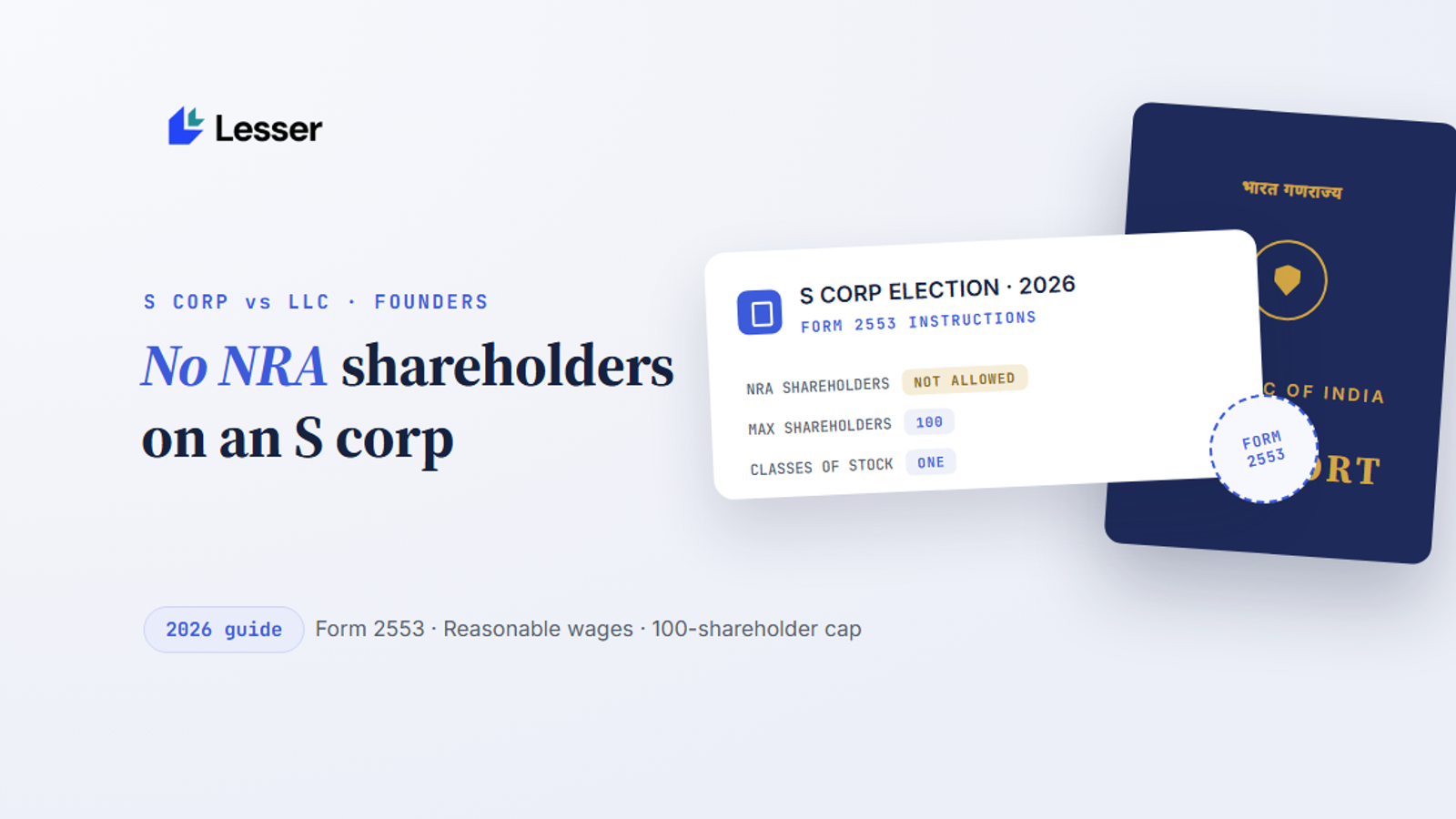
- An S corp election is made on Form 2553; the form instructions say the corporation must have "no nonresident alien shareholders (other than as potential current beneficiaries of an ESBT)" (Instructions for Form 2553).
- A US resident alien (an H-1B holder who passes the Substantial Presence Test, or a green card holder) is not a nonresident alien and is eligible to hold S corp stock. The constraint hits F-1/OPT and H-1B dual-status arrival years when the person is still an NRA for the tax year.
- An S corp can have "no more than 100 shareholders" and shareholders must be individuals, estates, certain exempt organizations, or certain trusts (Instructions for Form 2553) — not a corporation and not a foreign entity, which rules out holding the shares through an Indian company.
- An LLC with one US owner is a disregarded entity for income tax, and with two or more members is a partnership by default, unless Form 8832 is filed to be taxed as a corporation (IRS: Limited liability company (LLC)).
- When an S corp shareholder "perform[s] a service for the corporation and receive[s] or [is] entitled to payments, those payments are considered wages" (IRS: S corp employees, shareholders, officers). That is the "reasonable compensation" rule the Service enforces every year.
- For H-1B holders, the simple read is: owning passive S corp or LLC equity is a tax question, not an immigration one, but drawing wages from your own S corp is the thing H-1B rules do not accommodate without USCIS-approved sponsorship from that entity.
What is the difference between an S corp and an LLC?
An LLC is a state-law entity. An S corporation is a federal income tax status. The IRS's own page is explicit: "S corporations are corporations that elect to pass corporate income, losses, deductions, and credits through to their shareholders for federal tax purposes" (IRS: S corporations). The state entity can be a corporation or an LLC; the LLC simply files Form 8832 (if needed) and Form 2553 to be taxed as an S corp.
The practical consequence: when founders ask "should I set up an LLC or an S corp?", the real question is almost always "should my LLC or corporation elect S status?" The entity on the state filing is a separate decision from the tax classification.
| Default LLC (single-member) | Default LLC (multi-member) | S corp election | |
|---|---|---|---|
| Federal tax | Disregarded, reported on Schedule C/E | Partnership, Form 1065 + K-1 | Form 1120-S + K-1 |
| SE tax on profit | Yes on net earnings from SE | Yes on each member's distributive share from SE | No on K-1 distributions; wages carry FICA |
| Working owner's pay | None required; owner draw | None required; guaranteed payments optional | Reasonable W-2 wages are required |
| Non-US owners | Allowed | Allowed | Not allowed if any shareholder is a nonresident alien |
| Classes of ownership | Flexible | Flexible | One class of stock |
Context sentence: the S corp election trades flexibility for a payroll-tax saving on distributions, but adds payroll and a reasonable-compensation defense.
Who can be an S corp shareholder?
The Form 2553 instructions list the shareholder tests the corporation has to pass to make the election. Four of them matter for an immigrant founder:
- "It has no more than 100 shareholders."
- "Its only shareholders are individuals, estates, exempt organizations described in section 401(a) or 501(c)(3), or certain trusts described in section 1361(c)(2)(A)."
- "It has no nonresident alien shareholders (other than as potential current beneficiaries of an ESBT)."
- "Each shareholder consents as explained in the instructions for column K."
The nonresident alien test is a bright line and the one that trips Indian founders. If you are on F-1/OPT in 2026 and have not yet passed the Substantial Presence Test, you are a nonresident alien for the year; holding S corp stock on 31 December blows the election and the S corp defaults back to a C corporation for the year. The same risk shows up in your H-1B arrival year if you are dual-status — the preceding nonresident portion is fine, but you need to be a resident alien on the day you acquire the stock.
Two situations where the test can quietly fail even for a US resident:
- Stock is held through an Indian HUF or an Indian private limited company — that is a foreign entity, not an eligible shareholder.
- Stock is gifted to a parent in India for estate planning — the parent is a nonresident alien and the election terminates.
Who can be an LLC member?
The IRS page on LLCs is explicit on the other side: "Most states do not restrict ownership, so members may include individuals, corporations, other LLCs and foreign entities. There is no maximum number of members" (IRS: Limited liability company (LLC)). An LLC taxed as a partnership can have Indian individuals, an Indian company, or an HUF as members, subject to the IRS's partnership withholding rules on US effectively connected income allocated to foreign partners.
That difference is why many first-time Indian founders start as a US LLC with Indian co-founders: it works until a US VC asks you to convert to a Delaware C corporation.
Does the H-1B let me own an S corp or LLC?
Owning is not working. USCIS rules govern employment, not passive investment. The IRS instructions settle the tax eligibility: an H-1B holder who is a US resident alien for the tax year can be an S corp shareholder. What H-1B rules do not permit is working for your own S corp without a USCIS-approved H-1B petition from that company. A single-founder S corp needing a founder on W-2 wages is in direct tension with the rule the IRS wrote: "When corporate officers perform a service for the corporation and receive or are entitled to payments, those payments are considered wages" (IRS: S corp employees, shareholders, officers).
That is why H-1B founders who want to incorporate commonly set up a C corporation (not an S corp) with an independent board that can sponsor H-1B employment of the founder — a question with immigration-law dimensions that are outside this guide. For passive ownership — holding stock, taking distributions, not working for the entity — the S corp/LLC decision is purely tax.
For green card holders, every one of these constraints disappears. A lawful permanent resident is a US resident alien for tax every year under the "green card test," can be an S corp shareholder, can work for the entity on W-2 wages, and can hold membership interests in an LLC without immigration restriction.
When does the S corp election actually save tax?
The S corp election saves self-employment tax on the portion of profit paid out as a K-1 distribution rather than as wages. The IRS's SE tax page is explicit on the rate: "The self-employment tax rate is 15.3%. The rate consists of two parts: 12.4% for social security (old-age, survivors, and disability insurance) and 2.9% for Medicare (hospital insurance)" (IRS: SE tax). The 12.4% Social Security portion applies only up to the annual Social Security wage base; the 2.9% Medicare portion applies without a cap. On a default LLC, you pay SE tax on 92.35% of net earnings from self-employment. On an S corp, you pay FICA on the wages the corporation pays you; the K-1 distribution portion is not subject to FICA or SE tax.
The savings only exist if the IRS accepts the wage number. The IRS has a dedicated page for this: "Courts have consistently held S corporation officers/shareholders who provide more than minor services to their corporation and receive, or are entitled to receive, compensation are subject to federal employment taxes" (IRS: S corp employees, shareholders, officers). Setting wages at zero and taking everything as a distribution loses in Tax Court — the agency cites Veterinary Surgical Consultants, P.C. v. Commissioner, 117 T.C. 141 (2001).
As an illustration (not a promise), on $120,000 of profit paid entirely as SE income, the SE tax is 15.3% × ($120,000 × 92.35%) ≈ $16,950. If the same $120,000 flowed through an S corp as $70,000 of W-2 wages and $50,000 of K-1 distribution, FICA (combined employer + employee) on the wages is 15.3% × $70,000 = $10,710 — a gross saving of roughly $6,000 before payroll admin and before any state unemployment or disability payroll charges. The exact number depends on your state's payroll charges, the benefits you push through payroll, and whether the IRS would accept your wage as reasonable for your role.
When the default LLC is the better call
Three places the plain LLC usually wins for founders on a visa:
- You expect to lose money for the first two or three years. SE tax savings are a function of profit. An LLC with partnership taxation passes losses to the K-1 (subject to basis, at-risk and passive activity rules), which the member can deduct on Schedule E. S corp losses pass through too, but the payroll obligation does not pause.
- Any member is a nonresident alien or a foreign entity. The S corp election is simply not available.
- You plan to raise institutional venture capital. Investors want preferred stock; S corps are limited to one class of stock and C corp is standard.
Converting an LLC to an S corp: timing
An LLC that wants S corp tax treatment files Form 2553 (and typically Form 8832 or, more precisely, is treated as electing corporate status under the regulations by filing 2553 if it meets the requirements). "Generally, Form 2553 must be filed no later than 2 months and 15 days after the beginning of the tax year the election is to take effect" (Instructions for Form 2553). For a calendar-year LLC that wants S status from 1 January 2026, the deadline is 15 March 2026.
Missed that date? The IRS allows late-election relief under Revenue Procedure 2013-30 if several conditions are met and Form 2553 is filed within 3 years and 75 days after the intended effective date — the deep guide is Form 2553: electing S corp status, and relief if you missed the deadline (2026).
How we handle this at Lesser
For green card and resident-alien H-1B clients with a side business netting $100,000+ a year who are not raising venture capital, the usual sequence is: start as an LLC taxed as a partnership (or single-member disregarded), make the S corp election once profit is reliably above the breakeven point, and run reasonable wages through payroll with a documented comparables file. For H-1B founders at the pre-revenue stage who want to incorporate, the decision set is usually "stay as a passive LLC member" versus "set up a C corp with an independent sponsor" — both outside the S corp question. For founders with any nonresident Indian co-owner, S corp is off the table from day one.
For related planning on the equity side, see RSU taxes on H-1B (2026) and QSBS for immigrant founders (2026).
FAQ
Can an H-1B holder own an S corp?
Yes if the H-1B holder is a US resident alien for the tax year (passed the Substantial Presence Test). The Form 2553 ownership tests prohibit "nonresident alien shareholders"; H-1B holders who are resident aliens are not nonresident aliens. Working for your own S corp on W-2 wages is a separate USCIS-side question.
Can an F-1 or OPT holder own an S corp?
Not safely. F-1 students are generally treated as "exempt individuals" for Substantial Presence Test day-counting for an initial period, so they remain nonresident aliens in their early US years. A nonresident alien shareholder terminates the S corp election.
What is the S corp shareholder cap?
"It has no more than 100 shareholders. You can treat an individual and his or her spouse (and their estates) as one shareholder for this test" (Instructions for Form 2553).
Can an Indian company own US LLC shares?
Yes — an LLC can have foreign-entity members. An S corp cannot: shareholders must be individuals, estates, or specific trusts/exempt organizations (Instructions for Form 2553).
Do S corp owners have to pay themselves a salary?
If they perform services for the corporation, yes. The IRS says: "When corporate officers perform a service for the corporation and receive or are entitled to payments, those payments are considered wages" (IRS: S corp employees, shareholders, officers).
What is the deadline to elect S corp status?
"Generally, Form 2553 must be filed no later than 2 months and 15 days after the beginning of the tax year the election is to take effect" (Instructions for Form 2553). For a 1 January 2026 effective date on a calendar-year filer, that is 15 March 2026. Late relief is available under Revenue Procedure 2013-30.
Which saves more tax, an LLC or an S corp?
At low profit levels, the LLC usually wins because payroll overhead and the FICA on required wages outweighs the SE-tax saving. Above roughly $80,000-$100,000 of net profit for a working single owner, the S corp election typically starts to save, assuming your reasonable compensation would reasonably be below total profit.