
Lesser Tax
11 min read
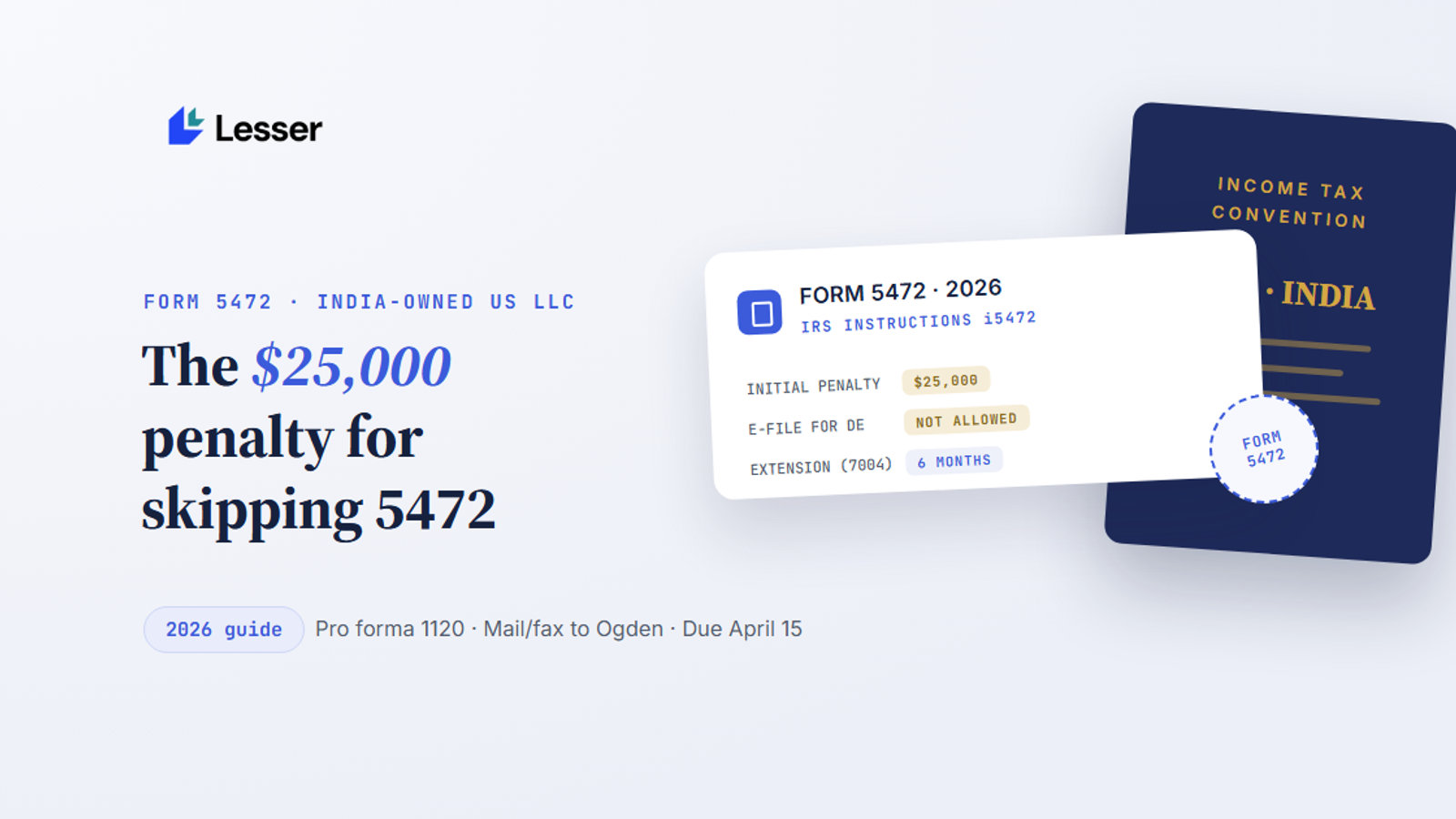
Quick answer: If you live in India and own a US single-member LLC, Form 5472 is almost certainly due every year, even if the LLC had no revenue. Form 5472 is an information return that reports money moving between a foreign-owned US entity and its related parties. The IRS treats your "disregarded" single-member LLC as a corporation for this one purpose, so you file a pro forma Form 1120 with Form 5472 attached, by mail or fax to Ogden, Utah, by April 15 (extendable to October 15 with Form 7004). The penalty for not filing, filing late, or filing a substantially incomplete form is $25,000.
Key takeaways
- A foreign-owned US disregarded entity is "treated as an entity separate from its owner and classified as a corporation for the limited purposes of the requirements under section 6038A" (IRS instructions).
- You file a pro forma Form 1120 with Form 5472 attached by the Form 1120 due date (including extensions) (IRS instructions).
- "If you are a foreign-owned U.S. DE, you cannot file Form 5472 electronically" — it goes to Ogden by mail or fax to 855-887-7737 (IRS instructions).
- Initial penalty: "$25,000 will be assessed on any reporting corporation that fails to file Form 5472 when due and in the manner prescribed" (IRS instructions).
- Form 7004 gets you an automatic 6-month extension, pushing the deadline from April 15 to October 15 for a calendar-year LLC (IRS about Form 7004).
Who exactly has to file Form 5472?
Form 5472 is used so the IRS can see money moving between a US entity and its foreign related parties. The IRS summarises it like this: "Corporations file Form 5472 to provide information required under sections 6038A and 6038C when reportable transactions occur with a foreign or domestic related party" (About Form 5472).
Two groups file it:
- A 25% foreign-owned US corporation.
- A foreign-owned US disregarded entity (DE). This is the one that catches founders in India. A single-member LLC is a disregarded entity by default, so a US LLC with one owner who sits in Bengaluru or Hyderabad falls here.
The instructions are explicit about the DE case: "a foreign-owned U.S. DE is treated as an entity separate from its owner and classified as a corporation for the limited purposes of the requirements under section 6038A" (IRS instructions). The entity itself has no US income tax return. The 5472 is bolted onto a pro forma 1120 purely as a reporting mechanism.
What is a "reportable transaction" for an India-based owner?
Most India-based founders file 5472 because they moved money between themselves and the LLC. The IRS describes a reportable transaction as "any type of transaction listed in Part IV (for example, sales, rents, etc.) for which monetary consideration (including U.S. and foreign currency) was the sole consideration paid or received" (IRS instructions).
Common items that are reportable transactions:
- The initial capital contribution you wired from your Indian account to open the LLC's US bank account.
- Any later owner draws or distributions back to you.
- Loans between you and the LLC in either direction.
- Services the LLC paid you for, or that you paid for on the LLC's behalf.
- Sales of inventory or software between you and the LLC.
The threshold is effectively zero. If your Form 5472 shows nothing but a $500 capital contribution for the year, you still file.
Do you really have to file with zero revenue?
Yes. The common misread is that "no business = no return." That is true for your personal US tax return if you have no US-source income, but not for 5472. The 5472 obligation is triggered by the structure (foreign-owned US DE) plus any reportable transaction with a related party, which the capital contribution alone usually creates.
The instructions treat the DE as a corporation specifically so this filing requirement exists. Skipping it because the LLC "didn't do anything" is the most common reason founders in India end up with a $25,000 notice.
How to file: the pro forma 1120 plus 5472
The filing is a two-part paper package.
Part 1: Pro forma Form 1120. You fill out only the top identifying strip. The instructions say: "The only information required to be completed on Form 1120 is the name and address of the foreign-owned U.S. DE and items B and E on the first page" (IRS instructions).
- Items B and E on page 1 are the employer identification number and date incorporated/organized.
- You write "Foreign-owned U.S. DE" across the top of Form 1120.
- The rest of the 1120 (income, deductions, tax) stays blank.
Part 2: Form 5472 itself. Standard fields: reporting corporation info (your LLC), 25% foreign shareholder info (you, in India), related party info (usually you again), and the reportable transactions in Part IV.
Both go in one envelope. The DE does not file a regular 1120, does not pay 1120 tax, and does not file 1120 Schedule K items. This is purely a reporting cover sheet so the 5472 has somewhere to live.
Where and how to send it
E-filing is not allowed for this filing. The instructions state: "If you are a foreign-owned U.S. DE, you cannot file Form 5472 electronically" (IRS instructions). You have two options.
| Method | Where it goes | Notes |
|---|---|---|
| Internal Revenue Service, 1973 Rulon White Blvd, M/S 6112 Attn: PIN Unit, Ogden, UT 84201 | Use a trackable courier from India (FedEx, DHL). The postmark date is the filing date. | |
| Fax | 855-887-7737 | "Fax (300 DPI or higher)" per the IRS. Keep the confirmation page. |
The mailing address above is the one the IRS publishes specifically for foreign-owned DEs filing Form 5472 (IRS instructions). Do not send it to the general 1120 service centre; the DE filing goes to this dedicated Ogden address.
If you want to see how this fits into the wider picture of what Lesser's CPAs file for Indian founders, the business filings page lists the US returns we handle for founders in India.
When is Form 5472 due in 2026?
Form 5472 attaches to the 1120, so it follows the 1120 due date. For Form 1120 the IRS rule is: "a corporation must file its income tax return by the 15th day of the 4th month after the end of its tax year" (IRS instructions, Form 1120).
For a calendar-year LLC, that is April 15 of the following year. For tax year 2025, Form 5472 plus the pro forma 1120 is due April 15, 2026. If the 15th lands on a weekend or holiday, the return is due the next business day.
You can extend with Form 7004, which gives "an automatic 6-month extension of time to file certain business income tax, information, and other returns" (IRS about Form 7004). The 6-month extension pushes a calendar-year LLC to October 15. The 7004 itself must be filed by the original due date.
The $25,000 penalty — what triggers it and how it grows
The penalty rule is written directly into the instructions. "A penalty of $25,000 will be assessed on any reporting corporation that fails to file Form 5472 when due and in the manner prescribed. The penalty also applies for failure to maintain records as required by Regulations section 1.6038A-3" (IRS instructions).
Three ways to trigger it:
- Not filing at all.
- Filing late (after the 1120 due date including extensions).
- Filing a substantially incomplete 5472 — missing related party information, missing reportable transactions, or missing records.
And it does not stop at $25,000 if the IRS notices and you do not respond: "If the failure continues for more than 90 days after notification by the IRS, an additional penalty of $25,000 will apply. This penalty applies with respect to each related party for which a failure occurs for each 30-day period (or part of a 30-day period) during which the failure continues after the 90-day period ends" (IRS instructions).
That is $25,000 every 30 days per related party, with no stated cap in the instructions. For a two-person founder LLC with the India founder and an India-based holdco as separate related parties, the continuing penalty runs on both.
What a reasonable-cause response looks like if you missed a year
The IRS does accept reasonable-cause abatement for 5472 penalties, but the bar is specific. The failure must be due to reasonable cause, you must have acted in good faith, and you need an affidavit explaining the facts. Being new to the US tax system is generally not sufficient on its own, but a clean prior history, the moment you discovered the obligation, and immediate corrective filing can be. This is judgment-dependent and we would not recommend you draft it yourself.
If you are already in a notice, the practical sequence is: file the missing 5472(s) with a reasonable-cause statement attached, keep every proof of mailing or fax confirmation, and respond to the notice inside the 90-day window to stop the continuing penalty clock.
How this fits with your other filings
The 5472 is a separate return from your personal US obligations. If you also have US tax residency, or you have other reporting touching India, keep each piece in its own lane:
- Your personal US return — the first-years NRI checklist covers residency, FBAR, 8938, DTAA, ITIN, and state.
- India income on a US return — reporting Indian accounts and NRE interest, with Foreign Tax Credit.
- FBAR and Form 8938 — the Indian accounts walkthrough.
- If you are the founder and holding equity — the RSU, ESPP/83(b), and QSBS for immigrant founders posts.
How Lesser handles this for India-based founders
For single-member LLCs owned by founders in India, Lesser files the pro forma 1120 and Form 5472 as a flat annual package. That means confirming your EIN, cataloguing every reportable transaction between you and the LLC for the year (including capital contributions and loans), preparing the 5472 and the pro forma 1120, and sending it by fax to the Ogden PIN Unit so there is a dated transmission record. If you want this handled, start on the Lesser business page.
FAQ
Does Form 5472 apply if I'm an F-1 or H-1B founder living in the US?
Not for a single-member LLC where you are personally the sole owner and a US resident for tax purposes. 5472 applies to foreign-owned US DEs. If you are a US tax resident, the LLC is not foreign-owned. The moment you move back to India and keep the LLC, you become the foreign owner, and the 5472 obligation starts for the year of the move for the reportable transactions after you ceased to be a US resident. Confirm with a CPA based on your specific residency dates.
I formed the LLC in Delaware but it has never done business. Do I still file?
Yes if there has been any reportable transaction, which usually includes the initial capital contribution to open the US bank account. The IRS does not have a de minimis exception for the foreign-owned DE 5472 obligation.
Can I file 5472 online through TurboTax or H&R Block?
No. The IRS instructions state: "If you are a foreign-owned U.S. DE, you cannot file Form 5472 electronically" (IRS instructions). It must be mailed to Ogden or faxed to 855-887-7737.
What if I missed Form 5472 for the last two years?
File each missing year on its own 5472 plus pro forma 1120, with a reasonable-cause statement attached. The $25,000 penalty is per form per year. Responding before an IRS notice issues gives you the strongest reasonable-cause position; waiting until a notice arrives starts the 90-day clock on continuing penalties.
Is the $25,000 penalty capped?
The initial failure-to-file penalty is a single $25,000 per return. But if the IRS issues a notice and you do not respond within 90 days, the continuing penalty is "$25,000 ... for each 30-day period (or part of a 30-day period) during which the failure continues after the 90-day period ends" (IRS instructions). The instructions do not state a maximum cap on the continuing penalty.
Do I need an EIN first?
Yes. The pro forma 1120 asks for the LLC's EIN in item E on page 1, which the instructions specifically require you to complete (IRS instructions). If the LLC does not have an EIN, apply with Form SS-4 before you can file 5472.
Does extending Form 1120 with Form 7004 also extend Form 5472?
Yes. Form 5472 is due with the 1120, and the instructions require filing it "by the due date (including extensions)" of the 1120 (IRS instructions). A valid 7004 pushes both to October 15 for a calendar-year LLC.