
Lesser Tax
14 min read
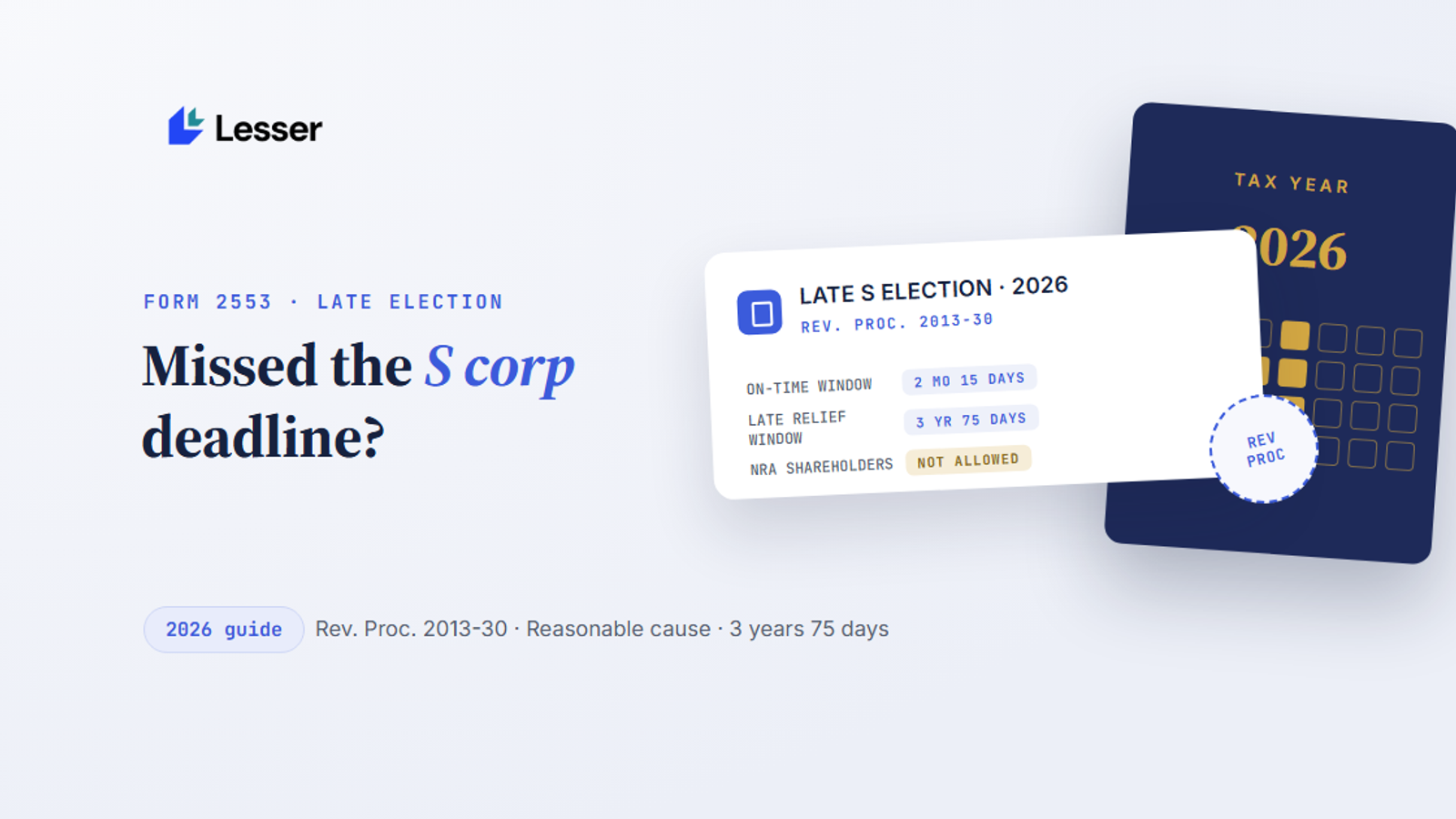
Quick answer: Form 2553 is the IRS form a corporation (or an LLC that wants to be taxed as a corporation) uses to elect S corporation status under section 1362(a). It must be filed no later than two months and 15 days after the start of the tax year the election is to take effect, per the Form 2553 instructions. If you miss that date, Rev. Proc. 2013-30 lets a corporation request relief by filing a late Form 2553 within three years and 75 days of the intended effective date, with "FILED PURSUANT TO REV. PROC. 2013-30" written across the top and a reasonable-cause statement attached. For Indian founders, the rule that trips most elections is the shareholder test: the corporation must have no nonresident alien shareholders, which excludes anyone who has not yet passed the Substantial Presence Test or who is not a green card holder.
Key takeaways
- Form 2553 is filed by "a corporation or other entity eligible to elect to be treated as a corporation ... to make an election under section 1362(a) to be an S corporation" (Instructions for Form 2553).
- The on-time filing window is "no later than 2 months and 15 days after the date entered for item E" (the intended effective date) (Instructions for Form 2553).
- To qualify as a small business corporation, the entity must have "no more than 100 shareholders" and "no nonresident alien shareholders (other than as potential current beneficiaries of an ESBT)" (Instructions for Form 2553).
- Late relief lives in Rev. Proc. 2013-30: the "Requesting Entity requests relief under this revenue procedure within 3 years and 75 days after the Effective Date" and must have "reasonable cause for its failure to make the timely Election Under Subchapter S and has acted diligently to correct the mistake upon its discovery."
- The late Form 2553 "must state at the top of the document 'FILED PURSUANT TO REV. PROC. 2013-30'" (Rev. Proc. 2013-30, § 4.03(1)).
- If more than three years and 75 days have passed but every return has been filed as if the election worked, Section 5.04 of Rev. Proc. 2013-30 drops the deadline — provided no IRS notice ever flagged the status.
- Once the S election is in effect, a shareholder who works in the business is an employee: payments for services "are considered wages," which is the reasonable-compensation rule (IRS: S corp employees, shareholders, officers).
What is Form 2553 and who files it?
Form 2553 is the single-page election a domestic corporation (or an LLC that will be taxed as a corporation) files to be treated as an S corporation for federal income tax. The IRS's own definition is explicit: Form 2553 is used by "a corporation or other entity eligible to elect to be treated as a corporation ... to make an election under section 1362(a) to be an S corporation" (Instructions for Form 2553). The practical effect: income, losses, deductions and credits "pass corporate income, losses, deductions, and credits through to their shareholders for federal tax purposes" (IRS: S corporations).
A single-member LLC that files Form 2553 is also deemed to have filed Form 8832 under the regulations, so a separate entity classification election is not required for most clean-start cases.
When is Form 2553 due?
Form 2553 is due "no later than 2 months and 15 days after the date entered for item E" of the form — item E is the intended effective date of the election (Instructions for Form 2553). For a calendar-year existing corporation that wants the election effective January 1, 2026, that puts the deadline at March 15, 2026. For a brand-new corporation, the 2-month-and-15-day window runs from the first day of the first tax year, which is the earlier of the day the corporation first had shareholders, acquired assets or began doing business (Instructions for Form 2553).
The instructions give a worked example: "A calendar year small business corporation begins its first tax year on January 7. The 2-month period ends March 6 and 15 days after that is March 21. To be an S corporation beginning with its first tax year, the corporation must file Form 2553 during the period that begins January 7 and ends March 21" (Instructions for Form 2553).
An election filed after the window but on or before the 15th day of the third month of the following tax year is treated as made for the following tax year, under section 1362(b)(3) (Rev. Proc. 2013-30 § 2.01) — the election is still valid, it just slips one year.
Who qualifies as an S corporation?
The IRS lists the tests on the Form 2553 instructions. The entity must:
- Be a domestic corporation or a domestic entity eligible to elect corporation treatment;
- Have no more than 100 shareholders (spouses, and in some cases family members, count as one shareholder);
- Have only "allowable shareholders" — individuals, estates, certain exempt organizations, or certain trusts; "may not be partnerships, corporations or non-resident alien shareholders" (IRS: S corporations);
- Have "no nonresident alien shareholders (other than as potential current beneficiaries of an ESBT)" (Instructions for Form 2553);
- Have one class of stock;
- Not be an "ineligible corporation" (certain banks, insurance companies, and other listed types).
For Indian founders, the shareholder test is the trap. A green card holder is a resident alien and is eligible. An H-1B holder who has met the Substantial Presence Test for the tax year is a resident alien and is eligible — but someone in their first year on H-1B, or on F-1/OPT (which has the student exemption from counting days), is often still a nonresident alien, which breaks the election.
| Shareholder situation | Treated as | Allowed to hold S corp stock? |
|---|---|---|
| US citizen | Citizen | Yes |
| Green card holder (LPR) | Resident alien | Yes |
| H-1B holder who meets SPT for the tax year | Resident alien | Yes |
| H-1B holder in arrival year who does not meet SPT | Nonresident alien | No |
| F-1/OPT, student exemption still applies | Nonresident alien (for tax purposes) | No |
| Indian parent back in India | Nonresident alien | No |
The simple test is tax residency for the full S corp tax year. An H-1B founder who incorporates in year one and hasn't passed SPT yet should delay the election until the first full year of residency.
How do you fill out Form 2553?
The form has four parts. Most clean S elections only need Part I. Across the top goes the corporation's name, EIN and address. The key line entries (Instructions for Form 2553):
- Item E — effective date of the election. For an existing corporation, this is the first day of the tax year the election is to apply. For a new corporation, it is the first day of its first tax year.
- Item F — selected tax year (usually a calendar year).
- Item I — explanation of reasonable cause (only needed if filing late under Rev. Proc. 2013-30).
- Column J-N — every shareholder's name, address, Taxpayer Identification Number, number of shares, acquisition date, and signed consent.
Every shareholder as of the effective date (and anyone who held stock between that date and the filing date) must consent on the form. Signatures are not optional: "If Form 2553 isn't signed, it won't be considered timely filed" (Instructions for Form 2553).
Submit by mail or fax to the IRS service center listed in the instructions for your state. "An acceptable proof of filing is: Form 2553 with an accepted stamp; Form 2553 with a stamped IRS received date; or an IRS letter stating that Form 2553 has been accepted" (Instructions for Form 2553). Keep that acknowledgment — it is the only thing that proves the election if the IRS later issues a notice treating the entity as a C corporation.
What is the relief for a late Form 2553 under Rev. Proc. 2013-30?
Rev. Proc. 2013-30 is the simplified route the IRS created so that late S elections do not require a private letter ruling and user fee for routine cases. The procedure "provides the exclusive simplified methods for taxpayers to request relief for late S corporation elections ... which the taxpayer intended to take effect on the same date that the taxpayer intended that an S corporation election for the entity should take effect" (Rev. Proc. 2013-30 § 1).
General requirements for relief, from Section 4.02:
- The entity intended to be classified as an S corporation as of the effective date.
- "The Requesting Entity requests relief under this revenue procedure within 3 years and 75 days after the Effective Date" (Rev. Proc. 2013-30 § 4.02(2)).
- The failure to qualify was solely because Form 2553 was not timely filed.
- "The Requesting Entity has reasonable cause for its failure to make the timely Election Under Subchapter S and has acted diligently to correct the mistake upon its discovery" (Rev. Proc. 2013-30 § 4.02(4)).
Procedurally (Section 4.03), the late Form 2553 must:
- Be marked at the top "FILED PURSUANT TO REV. PROC. 2013-30";
- Include a "Reasonable Cause/Inadvertence Statement" signed under penalties of perjury describing the reasonable cause and the diligent actions taken on discovery;
- Include statements from every shareholder between the intended effective date and the filing date that they have reported their income consistent with S corp status.
You can file the late Form 2553 three ways under Section 4.03(2):
- Attach it to the current year's Form 1120-S (if all prior Forms 1120-S have been filed);
- Attach it to a late-filed prior-year Form 1120-S (if the delinquent returns are filed simultaneously);
- File it independently, directly with the IRS service center, within three years and 75 days.
If the Form 2553 is attached to a Form 1120-S, that 1120-S also needs "INCLUDES LATE ELECTION(S) FILED PURSUANT TO REV. PROC. 2013-30" across the top (Rev. Proc. 2013-30 § 4.03(2)(a)).
What counts as reasonable cause?
Rev. Proc. 2013-30 does not list exclusive examples, but the Form 2553 instructions and IRC §301.9100-3 together define the operating standard: the taxpayer must show it "acted reasonably and in good faith" and that granting relief "will not prejudice the interests of the Government" (Rev. Proc. 2013-30 § 2.03). The regulation also recognizes that a taxpayer is deemed to have acted reasonably and in good faith if the taxpayer "reasonably relied on a qualified tax professional (including a tax professional employed by the taxpayer), and the tax professional failed to make, or advise the taxpayer to make, the election" (Rev. Proc. 2013-30 § 2.03, citing Reg. §301.9100-3(b)(1)(v)).
Reasonable-cause statements that typically succeed are specific and factual: the dates the attorney or CPA was engaged, the instruction given, the point at which the oversight was discovered, and the steps taken immediately to correct it. Vague statements along the lines of "we did not know we had to file" tend to invite follow-up.
Section 5.04: the "we've been filing as an S corp all along" exception
Rev. Proc. 2013-30 has a quiet escape hatch for the common situation where the business and all its shareholders have reported income as if the S election were in place, year after year, but no Form 2553 was ever filed or accepted. Section 5.04 waives the three-year-and-75-day deadline if all of these are true:
- The corporation is not also seeking a late entity classification election.
- The corporation fails to qualify as an S corporation solely because Form 2553 was not timely filed.
- The corporation and all of its shareholders "reported their income consistent with S corporation status for the year the S corporation election should have been made, and for every subsequent taxable year (if any)" (Rev. Proc. 2013-30 § 5.04(3)).
- At least six months have elapsed since the first Form 1120-S was filed.
- Neither the corporation nor any shareholder was notified by the IRS of any problem with S status within six months of filing that first 1120-S.
- The usual shareholder consent statements are attached.
This is the practical route when a founder discovers in year five that the attorney never actually filed Form 2553, but the business has consistently filed Form 1120-S and the shareholders' 1040s match.
What if 2013-30 relief does not apply?
If the three-year-and-75-day window has passed and Section 5.04 does not apply (for example, the entity filed Forms 1120 as a C corporation in some of those years), the only remaining route is a private letter ruling under §301.9100-3. The Form 2553 instructions put it plainly: "To request relief for a late election when the above requirements aren't met, the corporation generally must request a private letter ruling and pay a user fee in accordance with Rev. Proc. 2021-1, 2021-1 I.R.B. 1 (or its successor)" (Instructions for Form 2553). PLR user fees run several thousand dollars, so the economics only work when the back years saved outweigh the fee and professional cost.
Does an H-1B founder's S election survive the first year?
This is the hardest point in the whole guide. The Form 2553 shareholder test is tested on the effective date and continuously thereafter. If an H-1B holder is still a nonresident alien on the intended effective date — most commonly their arrival year, when they don't yet meet the Substantial Presence Test — the entity simply does not qualify, and no amount of 2013-30 relief fixes that. The election is only available once every shareholder is either a citizen, a green card holder, or a resident alien.
Two practical patterns we see at Lesser:
- Delay the election. If the arrival year is the problem, hold the LLC as a default disregarded entity for year one and file Form 2553 (effective January 1 of year two) only once the founder expects to pass SPT for the full year.
- Elect to be treated as a resident. Where the founder's spouse is a US citizen or green card holder, a §6013(g) election to be treated as a resident for the full year can qualify an otherwise-nonresident shareholder, but it drags worldwide income into the US return and is almost always more expensive than waiting a year.
There is no path that lets an H-1B founder who is still a nonresident alien hold S corp stock during that tax year.
FAQ
Can an LLC file Form 2553 without first filing Form 8832?
Yes, in most cases. The Form 2553 instructions state that "an entity eligible to elect to be treated as a corporation that meets certain tests discussed below will be treated as a corporation as of the effective date of the S corporation election and doesn't need to file Form 8832" (Instructions for Form 2553). The S election is treated as including the deemed entity classification election.
How many late years can Rev. Proc. 2013-30 cover?
Up to three years and 75 days from the intended effective date in the normal case. Section 5.04 of Rev. Proc. 2013-30 removes that deadline where every year has been filed consistently as an S corp and the IRS never flagged the status.
Can a single-member LLC with one H-1B owner elect S corp?
Only if the owner is a resident alien for the entire S corp tax year (passed the Substantial Presence Test, or made a valid §6013(g)/§6013(h) election). Form 2553 instructions require "no nonresident alien shareholders."
What's the user fee for a late Form 2553 under Rev. Proc. 2013-30?
None. Rev. Proc. 2013-30 relief does not require a private letter ruling or user fee; that is the point of the simplified procedure. A PLR under §301.9100-3 does carry a fee set each year by Rev. Proc. 2024-1 (or its successor).
What is "reasonable compensation" for the S corp owner?
Once the S election is effective, "when corporate officers perform a service for the corporation and receive or are entitled to payments, those payments are considered wages" (IRS: S corp employees, shareholders, officers). The IRS and the courts have held that a shareholder-employee cannot avoid payroll tax by taking only distributions; wages must be paid for services rendered before distributions. The "reasonable" amount is a facts-and-circumstances test benchmarked to what the business would pay an unrelated employee for similar work.
Does an S election change the state tax picture?
Not automatically. Some states (New York, New Jersey, California, among others) require a separate state-level S election; others ignore federal S status and tax the entity as a C corporation. Confirm the state election form with your state tax agency before relying on federal S treatment to shelter state income tax.
Can the Form 2553 effective date be more than two months and 15 days before the filing date?
Only if you qualify for Rev. Proc. 2013-30 or Section 5.04 relief. The on-time rule in section 1362(b)(1) only accepts an election "at any time during the preceding taxable year ... or ... on or before the 15th day of the 3rd month of the taxable year" (Rev. Proc. 2013-30 § 2.01(1)).