
Lesser Tax
14 min read
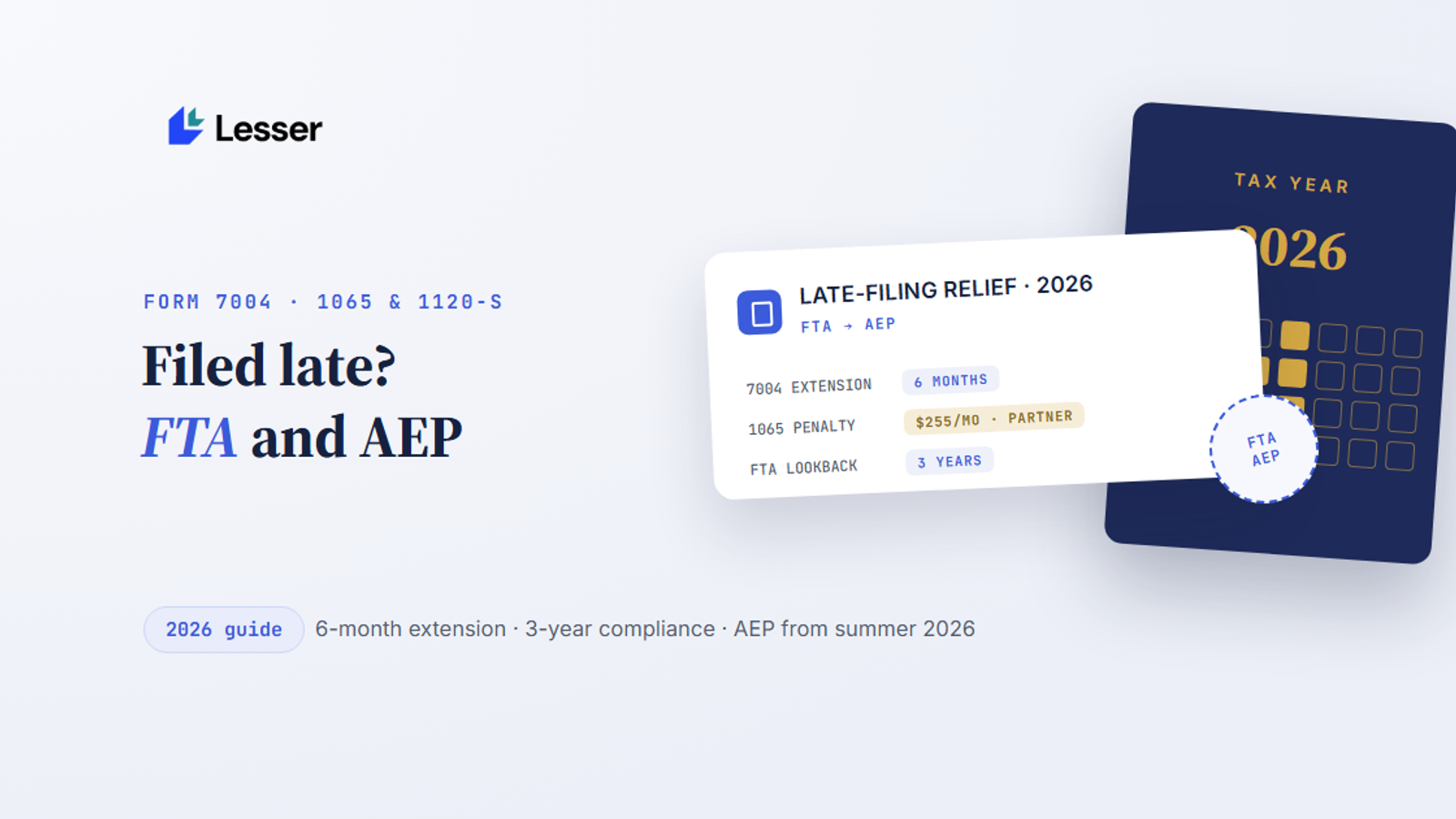
Quick answer: Form 7004 is the IRS form a partnership (Form 1065) or S corporation (Form 1120-S) uses to request an automatic six-month extension of time to file. The IRS: "Use Form 7004 to request an automatic extension of time to file certain business income tax, information, and other returns ... The automatic extension period for time to file is generally 6 months." A properly filed Form 7004, submitted by the original due date, is granted automatically; the IRS no longer sends an approval notice. The extension does not extend the time to pay. If you missed the deadline and never filed Form 7004, First Time Abate (FTA) still applies in the 2026 calendar year — and the IRS is transitioning FTA into a new Automatic Exemption from Penalty (AEP) procedure starting Summer 2026, under which eligible partnership and S corp returns that are late get the penalty removed automatically if the entity has three prior years of timely compliance.
Key takeaways
- Form 7004 gives "an automatic extension of time to file certain business income tax, information, and other returns" (Instructions for Form 7004). The automatic extension is "generally 6 months."
- The extension is only granted if you (a) complete Form 7004 properly, (b) make a proper estimate of any tax due (not applicable to pass-through 1065/1120-S returns), and (c) file Form 7004 "by the due date of the return for which the extension is requested" (Instructions for Form 7004).
- Due dates for calendar-year returns: Form 1065 is due March 15; Form 1120-S is due March 15. Form 7004 filed by March 15 extends to September 15. (From the Form 1065 and Form 1120-S instructions: 15th day of the 3rd month after the end of the tax year.)
- "The IRS will no longer send a notification that your extension has been approved. We will notify you only if your request for an extension is disallowed" (Instructions for Form 7004).
- Form 7004 does not extend time to pay. From the instructions: "Form 7004 does not extend the time to pay any tax due."
- Late-filing penalty for a Form 1065: "$255 for each month or part of a month (for a maximum of 12 months) the failure continues, multiplied by the total number of persons who were partners in the partnership during any part of the partnership's tax year" (Instructions for Form 1065) — IRC §6698(a)(1).
- Late-filing penalty for a Form 1120-S: same structure under IRC §6699(a)(1), based on the number of shareholders. Both pass-through penalties are eligible for FTA and the new AEP.
- First Time Abate (FTA): the IRS removes the eligible penalty if the entity has three prior years of timely compliance. "FTA has been the most common administrative relief for individuals and businesses with a history of timely compliance" (IRS: Administrative penalty relief).
- Automatic Exemption from Penalty (AEP) begins Summer 2026 and applies "to 2025 tax year and 2026 quarterly returns, and all future tax years/quarters." AEP is automatic (no taxpayer action required) where FTA was not.
What is Form 7004?
Form 7004, "Application for Automatic Extension of Time To File Certain Business Income Tax, Information, and Other Returns," is the single form the IRS uses to grant an automatic extension to a long list of entity returns. For Indian founders, the two that matter are Form 1065 (US partnership return, for multi-member LLCs that have not elected corporation treatment and for actual partnerships) and Form 1120-S (US S corporation return, after a valid Form 2553 election).
The IRS wording is specific: "Use Form 7004 to request an automatic extension of time to file certain business income tax, information, and other returns. The extension will be granted if you complete Form 7004 properly, make a proper estimate of the tax (if applicable), file Form 7004 by the due date of the return for which the extension is requested, and pay any tax that is due" (Instructions for Form 7004).
Two practical consequences:
- You do not get a confirmation. The IRS "will no longer send a notification that your extension has been approved. We will notify you only if your request for an extension is disallowed" (Instructions for Form 7004). Keep your e-file acknowledgement from the software (or your certified-mail receipt if you paper-filed) — that is the proof of timely filing.
- You must file a separate Form 7004 for each return. "File a separate Form 7004 for each return for which you are requesting an extension of time to file" (Instructions for Form 7004).
When is Form 7004 due for a 1065 or 1120-S?
The due date for a calendar-year Form 1065 and Form 1120-S is March 15 (the 15th day of the third month after the end of the tax year). For fiscal-year returns, substitute the 15th day of the third month after the entity's year-end.
Form 7004 must be filed by that same original due date. A timely Form 7004 grants a six-month extension: for calendar-year 1065 and 1120-S filers, the extended due date is September 15.
The IRS confirms the automatic 6-month default: "The automatic extension period for time to file is generally 6 months. Exceptions apply for certain filers of Form 1041 and for C corporations with tax years ending June 30" (Instructions for Form 7004).
| Return | Entity | Original due date (calendar year) | 7004 extended due date |
|---|---|---|---|
| Form 1065 | US partnership / multi-member LLC default | March 15 | September 15 |
| Form 1120-S | S corporation (post-2553) | March 15 | September 15 |
| Form 1120 | C corporation | April 15 | October 15 |
Does Form 7004 extend the time to pay?
No. The Form 7004 instructions are explicit: "Form 7004 does not extend the time to pay any tax due" (Instructions for Form 7004). For a partnership or an S corp this often doesn't bite — pass-through entities do not pay federal income tax at the entity level — but withholding tax under section 1446 (effectively connected income allocable to foreign partners) and the entity-level tax that some states charge are still due by the original due date.
For a C corporation using Form 7004, the entity's 21% federal tax is due by April 15 even if the return is extended to October 15; the extension covers only the return, not the balance.
How is Form 7004 filed?
E-file is the default. From the instructions: "Form 7004 can be filed electronically for most returns" (Instructions for Form 7004). The common tax software packages (ProConnect, Drake, UltraTax, TaxDome, TurboTax Business) submit it directly.
Paper filing is allowed to the IRS service center listed in the Form 7004 instructions, but note the IRS caution: "If you file Form 7004 on paper and file your tax return electronically, your return may be processed before the extension is granted. This may result in a penalty notice" (Instructions for Form 7004).
Line-by-line, the form asks for:
- The entity's name, address and EIN.
- Line 1 — the form code for the return being extended (code 12 for Form 1120-S, code 09 for Form 1065).
- Line 2 — box only if the filer is a foreign corporation without a US office or place of business.
- Line 4 — box only if a foreign/certain-domestic corporation or certain partnership with books outside the US (gets an extra extension).
- Lines 6-8 — tentative total tax, total payments, balance due. For a pass-through 1065/1120-S these are typically zero.
What is the late-filing penalty if you missed the deadline?
Separate penalties apply to pass-through returns and to C corporation returns. For partnerships and S corps, the penalty is per-partner (or per-shareholder) per month, up to twelve months, regardless of whether the entity owes tax.
Partnership (Form 1065), IRC §6698(a)(1), from the IRS Form 1065 instructions: "The penalty is $255 for each month or part of a month (for a maximum of 12 months) the failure continues, multiplied by the total number of persons who were partners in the partnership during any part of the partnership's tax year for which the return is due" (Instructions for Form 1065).
S corporation (Form 1120-S), IRC §6699(a)(1), has the same structure: $255 per month (adjusted annually) per shareholder, up to 12 months.
A four-partner LLP that files its 1065 three months late is looking at $255 × 3 × 4 = $3,060, before any K-1 penalties ($340 per K-1 for failure to furnish on time, from the Form 1065 instructions). These add up fast on partnerships with many partners.
What is First Time Abate, and does it apply to pass-through penalties?
First Time Abate is an IRS administrative waiver. The IRS: "FTA has been the most common administrative relief for individuals and businesses with a history of timely compliance" (IRS: Administrative penalty relief).
The penalties FTA covers include, specifically for pass-through entities:
- "Partnership returns – IRC 6698(a)(1)" (IRS: Administrative penalty relief) — the Form 1065 late-filing penalty.
- "S corporation returns – IRC 6699(a)(1)" (IRS: Administrative penalty relief) — the Form 1120-S late-filing penalty.
- Failure to pay (6651(a)(2) and (a)(3)).
- Failure to deposit (6656).
To qualify, the taxpayer must have a timely compliance history. The IRS: "The same return type, as the original return, was timely filed for the prior three years (or 12 consecutive quarters), and either no penalty (except the estimated tax penalty) was assessed or a penalty was assessed, but later abated for reasonable cause or IRS error" (IRS: Administrative penalty relief).
For businesses, two extra conditions: "The IRS did not waive the failure to deposit penalty four or more times during the prior three years ... and The failure to deposit penalty was not charged for Electronic Federal Tax Payment System (EFTPS) avoidance" (IRS: Administrative penalty relief).
FTA is not automatic. The IRS: "Though taxpayers must contact the IRS to request this relief, you don't need to specify FTA as the relief sought or provide supporting documents in your request for relief." The practical path is a phone call to the number on the penalty notice, or filing Form 843 (Claim for Refund and Request for Abatement) to the address in the Form 843 instructions.
What is AEP, and how is it different from FTA?
Automatic Exemption from Penalty is the IRS's replacement for FTA for most eligible returns. The IRS: "AEP begins summer 2026. Under AEP, if you file or pay late in the current year but have timely filed returns and paid tax due for the three prior years (or 12 consecutive quarters for quarterly filers), you won't be assessed a penalty" (IRS: Administrative penalty relief).
Which returns are eligible: "The following return series are eligible for AEP consideration: Forms 1040, 1065, 1120 / Forms 940, 941, 943, 944, 945 / Form CT-1" (IRS: Administrative penalty relief). Form 1120-S is covered through the 1120 series.
What changes:
- Automatic vs. request. FTA requires contacting the IRS; AEP is applied when the return finishes processing, with no taxpayer action.
- No assessment first. Under FTA, the penalty was assessed and then removed. Under AEP, "No penalty assessment is made" in the first place (IRS: Administrative penalty relief).
- Failure-to-pay penalty. FTA pauses the FTP penalty; AEP goes further: "Does not accrue and is not assessed on unpaid tax" (IRS: Administrative penalty relief).
| Feature | First Time Abate (FTA) | Automatic Exemption from Penalty (AEP) |
|---|---|---|
| Starting point | Current — applies to all prior years and 2025 tax year | Starting Summer 2026, for 2025 tax year and 2026 quarterly returns, and all future periods |
| How granted | Not automatic — taxpayer must request | Automatic — applied when return processes |
| Penalty assessment | Assessed first, then removed | Never assessed |
| Failure-to-Pay penalty | May continue to accrue until tax is paid | Does not accrue, not assessed |
| Taxpayer action | Call the IRS or file Form 843 | None |
The practical rule in late 2026: for 2025 tax year 1065 and 1120-S returns filed late in or after Summer 2026, the IRS applies AEP automatically if the entity qualifies. For earlier years or returns that fall outside AEP, FTA still works.
Who does not qualify?
The IRS lists the exclusions. Not eligible for FTA or AEP:
- "Returns filed once or infrequently (i.e., event-based filing requirements)" (IRS: Administrative penalty relief) — for example, a final return of a terminated entity if the entity does not have the three-year history.
- "The Daily Delinquency Penalty (DDP)" — for example, late Form 8955-SSA for benefit plans.
- "Information reporting dependent on another filing" — for example, Schedule K-1 penalties when the Form 1065 itself is also late.
Compliance history is a hard gate. A newly formed partnership whose first-ever Form 1065 is late does not have three prior years of timely compliance — the IRS has nothing to compare against — and most IRS examiners read the rule to disqualify in that situation. The reasonable-cause path remains.
What if I don't qualify for FTA or AEP?
The IRS: "If you don't qualify for the relief, you may request penalty relief based on reasonable cause" (IRS: Administrative penalty relief). Reasonable cause requires a specific, documented explanation of what prevented timely filing (illness, death, natural disaster, inability to obtain records, specific advice from a tax professional) and what the taxpayer did to correct the problem. Vague explanations typically fail.
For small partnerships of 10 or fewer partners, there is a separate route under Rev. Proc. 84-35 — the IRS has historically accepted a reasonable-cause claim where the partnership is a "small partnership" and each partner reported their share of income on a timely individual return. That procedure is still available in 2026, independently of FTA/AEP.
FAQ
Can a late Form 7004 extend my return?
No. Form 7004 "must be filed on or before the due date of the applicable tax return" (Instructions for Form 7004). A Form 7004 filed after the original due date does not grant the extension, and the return is treated as late from the original due date.
Does Form 7004 extend state partnership or S corp returns?
Not always. California, New York, New Jersey, Texas and many other states have separate extension forms (or honor the federal extension only if certain state requirements are met). Check the state tax agency's website — the federal Form 7004 alone is not enough in most states.
Can I get FTA on a Form 1065 K-1 penalty?
No. The IRS lists "Information reporting dependent on another filing" as not eligible, and K-1 failure-to-furnish penalties under §6698(b) are tied to the Form 1065 filing. If the underlying 1065 penalty is abated under FTA, the IRS will typically abate the related K-1 penalties as a matter of practice — but as a separate request, not automatically.
What is Form 843 and when do I use it?
Form 843, "Claim for Refund and Request for Abatement," is the paper form used to request abatement of certain penalties and interest after an assessment. The IRS specifically names it as one of the two ways to request FTA (IRS: Administrative penalty relief): "Send a written statement or Form 843, Claim for Refund and Request for Abatement, to the address specified in the Form 843 instructions."
Does AEP work for a 2024 or earlier Form 1065 that was filed late?
No. AEP "Applies to 2025 tax year and 2026 quarterly returns, and all future tax years/quarters" (IRS: Administrative penalty relief). For a late 2024 Form 1065, FTA remains the route in 2026.
Can an Indian-owner US LLC use Form 7004?
Yes. The entity's residency does not change the extension rules. If the US LLC is a multi-member LLC filing Form 1065, Form 7004 code 09 extends the 1065 by six months. If it has elected S corp status (and all shareholders are US-resident), Form 7004 code 12 extends the 1120-S by six months. If it has elected C corp status, Form 7004 code 12 extends the 1120 by six months.
Is interest also removed under FTA or AEP?
No, interest is not removed on its own. "The IRS assesses interest on penalties ... However, we'll automatically reduce or remove the interest related to a penalty if any of your penalties are reduced or removed" (IRS: Administrative penalty relief). So interest tied to an abated penalty goes away; interest on an underlying tax balance does not.