
Lesser Tax
7 min read
Quick answer: Four things come out of your US paycheck before you see it. Federal income tax withholding is set by your Form W-4 and the 2026 brackets (10% to 37%). FICA is Social Security at 6.2% up to the 2026 wage base of $184,500 and Medicare at 1.45% with no cap (plus 0.9% once your wages pass $200,000). State income tax varies by state of work. Paycheck withholding is pay-as-you-go: a prepayment, settled on your Form 1040 in April.
Key takeaways
- Federal income tax withholding is a prepayment set by your W-4; the real tax is calculated on your 1040 (IRS: Tax withholding).
- 2026 Social Security tax is 6.2% of wages up to a wage base of $184,500; Medicare is 1.45% with no cap (IRS Topic 751).
- An Additional Medicare Tax of 0.9% is withheld on wages over $200,000 in a calendar year (IRS Topic 751).
- F-1 and J-1 students in nonresident status for their first 5 calendar years are generally exempt from FICA; H-1B and L-1 holders are not (IRS: Foreign student FICA).
- State income tax varies by state of work, not visa; some states have no wage income tax.
Want an expert to handle this? Get your NRI taxes done right
Paycheck taxes explained: why is my US paycheck so much smaller than my offer letter?
Because your offer letter is gross and your paycheck is net. Taxes come out before money hits your account. The IRS calls this pay-as-you-go: "The federal income tax is a pay-as-you-go tax. You pay the tax as you earn or receive income during the year" (IRS: Tax withholding).
Four withholdings usually appear on an H-1B or L-1 pay stub:
- Federal income tax — a prepayment toward your Form 1040 tax, set by what you put on your Form W-4.
- Social Security tax (FICA) — 6.2% of wages up to the annual wage base.
- Medicare tax (FICA) — 1.45% of all wages, plus 0.9% on wages over $200,000.
- State income tax — set by the state where you work. Some states have none; others take over 10% at the top.
Local city taxes (where a city has one) and benefits deductions (health insurance, 401(k), HSA) also come out, but those are not US taxes — they are either local tax or your own money going into your own account.
What is federal income tax withholding and how is it calculated?
Federal withholding is an estimate of what you will owe on your 2026 Form 1040, taken out across the year. The IRS: "If you're an employee, your employer probably withholds income tax from your paycheck and pays it to the IRS in your name" (IRS: Tax withholding). Your employer uses the Form W-4 you filled out plus IRS tables. The 2026 single-filer brackets (Rev. Proc. 2025-32):
| Taxable income (single, 2026) | Marginal rate |
|---|---|
| Up to $12,400 | 10% |
| $12,400 - $50,400 | 12% |
| $50,400 - $105,700 | 22% |
| $105,700 - $201,775 | 24% |
| $201,775 - $256,225 | 32% |
| $256,225 - $640,600 | 35% |
| Over $640,600 | 37% |
The 2026 standard deduction for a single filer is $16,100 (Rev. Proc. 2025-32, §3.17), which reduces your taxable income before the brackets apply.
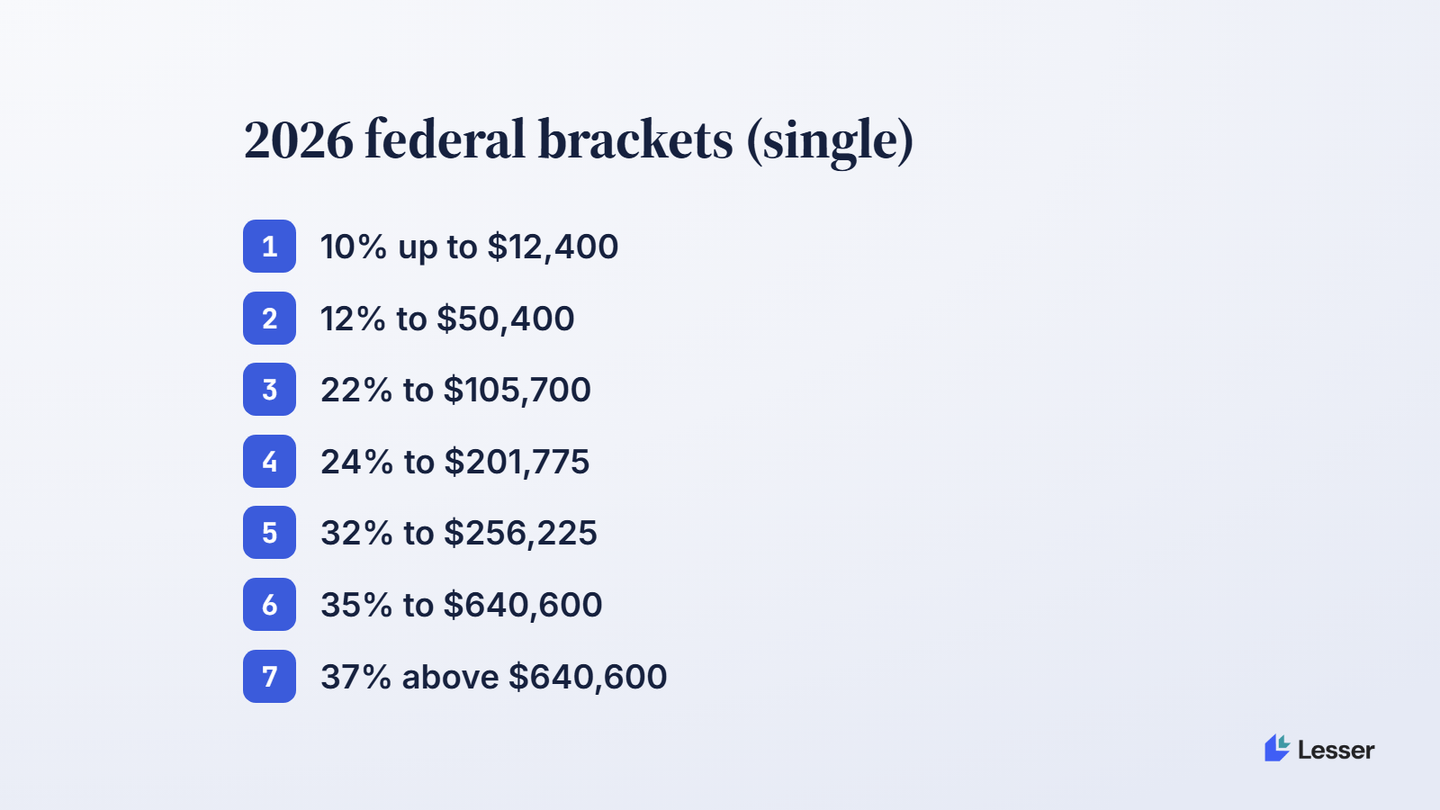
On $140,000 of gross wages with no other adjustments, taxable income is $140,000 - $16,100 = $123,900. Only the slice over $105,700 is taxed at 24%; the slice from $50,400 to $105,700 is taxed at 22%. Your marginal rate is 24%; your average rate is lower.
What is FICA and why is Social Security capped but Medicare is not?
FICA funds Social Security and Medicare. The IRS 2026 rates: "6.2% for the employer and 6.2% for the employee, or 12.4% total" for Social Security and "1.45% for the employer and 1.45% for the employee, or 2.9% total" for Medicare (IRS Topic 751). Only the employee half comes out of your paycheck.
Social Security has a wage base: "For earnings in 2026, this base limit is $184,500" (same source). Once your YTD wages at one employer cross $184,500, Social Security stops for the rest of the year. Medicare has no cap; an Additional Medicare Tax of 0.9% is withheld "on an individual's wages paid in excess of $200,000 in a calendar year" (same source).
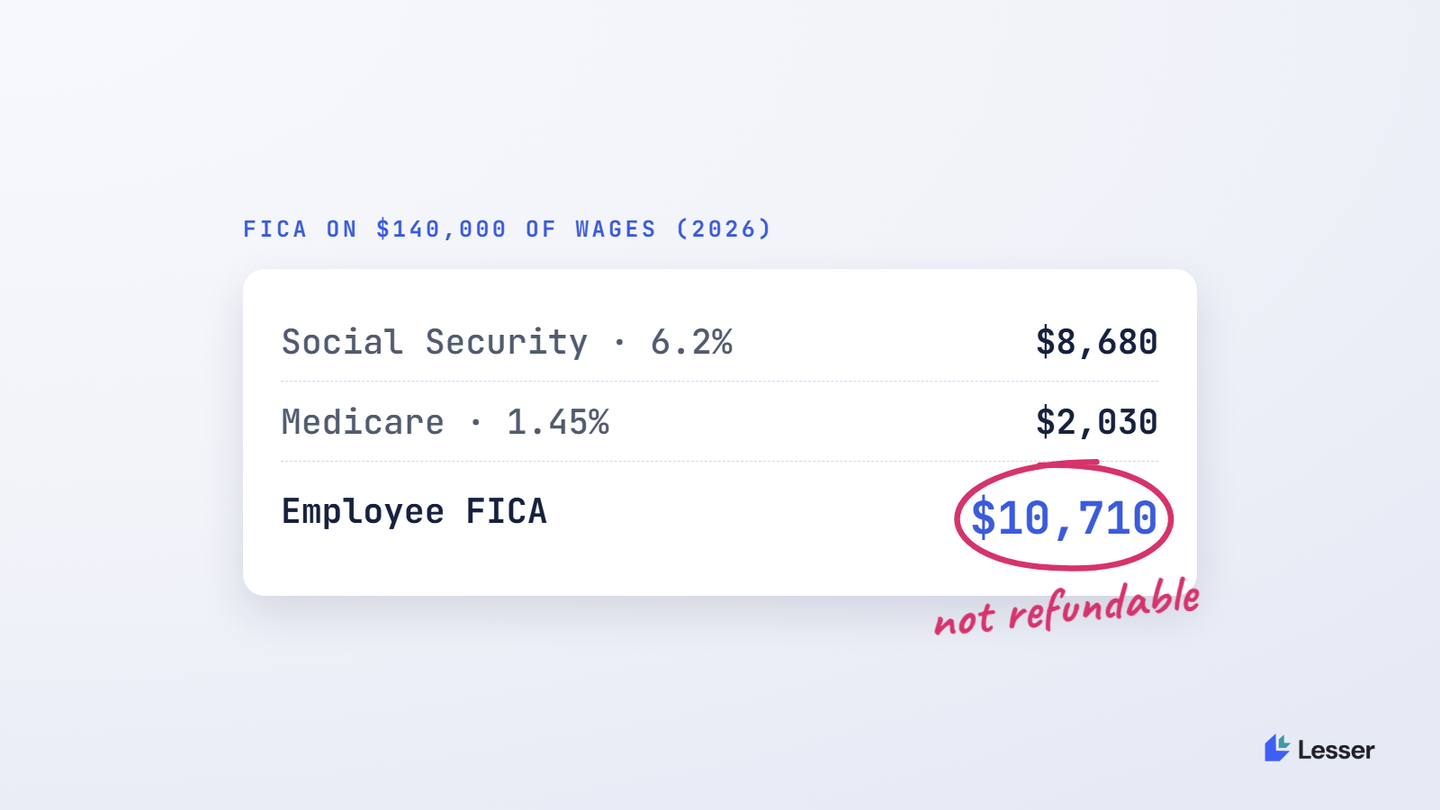
On $140,000: Social Security 6.2% × $140,000 = $8,680; Medicare 1.45% × $140,000 = $2,030; Additional Medicare $0 (under $200,000). Employee FICA total: $10,710. FICA is not refunded on your Form 1040.
Are F-1, OPT, H-1B and L-1 holders all treated the same for FICA?
No. F-1, J-1, M-1 and Q-1 students and scholars in nonresident alien status are generally exempt. The IRS: "Foreign students temporarily present in the U.S. in F-1, J-1, or M-1 status for less than 5 calendar years are generally nonresident aliens" and are "exempt from Social Security Tax and Medicare Tax on wages" (IRS: Foreign student FICA). After 5 calendar years they "become resident aliens for U.S. tax purpose" and are "liable for Social Security and Medicare taxes" (same source). H-1B and L-1 are not on the exemption list; FICA is withheld from day one.
| Visa status | Social Security + Medicare on wages |
|---|---|
| F-1 / OPT, first 5 calendar years (nonresident) | Exempt |
| F-1 / OPT, after 5 calendar years (resident) | Withheld |
| H-1B | Withheld from day one |
| L-1 | Withheld from day one |
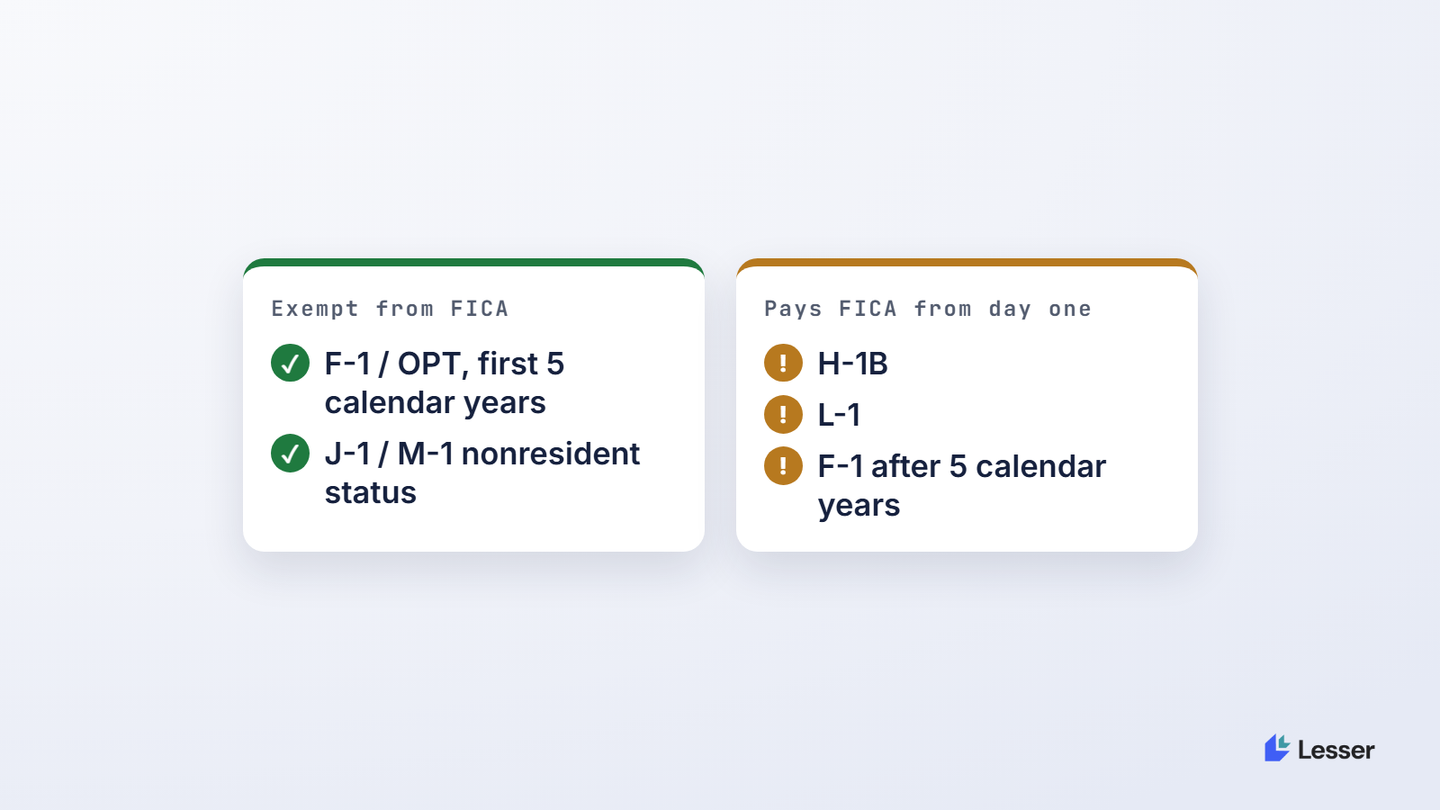
If you moved from F-1 OPT to H-1B mid-year, your stub should start showing FICA from the day H-1B starts; earlier OPT wages were correctly FICA-exempt.
How much state income tax comes out of my paycheck?
That depends on the state where you work, not your home state and not your visa. Some states have no wage income tax; others have a progressive bracket schedule with a top rate above 9%. Check the state revenue department's current bracket schedule for the number that applies to you.
Two situations trip up new H-1B workers:
- You work in a different state than you live. Some states tax income earned there even if you live elsewhere; your home state then usually gives a credit so you are not taxed twice. Expect two state lines on your stub and both a resident and non-resident state return in April.
- You moved mid-year. Wages you earned in the old state are still taxed there; the new state picks up from your move date. Payroll should switch the state code when you update your address.
Where a city has its own income tax, that is separate from state tax; look it up on the city's own revenue page.
What does this mean for your taxes?
Payroll withholding is a prepayment. Your real tax for the year is calculated on your Form 1040, due 15 April the following year. If your employer withheld too much, you get a refund; too little, and you owe plus possibly an underpayment penalty.
For Indians on H-1B, L-1 or F-1 OPT, three things decide whether withholding roughly matches your real tax: your W-4 was set up correctly, you were on the right FICA treatment for your visa, and India income (NRE interest, FDs, rent, equity) was handled on the US return. See the NRI tax checklist for the first-year list and NRI India income on a US tax return for how the India side gets reported in April. If your 1040 shows a big refund or a big balance due, the fix is to redo the W-4 with your employer, not to wait until April.
FAQ
Why is my first H-1B paycheck smaller than I expected?
Because federal, state and FICA come out before you see the money. On $140,000, FICA alone takes $10,710 and federal withholding takes another slice set by your W-4, before any state tax, 401(k) or benefits.
Do I pay FICA on OPT?
No, generally not, if you are still in nonresident alien status (first 5 calendar years in F-1). The IRS confirms the exemption on wages. Once you become a resident alien (after 5 calendar years) or convert to H-1B, FICA starts.
Can I get FICA back if my employer withheld it on OPT by mistake?
Yes. Start with the employer. If they refuse, Form 843 and Form 8316 are the IRS claim route (keep your pay stubs and I-20).
Does my state of residence or my state of work decide state tax withholding?
State of work usually drives withholding; some states have cross-border rules that create withholding in both. Your Form 1040 and state returns in April settle the actual tax.
Why did FICA stop halfway through December?
You hit the 2026 Social Security wage base of $184,500 at that employer. Medicare keeps coming out; Social Security does not resume until January.