

Lesser Tax
13 min read
Quick answer: Streamlined Foreign Offshore Procedures (SFOP) is the IRS catch-up program for US citizens and green card holders who live outside the United States and failed, non-willfully, to report foreign income or file FBAR/Form 8938. SFOP is a US person residing outside the US version of the Streamlined Filing Compliance Procedures. For a US citizen or green card holder in India after moving back, you file 3 years of amended or delinquent Form 1040 returns, 6 years of FBARs, and Form 14653 certifying non-willful conduct. If you qualify, the IRS does not charge the title 26 miscellaneous offshore penalty that applies under the Domestic version, and no FBAR, failure-to-file or accuracy-related penalties apply either. SFOP is not open to anyone the IRS has already started examining.
Key takeaways
- SFOP is the Streamlined Filing Compliance Procedures track for US individual taxpayers "residing outside the United States" (IRS: Streamlined Filing Compliance Procedures).
- You must have been "physically outside the United States for at least 330 full days" in one of the last three years and had no US abode (IRS: SFOP).
- You certify on Form 14653 that the failure "resulted from non-willful conduct" (negligence, inadvertence, mistake, or a good-faith misunderstanding of the law) (same source).
- You file the most recent 3 years of returns and 6 years of FBARs (same source).
- Compliant SFOP filers "will not be subject to failure-to-file and failure-to-pay penalties, accuracy-related penalties, information return penalties, or FBAR penalties" (same source).
- The IRS cannot approve SFOP once a civil examination of your returns has started (IRS: Streamlined Filing Compliance Procedures).
Want an expert to handle this? Get your NRI taxes done right
Who should actually use the SFOP track and not the US-resident one?
The Streamlined program has two tracks. The Foreign Offshore (SFOP) version is for "U.S. individual taxpayers residing outside the United States"; the Domestic Offshore (SDOP) version is for those "residing in the United States" (IRS: Streamlined Filing Compliance Procedures). Which one applies to you is a facts test, not your passport or your green card status.
For a US citizen or green card holder who moved back to India permanently, the SFOP track is almost always the one that fits. The IRS non-residency condition for individuals who are US citizens or lawful permanent residents: "the individual did not have a U.S. abode and the individual was physically outside the United States for at least 330 full days" in at least one of the last three years for which the US tax return due date has passed (IRS: SFOP).
If you kept a US apartment that you treat as home while visiting, "no US abode" gets harder to establish. The 330-day count is the easier gate. If you moved back to Bengaluru in May 2024 and have been in India every day since, calendar year 2025 easily has 330+ days outside the US and you cleanly qualify.
If you still live in the US and just missed FBAR or 8938 on your returns, the Domestic (SDOP) track applies and comes with a 5% miscellaneous offshore penalty on the highest aggregate year-end balance of the undisclosed foreign assets. For NRIs who moved back, SFOP is simpler and has no such penalty.
What exactly is "non-willful" and why does it decide everything?
Non-willfulness is the single qualifying judgment that determines whether you can use the Streamlined program at all. The IRS defines non-willful conduct as "conduct that is due to negligence, inadvertence, or mistake or conduct that is the result of a good faith misunderstanding of the requirements of the law" (IRS: SFOP).
Common NRI situations that fit:
- You maintained an NRE/NRO account in India through your US years and didn't know your interest was US-taxable even though the NRE interest is Indian tax-exempt.
- You held an Indian mutual fund (treated as a PFIC in the US) and didn't realise you had an annual Form 8621 filing on top of the income reporting.
- You held Employees' Provident Fund (EPF) or Public Provident Fund (PPF) and didn't understand they count as "financial accounts" for FBAR.
- You filed US returns while in the US but stopped once you moved back, not knowing a US citizen or green card holder owes US tax on worldwide income regardless of where they live.
Situations that typically do NOT qualify as non-willful:
- You received warning letters from a bank, a CPA or a prior OVDP (Offshore Voluntary Disclosure Program) advisor and continued to leave the accounts off.
- You moved funds between accounts to avoid US reporting thresholds.
- You used the "quiet disclosure" method (filing amended returns silently) and the IRS later caught it.
Form 14653 is where you tell the IRS, in your own words, the specific facts that made your non-compliance non-willful. "I did not know" is not enough on its own. You need a narrative with dates, visa changes, and what caused the oversight. The IRS reads the Form 14653 carefully; a weak narrative is the main reason SFOP submissions get kicked back.
What do you actually file under SFOP?
For a qualifying US citizen or green card holder living in India, the SFOP submission is five things:
- Three years of US individual tax returns (Form 1040 and all international information schedules). For the most recent three years whose due date has passed. These are amended if the originals were filed and left things off, or delinquent (originals) if you never filed those years at all.
- Six years of FBARs (FinCEN Form 114), filed electronically on the FinCEN BSA e-filing system, with the "Streamlined Filing Compliance Procedures" reason code at the top.
- Form 14653, Certification by U.S. Person Residing Outside the United States for Streamlined Foreign Offshore Procedures, signed and detailed.
- A full tax payment of any US tax plus interest shown on the three returns.
- For each return and the Form 14653, "Streamlined Foreign Offshore" written in red at the top of the first page.
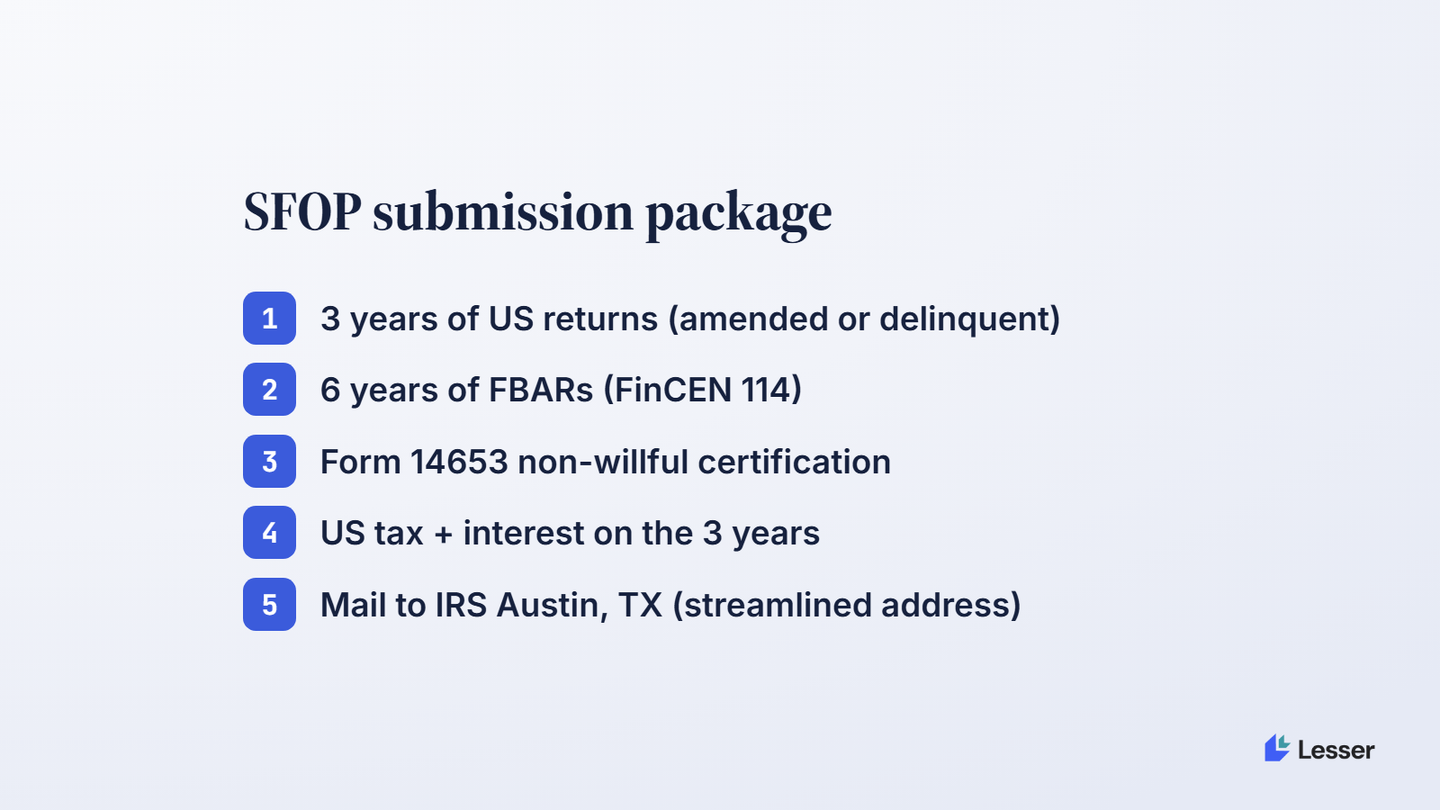
The package is mailed to one specific address: "Internal Revenue Service, 3651 South I-H 35, Stop 6063 AUSC, Attn: Streamlined Foreign Offshore, Austin, TX 78741" (IRS: SFOP). The IRS notes: "This address may only be used for returns filed under these procedures" (same source). Sending the returns to the normal 1040 processing centre will not work.
What penalties does SFOP waive, and which still apply?
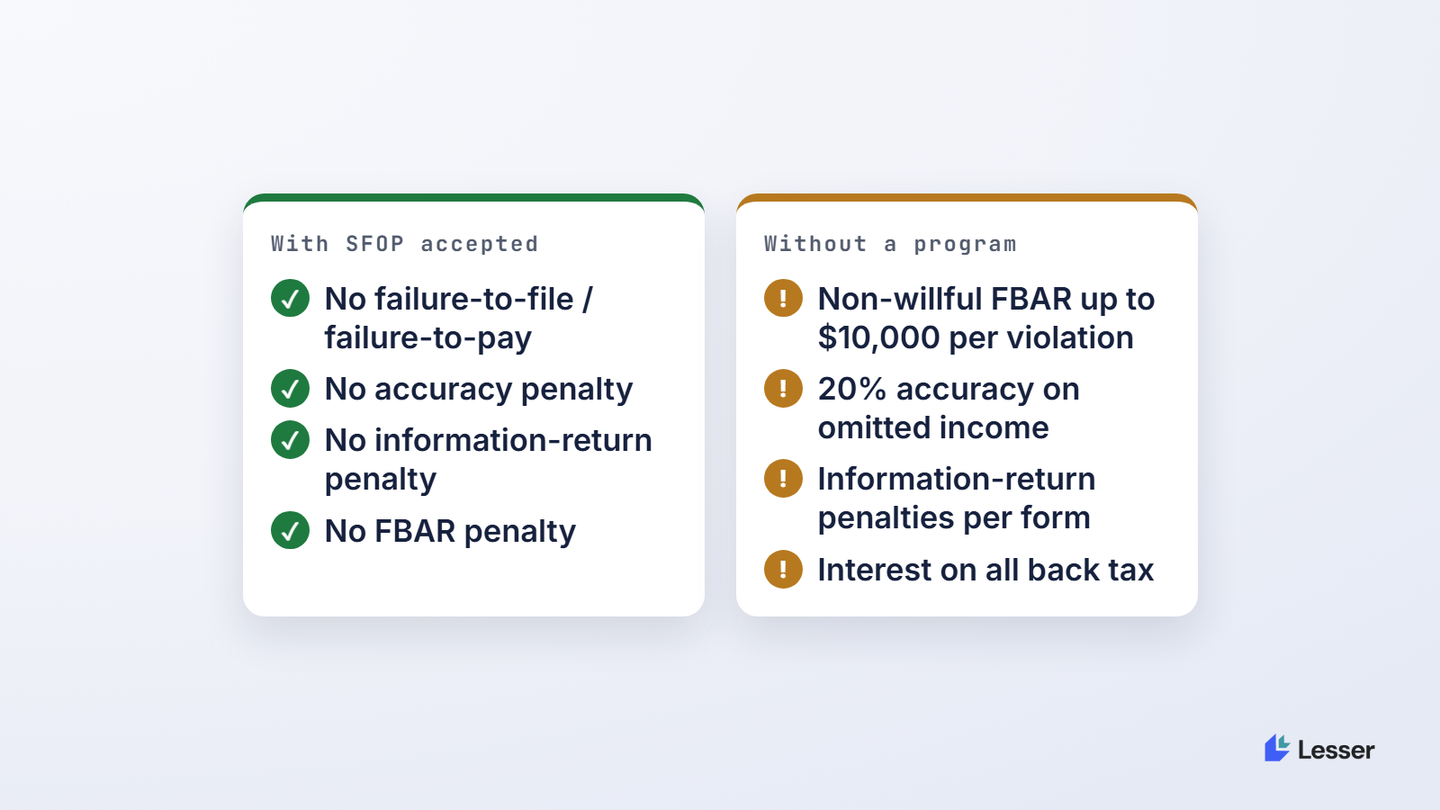
Taxpayers who qualify "will not be subject to failure-to-file and failure-to-pay penalties, accuracy-related penalties, information return penalties, or FBAR penalties" (IRS: SFOP).
| Comparing paths for a US citizen in India who missed FBAR + NRE interest | SFOP | SDOP | Delinquent return (no program) |
|---|---|---|---|
| Residency gate | 330 days outside US in one of last 3 years | Lives in US | n/a |
| Returns to file | 3 years amended/delinquent | 3 years amended | Each year on its own |
| FBARs to file | 6 years | 6 years | 6 years |
| Non-willful certification | Form 14653 | Form 14654 | n/a |
| Miscellaneous offshore penalty | None | 5% of highest aggregate year-end balance | n/a (but all other penalties possible) |
| Failure-to-file, failure-to-pay, accuracy, info-return, FBAR penalties | Waived if accepted | Waived if accepted | Full exposure |
What SFOP does not waive:
- Interest on the underlying tax due. You still pay interest from the original due date of each of the three years.
- Fraud liability or criminal exposure, if the IRS determines your facts were willful. Streamlined is explicitly a non-willful path.
- Civil examination exposure once SFOP is accepted. The IRS can audit the submitted years; what it cannot do is drop a penalty on an item you reported in the submission package.
If the IRS has already started a civil examination of any of your returns, SFOP is off the table: the Streamlined program is unavailable "If the IRS has initiated a civil examination of taxpayer's returns for any taxable year" (IRS: Streamlined Filing Compliance Procedures).
How does SFOP work for an NRI who moved back to India in 2024?
A worked case to make the three-year and six-year counts concrete.
Priya is a US green card holder. She moved from New Jersey to Pune permanently in May 2024. She filed US returns through tax year 2023 but did not include $4,200/year of NRE and NRO interest in 2021-2023 (she thought NRE interest was "tax-free" because it is in India). She did not file FBARs for her Indian accounts in 2019-2023 even though her aggregate balance crossed $10,000 every year. She has not filed any US return for 2024 because she thought moving back ended her obligation.
Her SFOP submission in 2026 would include:
- Three years of US returns: amended 2023, amended 2024 (delinquent original was never filed), and 2025 return filed in 2026. (If 2025 has not been filed yet by the time she submits, SFOP would be 2022, 2023, 2024 instead; the IRS rule is the most recent three for which the US tax return due date has passed.) Each return adds the previously omitted NRE/NRO interest, applies the standard deduction, and computes any tax due.
- Six years of FBARs (FinCEN 114): 2019 through 2024, each listing the Indian bank accounts with the maximum calendar-year balance in US dollars.
- Form 14653: a narrative explaining the move, her reliance on the Indian tax treatment of NRE interest, that she did not know about FBAR when her balances crossed the threshold, that she stopped filing when she moved thinking the obligation ended with physical residence, and the facts that made each oversight non-willful.
- Interest on the small amount of US tax due across the three years.
With the Form 14653 accepted, Priya owes the small amount of back tax plus interest, and no FBAR or accuracy-related penalty on the 2019-2023 missed FBARs or the three years of amended returns. Without SFOP, each missed FBAR year could carry a non-willful penalty of up to $10,000 per violation (indexed), and the omitted income on each return could carry a 20% accuracy-related penalty.
What does Form 14653 need to say?
Form 14653 has a block for the non-willful narrative. The IRS reads this and decides whether to accept the submission. A good narrative has four pieces:
- Timeline. Dates: when you moved to the US, visa status at each stage (H1B, L1, GC, naturalisation), when you moved back, where you lived, where the accounts were.
- Each omitted item named and explained. Separately for NRE interest, NRO interest, PPF, EPF, mutual funds, rent, etc. Why did you not report it? What did you believe at the time? Did any advisor say anything specific?
- What you did when you learned. When did you discover the obligation? What did you do about it (hired a CPA, started reading IRS guidance, consulted a lawyer)? If this took years, say why.
- Statement of non-willfulness. A plain-English statement that each omission was due to negligence, inadvertence, mistake, or a good-faith misunderstanding of the law — tracking the IRS wording from the SFOP page.
A one-paragraph narrative that says "I didn't know" rarely survives IRS review. A page-long narrative that walks through the move, the accounts, the specific belief about NRE interest and the specific reason you did not file FBARs usually does.
How does SFOP interact with the India side (Indian ITR, DTAA, PPF)?
The SFOP submission is a US filing. It does not change your Indian ITR obligations. But two India items usually come up:
- DTAA foreign tax credit. If you paid Indian tax on interest or capital gains during the SFOP years, claim the Foreign Tax Credit on Form 1116 for each amended US return. The India-US treaty's method of avoidance is in Article 25. Indian tax actually paid on the item usually reduces US tax to zero or near zero for NRE/NRO interest at your marginal rate.
- PPF and EPF. The IRS has not issued a clean "PPF is a trust" or "PPF is not a trust" ruling. The conservative path during SFOP is to disclose PPF and EPF as foreign financial accounts on FBAR and Form 8938 (where thresholds apply) and to report the yearly earnings (even when the Indian tax rule exempts them from Indian tax). If you took the aggressive position and skipped PPF on earlier FBARs, say so in the Form 14653 narrative and include it going forward.
See our deeper write-ups on these items for the full tax treatment: FBAR and Form 8938 for Indian accounts, NRI India income on a US tax return, and the US-resident Streamlined track at streamlined filing for NRIs. For the amendment mechanics once your SFOP is accepted and you later find another missed item, see amending a prior US return.
What are the biggest mistakes NRIs make with SFOP?
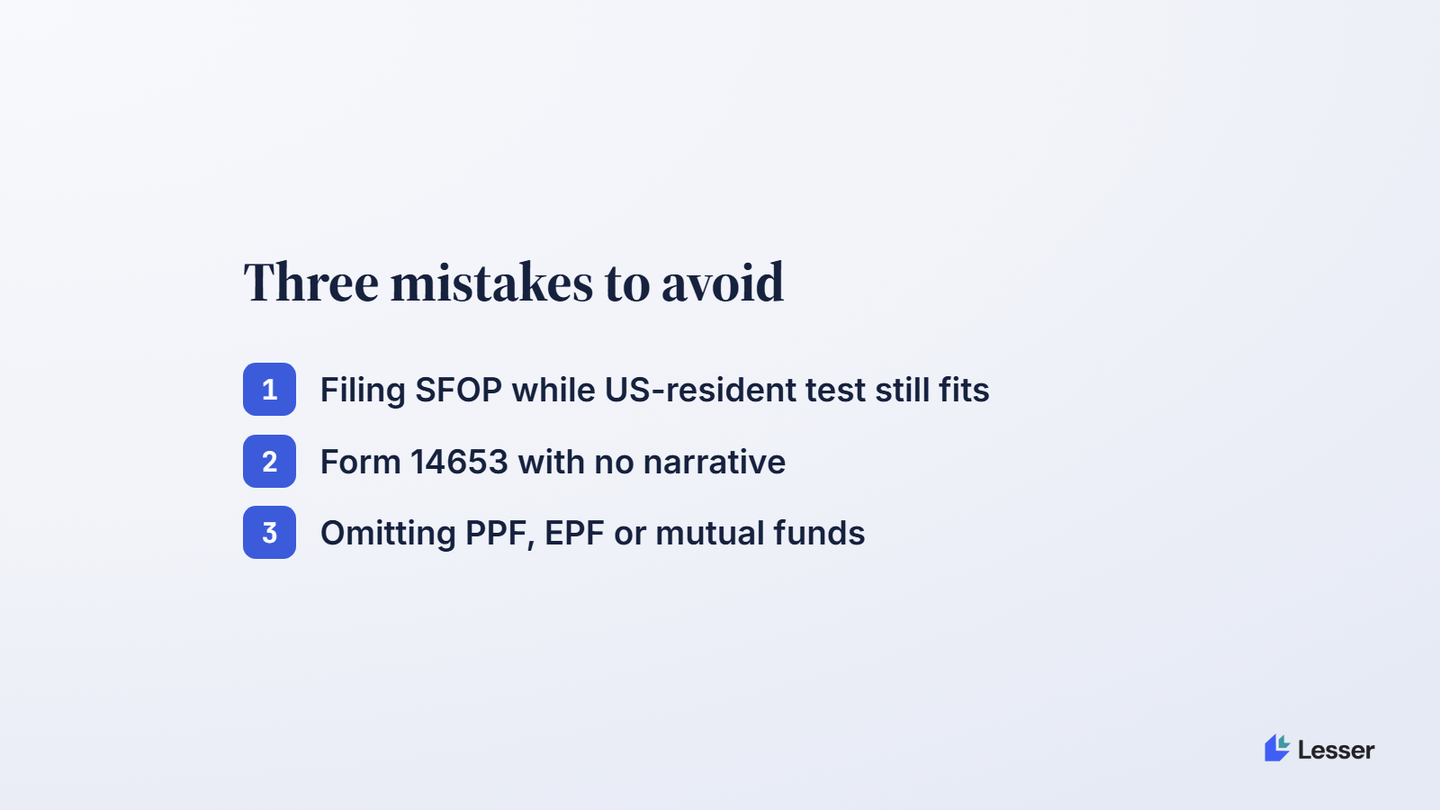
Three mistakes repeat:
- Filing SFOP while the US-resident test still fits. If you still have a US abode and have not been physically outside the US for 330 days in any of the last three years, you are not SFOP-eligible; the IRS will reject it or convert it to SDOP (with the 5% penalty). Confirm the 330-day count year by year before submitting.
- Submitting Form 14653 with no narrative. A one-paragraph statement will usually be challenged. Write out the full timeline and reasoning.
- Skipping PPF/EPF or mutual funds on the submission. If these items were part of the original non-compliance, leaving them out of the SFOP package creates a quiet-disclosure problem for the next discovery. Disclose everything you can document.
FAQ
I am a US citizen living in India. I never filed FBAR. Do I need SFOP, or can I just start now?
If you had reportable foreign accounts in prior years (aggregate above $10,000 at any point) and you did not file FBAR for those years, filing only going forward leaves the prior years exposed. SFOP is the clean path for a US person outside the US; it brings 6 years of FBARs and 3 years of returns current together.
What is the deadline for an SFOP submission?
There is no fixed deadline, but the "3 years / 6 years" count moves forward as time passes. The IRS can also close the Streamlined program with notice; it has been open since 2014.
Does SFOP cover PFIC Form 8621 for Indian mutual funds?
Form 8621 is one of the "required information returns" the non-willful certification covers. Include the missed 8621s with the amended returns in the 3-year window. For the full PFIC mechanics for Indian mutual funds, see Form 8621 for Indian mutual funds.
My Indian bank will not give me statements going back 6 years. What do I do?
Use what you can obtain in good faith; the FBAR allows "maximum value" to be a reasonable estimate when exact statements are not available. State the limitation in the Form 14653 narrative.
If my SFOP is accepted, am I safe from audit?
Not from audit, from penalties. The IRS can still examine the submitted years. The protection is: no failure-to-file, failure-to-pay, accuracy, information-return or FBAR penalties on what you disclose. Interest on the back tax still applies.
Can my spouse join one SFOP submission with me?
Yes if both are eligible and both sign a joint Form 14653 narrative. Both spouses certify the facts.
What if I was a green card holder but have since surrendered the green card?
If you were a US tax resident during the SFOP years, you are a "US person" for those years and the obligation applies. Expatriation does not retroactively erase the earlier obligation; SFOP is still the catch-up track. See US exit tax for green card holders moving to India for the surrender itself.