
Lesser Tax
12 min read
Quick answer: Whether an LLC with no income has to file a federal return is a classification question, not an income question. A single-member LLC is a disregarded entity and files only if its owner has to file; a multi-member LLC is a partnership and must file Form 1065 "unless it neither receives income nor incurs any expenditures treated as deductions or credits" (Instructions for Form 1065); an LLC that elected S corp must file Form 1120-S once the election is in effect (Instructions for Form 1120-S); an LLC taxed as a C corporation must file Form 1120 "whether or not they have taxable income" (Instructions for Form 1120); and a foreign-owned single-member LLC must file a pro forma Form 1120 with Form 5472 attached even with zero activity (Instructions for Form 5472).
Want an expert to handle this? File your business tax return for $100
Situations you'll recognise
- You formed a Delaware or Wyoming LLC last year "just to hold the idea" and haven't invoiced anyone yet.
- You and a co-founder filed an LLC in April 2026 and only opened the bank account. Nothing came in, nothing went out.
- Your C corp has been inactive for a year while you decide whether to shut it down. You skipped filing because there was no income.
- You are on H-1B and set up a US LLC that your parents in India fund; the LLC had no US-source revenue.
- You dissolved the LLC with the state in October and assumed the IRS clock stopped the same day.
Why this happens
The IRS does not look at an LLC's bank statement first. It looks at how the entity is classified for federal tax purposes, and the filing rule follows from the classification. The IRS page on LLCs is explicit that "for income tax purposes, an LLC with only one member is treated as an entity disregarded as separate from its owner, unless it files Form 8832 and affirmatively elects to be treated as a corporation" (IRS: Limited liability company (LLC)). Multi-member LLCs default to partnership treatment unless an election is filed. On top of that, state formation and foreign ownership create filing duties that do not care about revenue.
So the practical test is: what is the LLC's federal classification, and what does that classification require when there is no activity? Each of the four answers is below.
Single-member LLC (disregarded entity): usually nothing separate, with two exceptions
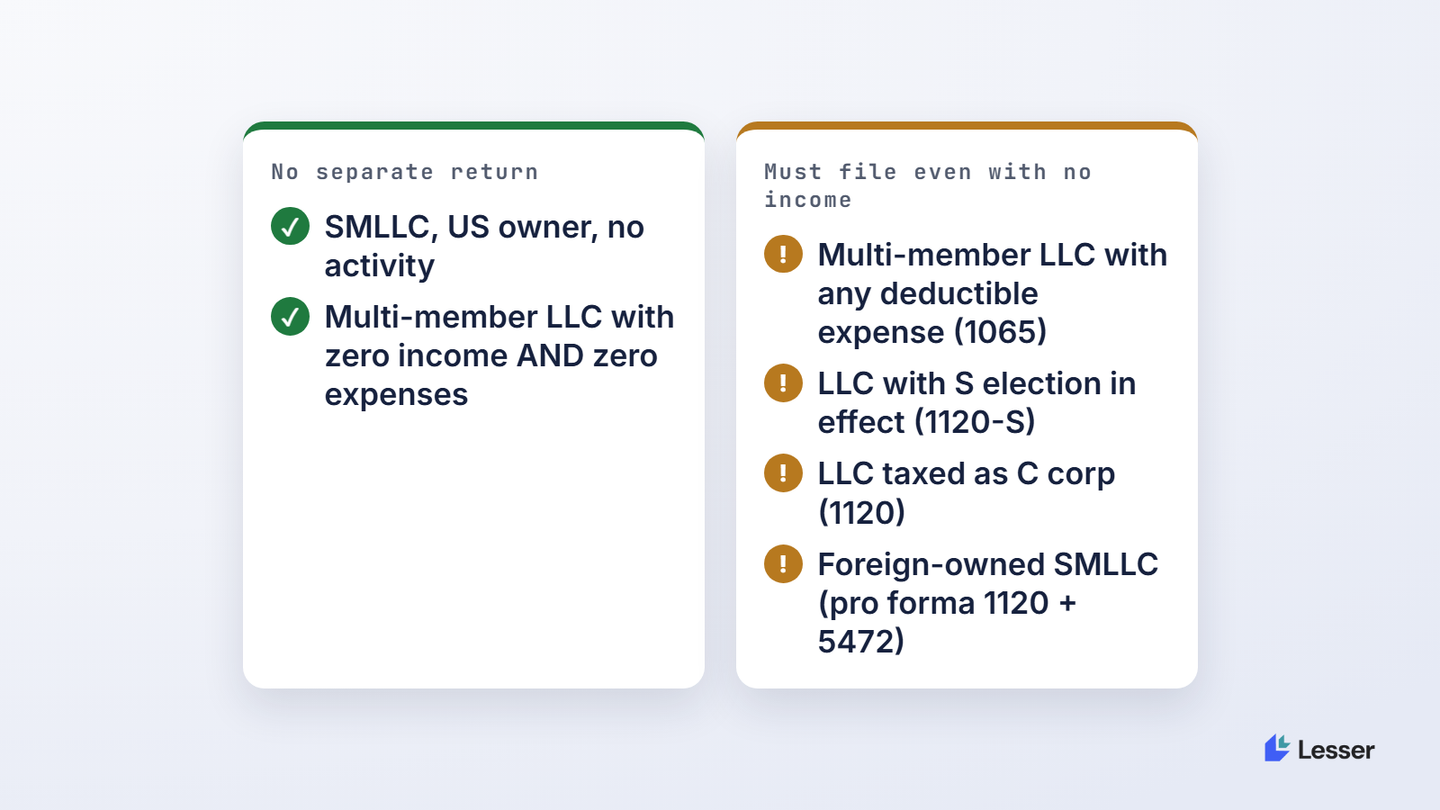
A domestic single-member LLC with no S or C election has no separate federal income tax return. Its activity "will generally be reflected on" the owner's Form 1040, "Schedule C, Profit or Loss from Business (Sole Proprietorship)," Schedule E, or Schedule F (IRS: Single member limited liability companies). If the LLC had no income and no deductible expenses, there is nothing to put on Schedule C, and the owner's own 1040 obligation is what decides whether anything is filed at all.
Two exceptions make a dormant single-member LLC file anyway:
- Foreign-owned US DE. If the single member is a foreign person (an Indian citizen living in India, for example), the LLC is a reporting corporation for Form 5472 purposes. The 5472 instructions state that "while a foreign-owned U.S. DE has no income tax return filing requirement, as a result of final regulations under section 6038A, it will now be required to file a pro forma Form 1120, U.S. Corporation Income Tax Return, with Form 5472 attached by the due date (including extensions) of that Form 1120" (Instructions for Form 5472). The penalty for missing this is $25,000: "A penalty of $25,000 will be assessed on any reporting corporation that fails to file Form 5472 when due and in the manner prescribed" (Instructions for Form 5472). This applies whether or not the LLC had any revenue.
- Payroll or excise obligations. The IRS SMLLC page notes that "a single-member LLC that is a disregarded entity that does not have employees and does not have an excise tax liability does not need an EIN" (IRS: Single member limited liability companies); the flip side is that if the LLC does have employees or excise obligations, those payroll/excise returns are the LLC's own and must be filed regardless of profit.
Multi-member LLC (partnership by default): file Form 1065 unless truly zero
A multi-member LLC without an S or C election is a partnership for federal tax. The Form 1065 instructions say: "Except as provided below, every domestic partnership must file Form 1065, unless it neither receives income nor incurs any expenditures treated as deductions or credits for federal income tax purposes" (Instructions for Form 1065).
The sentence is strict. "Receives income" is any receipts, not just profit, and "expenditures treated as deductions or credits" picks up ordinary start-up costs like state filing fees, registered agent fees, legal and accounting fees, software subscriptions, and bank charges. In practice, almost every multi-member LLC that opened a bank account has at least one deductible expense in the year it was formed and therefore owes a 1065.
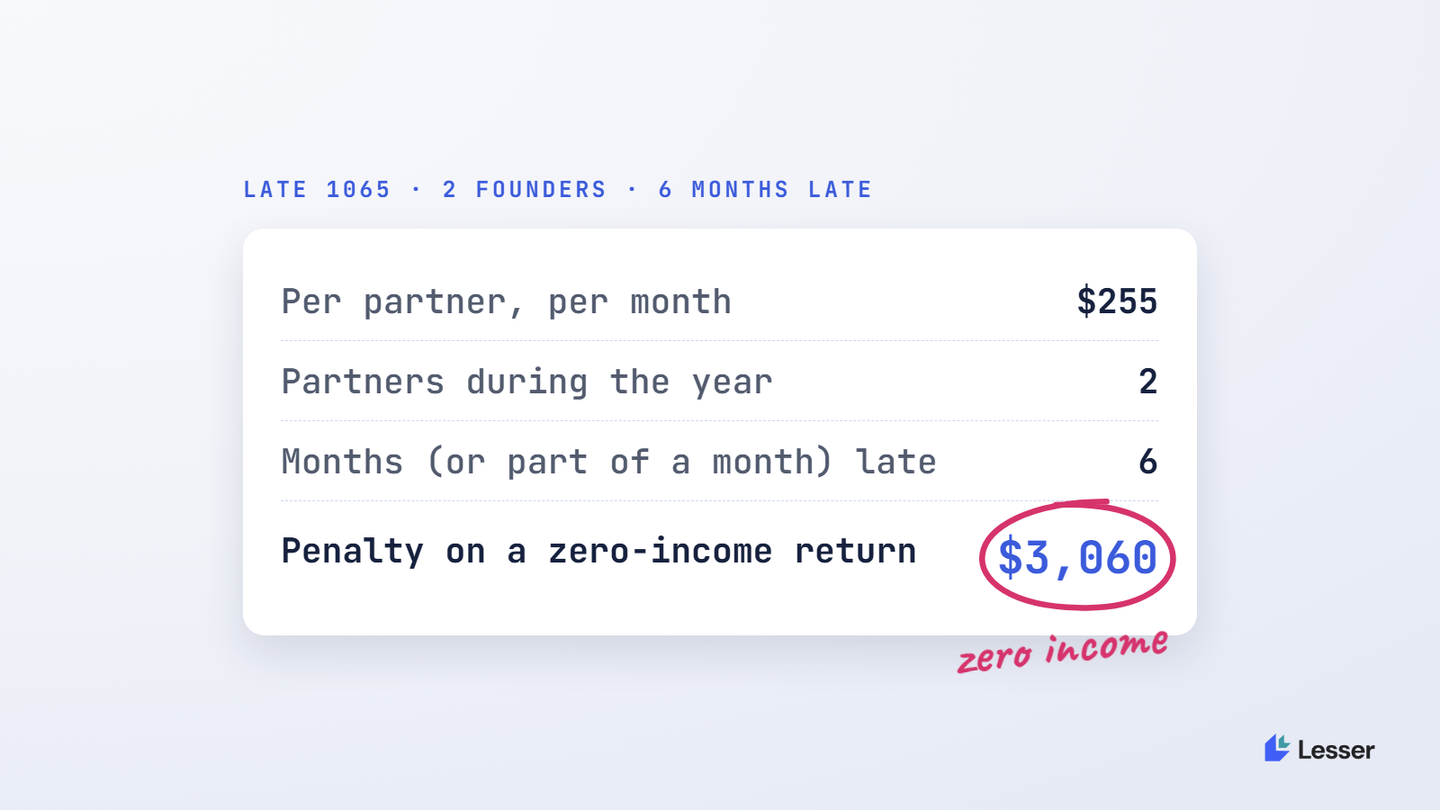
The penalty for not filing is per partner and per month: "The penalty is $255 for each month or part of a month (for a maximum of 12 months) the return is late or doesn't show all the information required, unless such failure is due to reasonable cause" (Instructions for Form 1065), multiplied by the number of partners during the year. Two co-founders, six months late, is $255 × 2 × 6 = $3,060 before anyone has made a dollar. A late Schedule K-1 adds a separate $340 per K-1 (Instructions for Form 1065).
Small-partnership relief under Rev. Proc. 84-35 can apply where there are 10 or fewer partners and every partner has fully reported their share on their own 1040; it is a reasonable-cause claim, not an automatic exemption, and the IRS asks the partnership to request it after a notice is issued.
LLC that elected S corp: file Form 1120-S for every year the election is in effect
Once an LLC files Form 2553 and the election takes effect, the 1120-S filing duty does not pause because there was no activity. The 1120-S instructions state the "Who Must File" rule: "A corporation or other entity must file Form 1120-S if (a) it elected to be an S corporation by filing Form 2553, (b) the IRS accepted the election, and (c) the election remains in effect" (Instructions for Form 1120-S). There is no "unless the activity is zero" exception.
The penalty is the same structure as a partnership: "For returns on which no tax is due, the penalty is $255 for each month or part of a month (up to 12 months) the return is late or doesn't include the required information, multiplied by the total number of persons who were shareholders in the corporation during any part of the corporation's tax year for which the return is due" (Instructions for Form 1120-S). A single-shareholder S corp that files eight months late owes $255 × 1 × 8 = $2,040 even with zero revenue.
If you decided not to run the entity after making the election, the fix is to revoke the S election in writing — "to revoke the election, the corporation must file a statement with the appropriate service center listed under Where To File in the Instructions for Form 2553" (Instructions for Form 1120-S) — and then dissolve the entity at the state level. Until the revocation and dissolution are on record, the 1120-S is due.

LLC that elected C corp: file Form 1120, income or no income
An LLC that filed Form 8832 to be taxed as an association, or an actual corporation, files Form 1120. The instructions do not leave this to interpretation: "Unless exempt under section 501, all domestic corporations (including corporations in bankruptcy) must file an income tax return whether or not they have taxable income. Domestic corporations must file Form 1120, unless they are required, or elect to file a special return" (Instructions for Form 1120).
A C corporation that did nothing for the year still files a Form 1120 showing zeros. The minimum penalty for a Form 1120-S more than 60 days late is "the smaller of the tax due or $525" (Instructions for Form 1120-S); for 1120 and 1065, the per-partner/shareholder monthly penalties apply.
A real example
A two-founder Delaware LLC was formed in March 2026. The founders paid the state formation fee, a registered agent, and a legal setup bill — about $1,900 of expenditures. They opened a Mercury account, raised no money, invoiced nothing, and did not elect S corp. The LLC is a partnership by default.
Because the LLC "incurs expenditures treated as deductions or credits" (the $1,900), the Form 1065 "every domestic partnership must file" rule applies. The founders missed the March 15, 2027 deadline and filed in September 2027, six months late. The penalty is $255 × 2 partners × 6 months = $3,060 (Instructions for Form 1065). On the K-1 side, if neither K-1 was issued to each partner on time, that adds up to $340 × 2 = $680 (Instructions for Form 1065). Rev. Proc. 84-35 relief may apply if both founders reported the partnership's zero income on their own 1040s on time; it has to be requested in response to the IRS notice.
What getting it right gives you
- Clean record for the real year. When revenue finally comes in, the IRS already has the LLC's EIN, classification, and tax-year history on file, so nothing holds up a refund or a QSBS claim.
- No per-partner penalty surprise. For a two- or three-founder LLC, the per-partner-per-month structure runs faster than most people expect; filing a zero-activity 1065 or 1120-S costs nothing and avoids four-figure letters.
- Immigration-safe answer. H-1B holders should be able to point to a filed US return for the LLC that funds their side-letter or passive stake; a missing return is harder to explain than a zero return.
| LLC classification | File even with no income? | Form | Primary rule |
|---|---|---|---|
| Single-member LLC, US owner | Only if owner's 1040 requires it; no separate LLC return | Schedule C/E/F on Form 1040 | [IRS: SMLLC](https://www.irs.gov/businesses/small-businesses-self-employed/single-member-limited-liability-companies) |
| Single-member LLC, foreign owner | Yes, pro forma 1120 with 5472 attached | Form 1120 + Form 5472 | [Instructions for Form 5472](https://www.irs.gov/instructions/i5472) |
| Multi-member LLC (partnership) | Yes, unless truly no income and no deductible expenses | Form 1065 + K-1s | [Instructions for Form 1065](https://www.irs.gov/instructions/i1065) |
| LLC with S election in effect | Yes, every year the election is in effect | Form 1120-S + K-1s | [Instructions for Form 1120-S](https://www.irs.gov/instructions/i1120s) |
| LLC taxed as C corp (Form 8832) | Yes, "whether or not they have taxable income" | Form 1120 | [Instructions for Form 1120](https://www.irs.gov/instructions/i1120) |
Context sentence: the row that most dormant LLCs miss is "LLC with S election in effect," because the owners assume no activity means no return.
What's next
Lesson 4 of this series walks through how to actually file a zero-activity 1065 or 1120-S: which boxes are required, what to put on the K-1, and how to request Rev. Proc. 84-35 relief after a late-filing notice. For founders deciding between the partnership default and an S election in the first place, read S corp vs LLC for founders on an H-1B or green card. Foreign-owned LLCs with no US activity should read Form 5472 for an LLC owned by a founder in India before the March deadline.
Further reading
- Deep guide: S corp vs LLC for founders on an H-1B or green card
- Deep guide: Form 5472 for an LLC owned by a founder in India
- Related: Single-member rental LLC taxes: Schedule E, not Schedule C
- Related: NRI tax CPA vs TurboTax: when software breaks
- Offer: Flat-fee business filings for founders — lesser.tax/business
FAQ
Does a single-member LLC with no income have to file anything?
If the owner is a US person and the LLC has no activity, there is no separate LLC return; the LLC "will generally be reflected on" the owner's Form 1040, Schedule C/E/F (IRS: SMLLC). With no revenue and no expenses, nothing lands on the 1040 attributable to the LLC. If the single owner is a foreign person, the pro forma Form 1120 with Form 5472 is required even at zero activity (Instructions for Form 5472).
Does a two-member LLC with no activity have to file a 1065?
If the LLC had any deductible expense — state fees, registered agent, bank charges, legal, accounting — the 1065 is due, because the "unless it neither receives income nor incurs any expenditures treated as deductions or credits" test is not met (Instructions for Form 1065). A multi-member LLC that genuinely had zero receipts and zero expenses is the only partnership that can skip 1065 for the year.
What is the penalty for not filing a 1065 or 1120-S when there was no income?
Both forms carry a $255 per partner (or shareholder) per month penalty, up to 12 months, "unless such failure is due to reasonable cause" (Instructions for Form 1065; Instructions for Form 1120-S). Reasonable-cause relief and Rev. Proc. 84-35 small-partnership relief are available on request after a notice is issued.
I made an S corp election and then did nothing with the LLC. Do I still have to file?
Yes. The 1120-S "Who Must File" rule triggers once "it elected to be an S corporation by filing Form 2553, (b) the IRS accepted the election, and (c) the election remains in effect" (Instructions for Form 1120-S). The return is due every year the election is in effect; to stop the duty, the corporation must revoke the election in writing and dissolve the entity.
My LLC is in Delaware but I live in India. Does zero US income mean no US return?
No. A foreign-owned US disregarded entity files a pro forma Form 1120 with Form 5472 attached even with no income (Instructions for Form 5472); the penalty for missing it is $25,000 per year.
Can I just dissolve the LLC with the state and skip the final return?
State dissolution does not close the federal file. A C corp "that has dissolved must generally file by the 15th day of the 4th month after the date it dissolved" (Instructions for Form 1120); S corps and partnerships have equivalent short-year rules. The final federal return has to be filed and marked final.