
Lesser Tax
6 min read
Quick answer: A single-member rental LLC is, by default, a disregarded entity for federal income tax. There is no separate LLC tax return. The rental income, expenses and depreciation go on Schedule E of the owner's Form 1040. The LLC does not file a Form 1065 (that is for partnerships) and does not file a Form 1120 (that is for corporations) unless you affirmatively elect to be taxed as a corporation on Form 8832. An Intuit-badged forum answer that tells you to file Form 1065 for a one-owner LLC is wrong.
Want an expert to handle this? File your business tax return for $100
Situations you'll recognise
- You bought a rental in your sole name's single-member LLC and your CPA is quoting you for "an LLC return" on top of your 1040.
- A free online answer told you to file Form 1065, and the quoted rate is $800 or more just for that extra return.
- You asked ChatGPT and it said "an LLC files its own return," then listed Form 1065.
- Your bookkeeper set up QuickBooks "for the LLC" and treats it as if it were a separate taxpayer, so now you have two sets of books that need to reconcile.
- Your LLC has an EIN and the IRS mailed you a notice that looks like it is asking for a return.
Why this happens
The confusion comes from the word "LLC." An LLC is a state-law entity; it has nothing to do with how the IRS taxes it. The IRS has a default classification rule for LLCs that most forum answers get wrong when there is only one owner. The IRS puts it plainly: "For income tax purposes, an LLC with only one member is treated as an entity disregarded as separate from its owner, unless it files Form 8832 and affirmatively elects to be treated as a corporation" (IRS: Single-member LLCs).
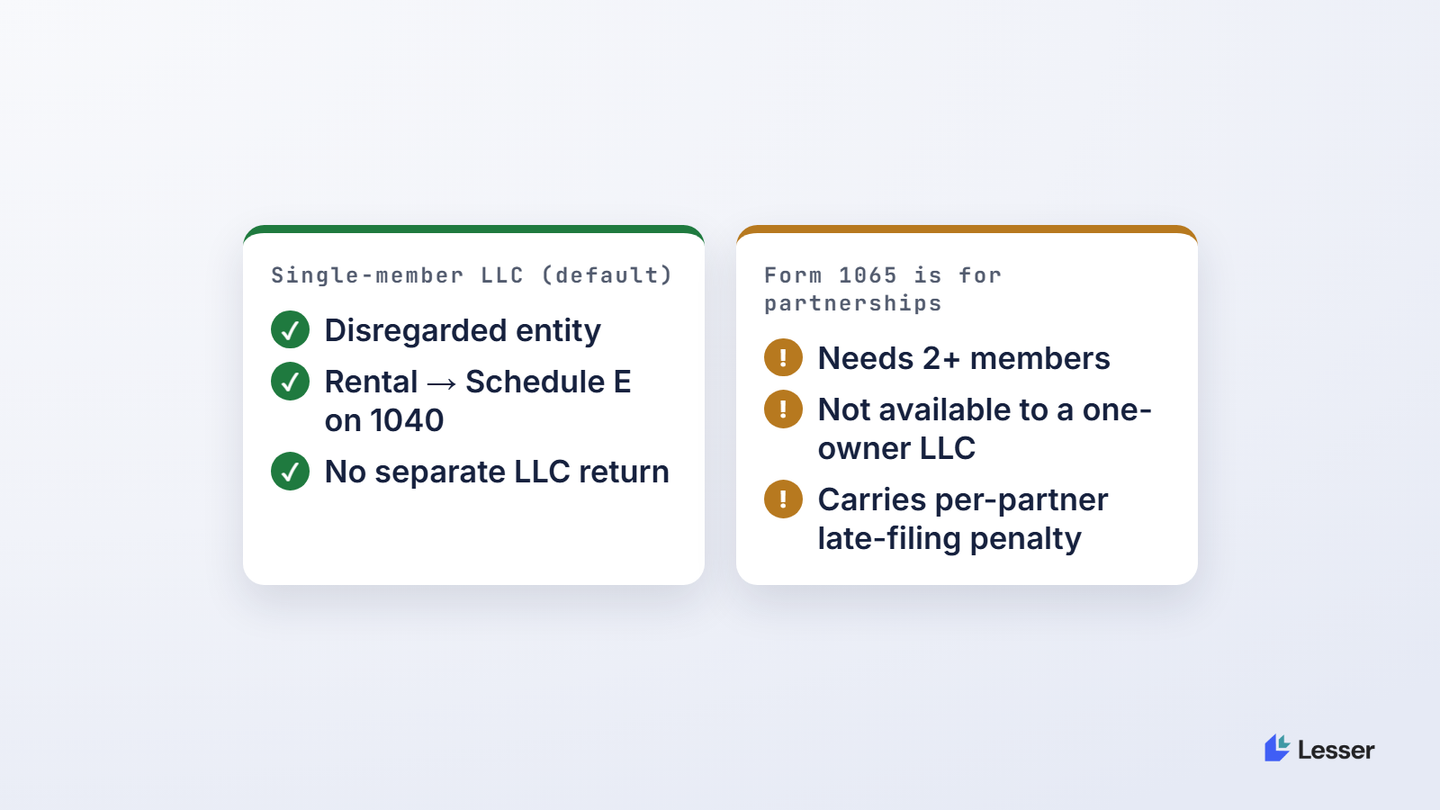
"Disregarded" means the LLC does not exist for income tax. Your rental's income and expenses go directly on your own 1040 as if the LLC were not there. Rental real estate flows to Schedule E; the IRS: "Use Schedule E (Form 1040) to report income or loss from rental real estate" (IRS: Schedule E instructions).
Form 1065 is a partnership return. By definition, a partnership needs two or more members. A single-member LLC is not a partnership and cannot file Form 1065. Form 1120 (or 1120-S) is for corporations. A single-member LLC is not a corporation unless you filed Form 8832 to elect corporate treatment, which almost no one does for a rental property because it loses passive-activity treatment and introduces corporate-level tax.
The piece most forum answers miss: rental income is already reported on Schedule E whether you hold the property in your personal name or in your single-member LLC. The LLC does not change the schedule, the rate, or the depreciation life. It only changes who the state-law landlord is (the LLC, for liability shielding).
A real example
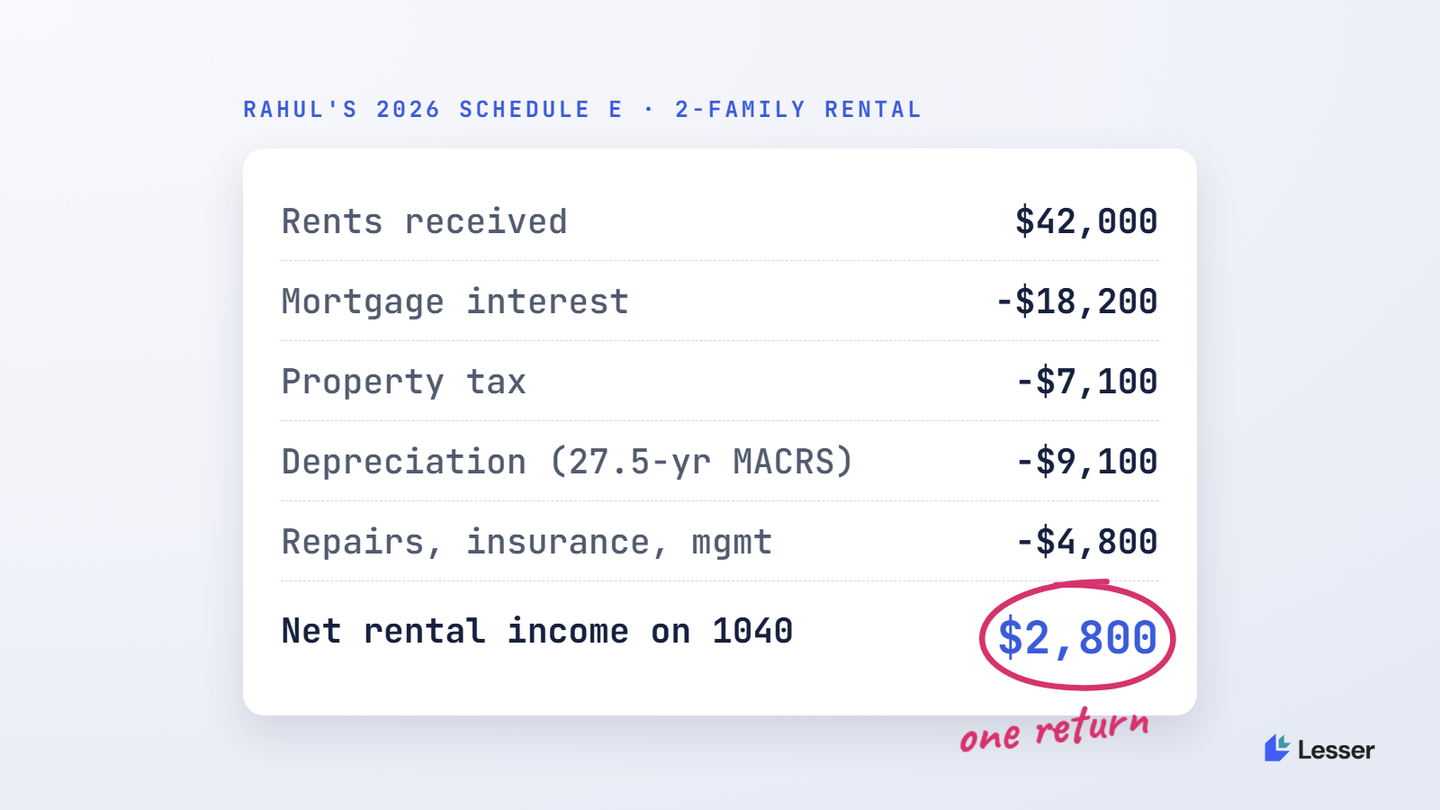
Rahul buys a two-family rental in New Jersey in April 2026 and funds it through a single-member LLC he set up for the purchase. His 2026 Schedule E, Part I, has one column:
| Line | Rahul's 2026 Schedule E |
|---|---|
| Rents received | $42,000 |
| Mortgage interest | $18,200 |
| Property tax | $7,100 |
| Depreciation (27.5-yr residential MACRS) | $9,100 |
| Repairs, insurance, management fees | $4,800 |
| Net rental income/(loss) | $2,800 |
He reports the $2,800 on his personal 1040. There is no separate LLC return. The LLC's EIN appears on his W-9s to the property manager and on the LLC's bank account, but the IRS does not expect a 1065 or 1120 from the LLC. If his CPA charges "$500 for the LLC return," there is no return to prepare.
Where it matters most is for a buy-and-hold investor who thinks the LLC adds a layer of tax filing. It does not. One Schedule E per rental, inside one 1040.
Important facts the single-member rental LLC does not change:
- Depreciation life is 27.5 years for residential, 39 years for commercial (owner-held or LLC-held, same).
- Passive activity loss rules apply the same way. The IRS: "The passive activity loss rules may limit the amount of losses you can deduct. These rules apply to losses in Parts I, II, and III" of Schedule E (IRS: Schedule E instructions).
- Self-employment tax does not attach. The IRS: "Rental real estate income is generally not included in net earnings from self-employment subject to self-employment tax" (same source). Owning through an LLC does not turn rent into self-employment income.
- Form 8825 is a partnership schedule for rental real estate on Form 1065. A single-member LLC does not file 8825.
What getting it right gives you
- One return, not two. Your 1040 with a Schedule E is the whole federal filing. A one-owner LLC return does not exist to file.
- Lower prep fees. A CPA who was going to add "LLC return $500" has nothing to prepare at the entity level. The Schedule E was always on your personal return.
- No late-filing exposure. Form 1065 carries a per-partner-per-month late-filing penalty under section 6698. There is no equivalent penalty for not filing a return your single-member LLC was never required to file.
- State return clarity. Most states follow the federal classification; the LLC is reported on the owner's state personal return as part of Schedule E. A small number of states (California, Texas) require a franchise or annual report filing for the LLC itself; those are separate from income tax and still do not require a federal 1065.
What's next
The next lesson covers how to depreciate the rental and when to split land from building: Depreciating rental property on your US return. If your rental is in India and held through a single-member LLC or in personal name, see NRI India income on a US tax return for how the India rent interacts with Form 1116. For entity choice at the start — LLC vs corporation for a founder — see Corp vs LLC for founders on H-1B or green card. And for broader real estate reporting, see our NRI tax checklist.
Further reading
- IRS: Limited Liability Company (LLC). irs.gov
- Depreciating rental property on your US return. lesser.tax/blog/depreciating-rental-property-india-us-return
- NRI India income on a US tax return. lesser.tax/blog/nri-india-income-us-tax-return