
Lesser Tax
7 min read
Quick answer: A mid-year move between US states is usually a two-state tax event. A part-year resident is any individual who is a resident of a state for part of the year and a nonresident for part of the year, and in the year you move you generally file a part-year return in each state that has an income tax. Move from Seattle to the Bay Area and you file one California Form 540NR; move from California to Austin and you file Form 540NR for the California portion and no Texas return.
Key takeaways
- A part-year resident is any individual who is a California resident for part of the year and a nonresident for part of the year, and they file Form 540NR (FTB Publication 1031, 2023).
- California taxes all income received while you resided in California and the income you received from California sources while a nonresident (FTB 540NR Booklet, 2023).
- Washington does not currently have an individual income tax, so a move into Washington from a taxing state means one part-year return in the state you left, not two (Washington DOR).
- You are a New York State part-year resident if you meet the definition of resident or nonresident for only part of the year, and the statutory-resident day test uses 184 days in New York during the taxable year (NY DTF, IT-203 definitions).
- Part-year residents include all income received while residing in New York plus New York source income earned during the nonresident period in their taxable base before determining the portion subject to New York tax (NY DTF, IT-203 instructions).
Want an expert to handle this? Get your NRI taxes done right
Am I a part-year resident of both states if I moved mid-year?
Usually, yes. California puts it plainly: a part-year resident is any individual who is a California resident for part of the year and a nonresident for part of the year (FTB Publication 1031, 2023). New York uses the same shape: you are a New York State part-year resident if you meet the definition of resident or nonresident for only part of the year (NY DTF, IT-203 definitions).
For the year of the move you generally file two state returns, each covering the months you lived there. The form depends on the state (California uses Form 540NR, New York uses Form IT-203), but the idea is the same: two residency periods, two returns, one federal 1040 covering the whole year.
What if one of the states has no income tax, like Washington or Texas?
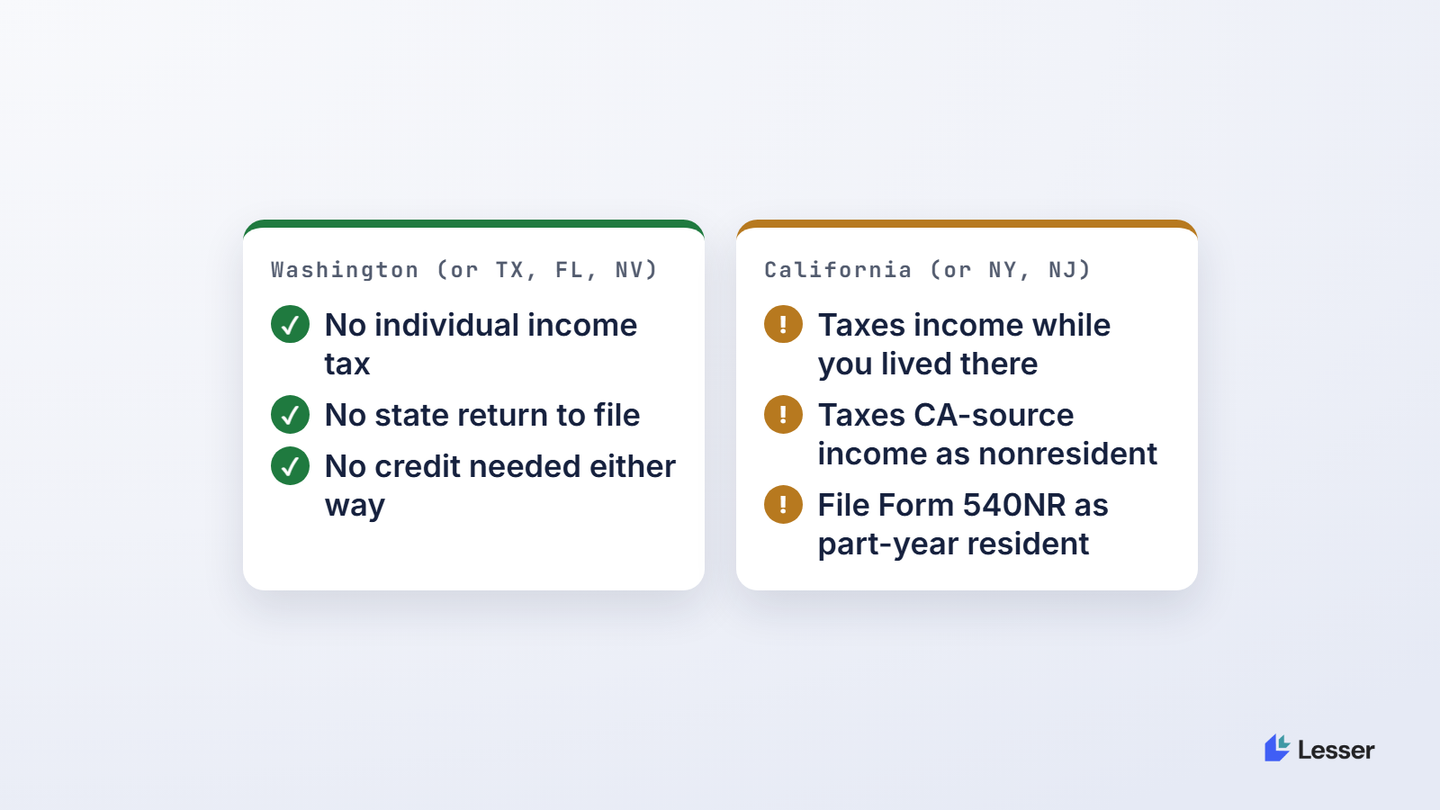
Then you only file where the income tax exists. Washington does not currently have an individual income tax (Washington DOR); Texas, Florida, Nevada, South Dakota, Tennessee, Alaska and Wyoming also do not tax wage income.
Two common H-1B cases:
- Seattle to the Bay Area. You file California Form 540NR as a part-year resident for the months you lived in California. There is no Washington return because Washington has no income tax. California taxes all income received while you resided in California and the income you received from California sources while a nonresident (FTB 540NR Booklet, 2023).
- Bay Area to Austin. You file California Form 540NR for the months you lived in California and nothing in Texas. If you still have California-source income after the move (a California rental, say, or California workdays for RSUs granted while you lived there), it stays on the 540NR.
How do two taxing states avoid double-taxing the same paycheck?
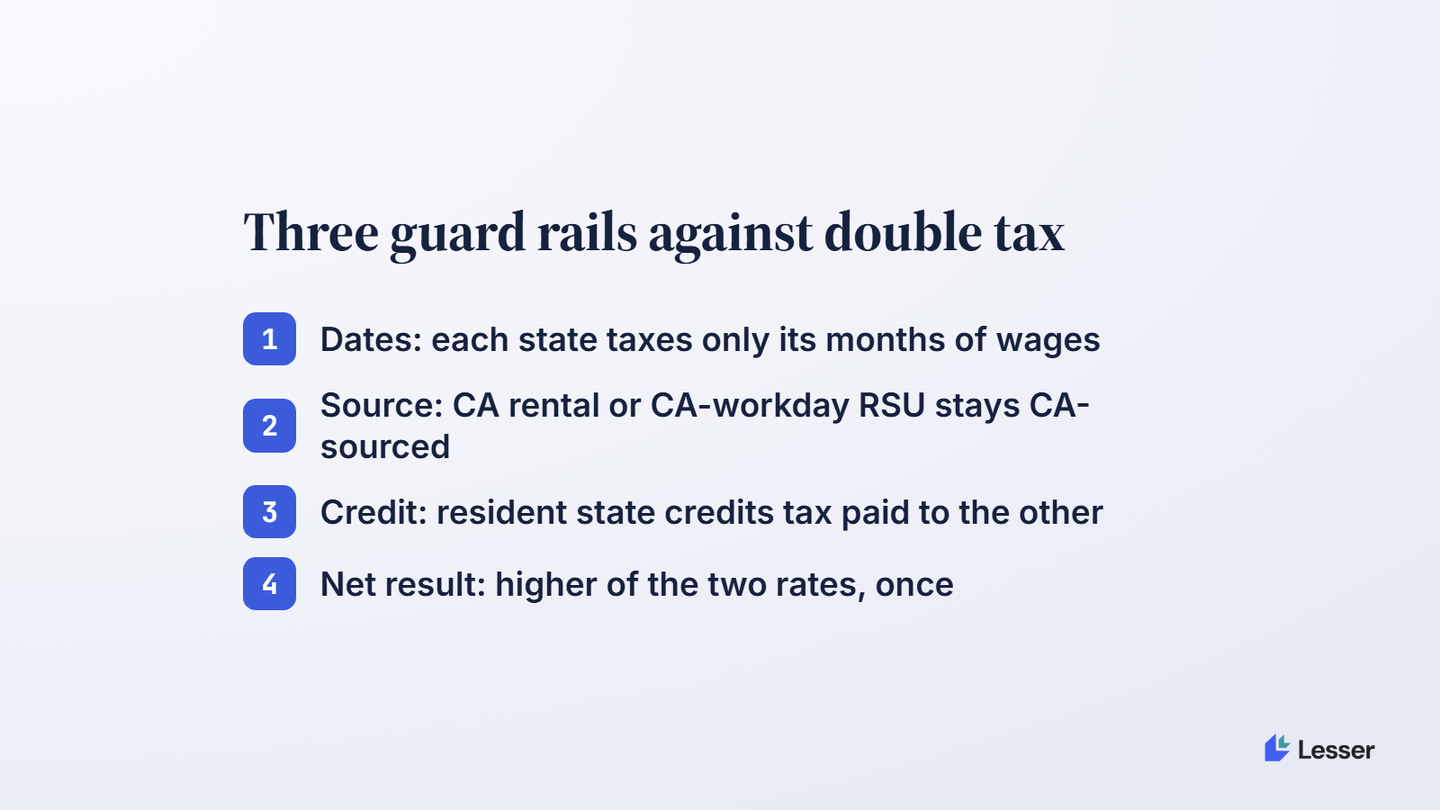
Three guard rails usually line up to stop the same dollar from being taxed twice.
- Dates. Each state only taxes the wages you earned while you were a resident there. California taxes all income received while you resided in California and the income you received from California sources while a nonresident (FTB 540NR Booklet, 2023).
- Source rules for stragglers. Some items keep a tie to the state you left. California-source rental income stays California source after you move. For equity, states generally allocate RSU wages to the state where you worked between grant and vest, by workdays.
- Credit for taxes paid to another state. When two taxing states overlap on the same dollar, the resident state usually credits tax paid to the nonresident state on that income, so you pay the higher of the two rates once, not both.
| Your move | State returns you file | Where the credit usually comes in |
|---|---|---|
| Washington → California | CA 540NR as part-year resident | No credit needed; Washington has no income tax ([Washington DOR](https://dor.wa.gov/taxes-rates/income-tax)) |
| California → New York | CA 540NR + NY IT-203, both as part-year resident | If an RSU with CA-source workdays vests while you are a NY resident, NY taxes it and gives a credit for the CA tax ([FTB 540NR Booklet, 2023](https://www.ftb.ca.gov/forms/2023/2023-540nr-booklet.pdf)) |
| California → Texas | CA 540NR + no Texas return | No credit needed |
| New York → New Jersey | NY IT-203 + NJ part-year | Credit for taxes paid to other states on the overlapping wages |
Does living somewhere 183 days make me a resident of that state?
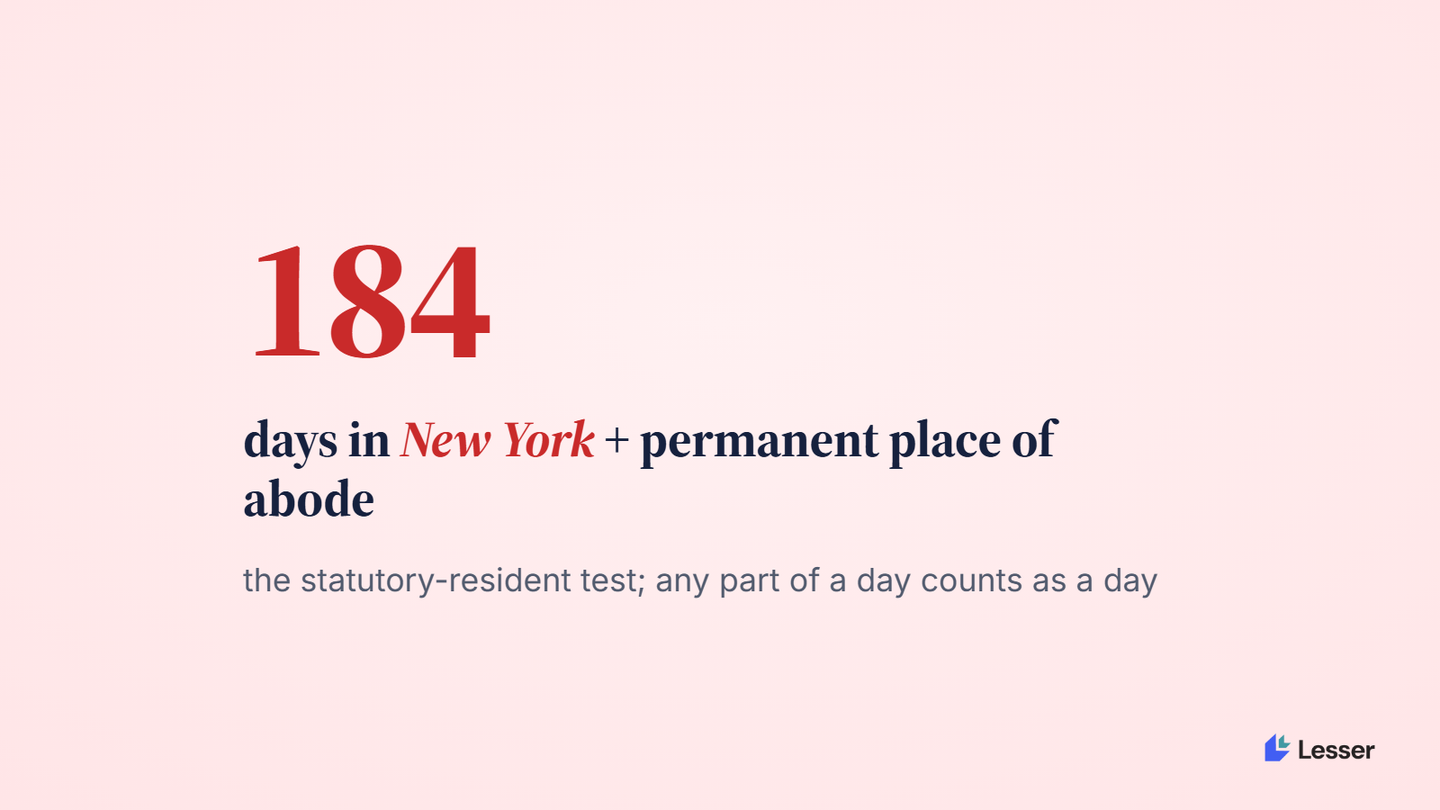
A day-count test exists in some states, but it is narrower than the federal substantial presence test. New York's version applies when you keep a permanent place of abode in New York and spend 184 days or more in New York State during the taxable year, in which case any part of a day is a day for this purpose (NY DTF, IT-203 definitions). California has no fixed day count; it looks at where your closest connections are — job, home, family, driver's licence, voter registration, cars.
For most H-1B movers the test that actually applies is simpler: the date you physically moved and started treating the new state as home. That date splits the year. The day count matters most when you keep a foot in both states (a Manhattan apartment you still visit on weekends), not when you actually relocated.
What does this mean for your taxes?
In the year of the move, expect two state returns if both states have an income tax (for example California Form 540NR and New York Form IT-203), each covering the months you lived there. Nonresidents of California who received California sourced income, or moved into or out of California, file Form 540NR (FTB 540NR Booklet, 2023); New York's requirement sits inside the IT-203 instructions (NY DTF, IT-203 instructions). If one state has no income tax, file only in the taxing state. Your federal 1040 still covers the whole year.
For H-1B movers, two items trip people up: an RSU vesting after the move often has wages earned in both states by workdays, and employer-paid relocation is taxable W-2 wages in the state you moved to. The vest-sourcing walk-through: RSU taxes on H-1B (2026). For NRE/NRO interest and India income in the same year: NRI tax checklist (USA). First US tax year? Dual-status and W-8BEN on moving to the US.
FAQ
I moved from Washington to California on July 1. Do I file a Washington return?
No. Washington does not currently have an individual income tax (Washington DOR). You file California Form 540NR as a part-year resident for the months from July 1 onward.
I moved from California to Texas mid-year. Can California still tax me?
Yes, on the California portion. California taxes all income received while you resided in California and the income you received from California sources while a nonresident (FTB 540NR Booklet, 2023). Later California-source income (a California rental, California workdays for an RSU) stays on Form 540NR. Texas has no income tax, so there is no Texas return.
My RSU vested two weeks after I landed in California. Is the whole vest California wages?
Not necessarily. States generally tax the portion of the vest attributable to workdays in that state between grant and vest. The walkthrough: RSU taxes on H-1B (2026).
What is the 184-day rule I keep reading about for New York?
It is a statutory-resident test. If you keep a permanent place of abode in New York and spend 184 days or more in New York State during the taxable year, you can be taxed as a resident even if your official domicile is elsewhere; any part of a day counts as a day (NY DTF, IT-203 definitions).