
Lesser Tax
7 min read
Want an expert to handle this? Get your NRI taxes done right
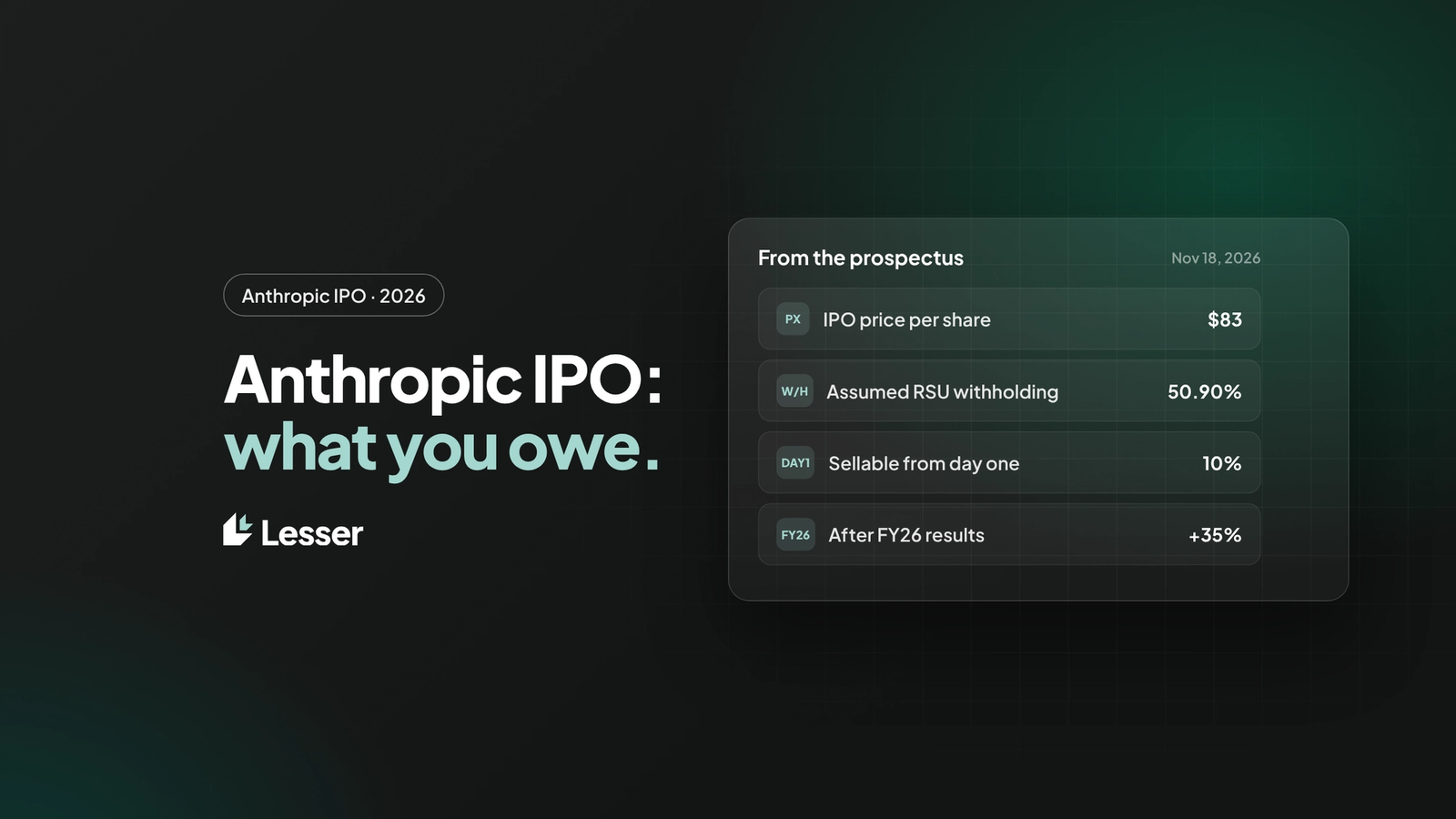
Anthropic began trading on Nasdaq as ANT on November 19, 2026, after pricing its IPO at $83 a share. Employees' service-vested RSUs settled with the IPO, and the final prospectus says Anthropic withheld shares at an assumed 50.90% tax rate. Employees can sell up to 10% of their locked-up shares from day one. Three tax questions follow: is 50.90% enough, how is a first-window sale taxed, and what do you owe by January 15 and April 15, 2027?
What happened to Anthropic RSUs at the IPO?
Anthropic's RSUs had two conditions: a time-based (service) condition and a liquidity condition. The final prospectus, dated November 18, 2026, says the service condition was satisfied as of November 19, 2026 and the performance condition was met when the registration statement became effective. That is the "RSU Settlement".
Three numbers from the prospectus matter for employees:
- 101.3 million shares settled in total (49,754,965 delivered net to employees plus 51,578,975 withheld).
- 50.90% is the assumed tax withholding rate Anthropic used to work out how many shares to keep back.
- $4.3 billion of IPO proceeds is set aside to pay those withheld taxes to the IRS and the states, based on the $83 price.
For you, the settlement is ordinary wage income. The value of the shares on the settlement date goes on your 2026 Form W-2, together with your salary, and is taxed at your regular income tax rates plus Medicare. The withheld shares are the tax prepayment.
Is 50.90% withholding enough?
It depends on how much settled and what else you earned in 2026. The 50.90% is one assumed rate across the whole settlement; your own withholding is on your equity portal and final pay statement.
For a sense of scale, here are the top marginal rates a California resident with very high 2026 wages faces:
| Tax | Top marginal rate on wages | When it applies |
|---|---|---|
| Federal income tax | 37% | Taxable income in the top bracket |
| California income tax | 12.3% plus 1% Mental Health Services Tax | The 1% applies to income above $1 million |
| Medicare | 1.45% plus 0.9% Additional Medicare Tax | The 0.9% applies to wages above $200,000 |
| Total at the very top | About 52.65% | Every extra dollar of wages for a California resident above $1 million |
So the rule of thumb is:
- Very large settlements (well above $1 million of total wages): 50.90% can still fall short by about 1.75 cents on every dollar taxed at the top rates. On $2 million of RSU income taxed at the top rates, that is roughly $35,000 still due.
- Smaller settlements: much of your income is taxed in lower federal brackets (24%, 32%, 35%) and lower California brackets, so 50.90% is often more than you will owe. The difference comes back as a refund when you file in 2027.
- Lived outside California, or moved during vesting: California taxes RSU income by the share of your vesting-period workdays spent in California. See our guide on moving states with a two-state tax return.
These are marginal-rate comparisons, not your bill. Run your own 2026 projection with salary, bonus, the settlement and any sales before deciding anything.
How is a sale in the first selling window taxed?
The prospectus lets non-founder employees sell up to 10% of their lock-up securities (counted as of the last day of the month before the prospectus date) from the first trading day. Another 35% can be sold from the second full trading day after Anthropic releases its full-year 2026 results. The rest stays locked until the earlier of two trading days after the results for the quarter ending March 31, 2027, or the 180th day after the prospectus date.
When you sell settled RSU shares:
- Your cost basis is the value already taxed as wages on the settlement date, not zero. Brokers often show a zero or missing basis on Form 1099-B for RSU shares. If you report it as shown, you pay tax twice. We explain the fix in our RSU tax guide for H-1B and US workers.
- Any gain is short-term if you sell within a year of settlement, so it is taxed at ordinary rates, not the lower long-term rates.
- Nothing is withheld on a share sale. If ANT trades above your settlement value, the gain adds tax that no one has prepaid. High earners also owe the 3.8% Net Investment Income Tax on that gain.
- A sale at a loss produces a short-term capital loss. Watch the wash sale rule if more shares vest or you buy ANT within 30 days; see RSUs that fell after vesting.
A worked example
Illustrative only, not any real employee. Riya is a California resident and an Anthropic engineer on an H-1B. Her 2026 salary is $300,000. At the IPO, 12,000 service-vested RSUs settle at $83 a share.
- RSU income: 12,000 x $83 = $996,000 of wages, so her 2026 W-2 wages are about $1.3 million.
- Shares withheld at 50.90%: about 6,108 shares (worth about $507,000) go to taxes. She receives about 5,892 shares.
- Window 1 sale: she sells 1,200 shares in late November at $110. Proceeds are $132,000, her basis is $99,600 (1,200 x $83), and her short-term gain is $32,400.
- Tax on that gain, no withholding: at 37% federal, about 12.3% to 13.3% California and 3.8% NIIT, the gain adds roughly $17,000 of tax.
Riya's settlement withholding likely covers most of the tax on the RSU income itself. The gap is the tax on her sale, plus any California shortfall on wages above $1 million. Both need a plan before April.
What do you owe by January 15 and April 15, 2027?
Withholding counts as if it was paid evenly through the year. A large withholding in November therefore often helps you meet the federal underpayment safe harbor: 110% of your 2025 tax if your 2025 AGI was over $150,000, or 90% of your 2026 tax.
- If your total 2026 withholding already exceeds 110% of your 2025 tax, you generally have no federal underpayment penalty, even if you owe more in April.
- If it does not, a January 15, 2027 estimated payment (or extra withholding from a December paycheck) can close the gap. Our guide to RSU withholding and the January 15 safe harbor walks through the math.
- California has its own estimated tax rules, so check the state side separately.
- The final bill is due April 15, 2027 with your 2026 return.
What if you are on an H-1B or plan to move to India?
On an H-1B you are usually a US tax resident under the substantial presence test, so the settlement and any sale are taxed exactly as for a US citizen. Visa status changes nothing about the rates.
If you plan to move back to India, timing matters. RSU income from US work stays taxable in the US. Shares you hold and sell later can also be taxed in India once you become an Indian tax resident, though a returning NRI often gets a window as "Resident but Not Ordinarily Resident" first. Read selling RSUs before or after moving back to India before you decide what to keep. If you hold stock options too, see ISO AMT when leaving the US and NSO tax at exercise after a move.
Securities rules, trading windows and any 10b5-1 plan details come from Anthropic's own notices. Follow those, and ask your company's equity team if anything is unclear.
What to do this week
- Download your settlement statement: shares settled, value per share, shares withheld.
- Note the settlement value per share. It is your cost basis for every share you later sell.
- Before selling in the first window, estimate the tax on the gain and set that cash aside.
- Compare your total 2026 withholding with 110% of your 2025 tax. If you are short, plan a January 15 payment or extra December withholding.
- If you work with a tax professional, share the settlement statement now, not in March. Lesser Tax does tax planning and filing for tech employees with equity, including IPO years.
This is general information, not personal tax advice.