
Lesser Tax
7 min read
Want an expert to handle this? Get your NRI taxes done right
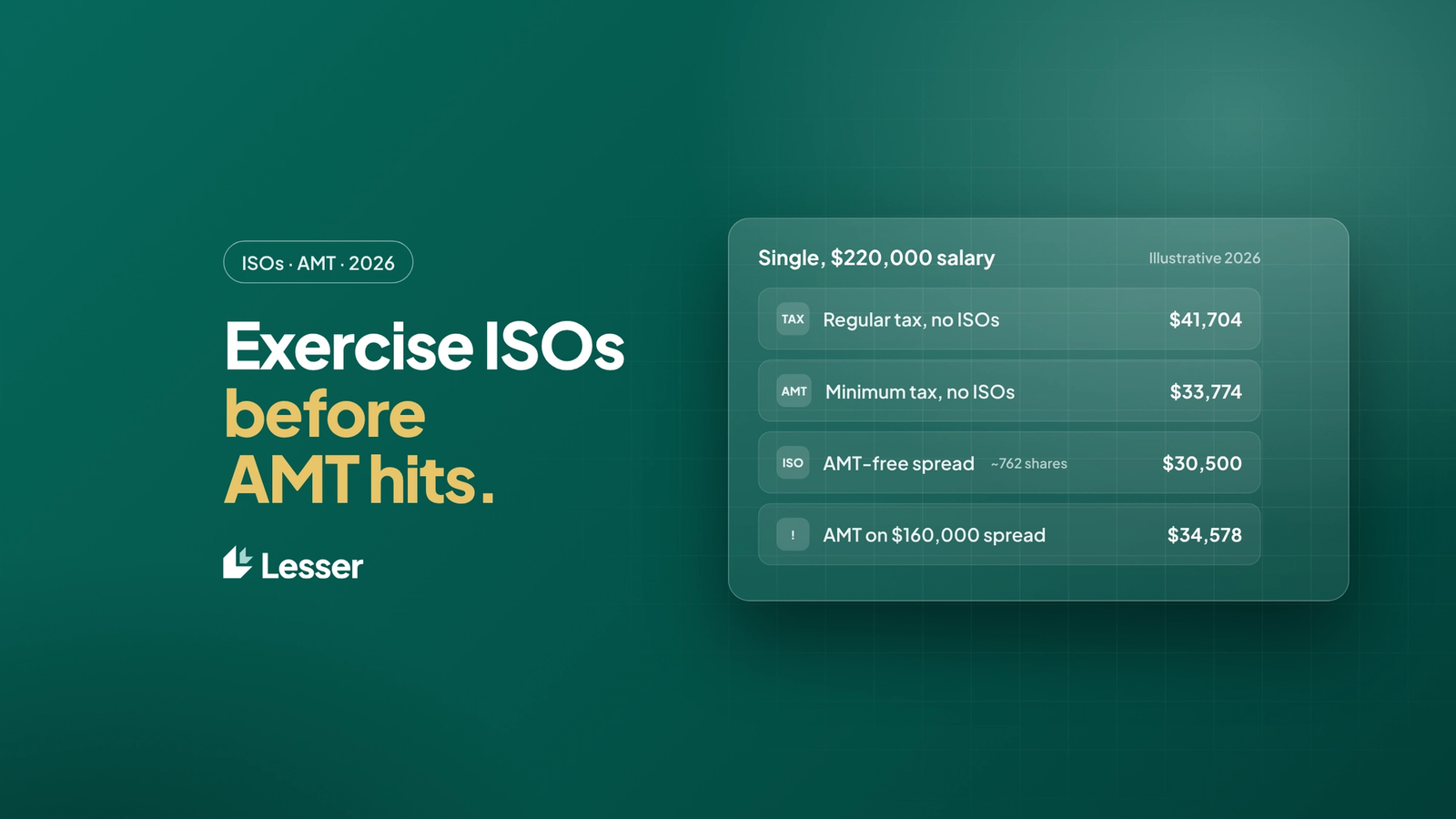
If you exercise incentive stock options (ISOs) in 2026 and still hold the shares on December 31, the spread (market value minus your strike price) counts as income for the alternative minimum tax (AMT), even though your regular tax ignores it. For 2026 the AMT exemption is $90,100 for single filers and $140,200 for joint filers, and it now shrinks by 50 cents for every dollar of AMT income above $500,000 ($1,000,000 joint). In our illustrative example, a single filer earning $220,000 can exercise about $30,500 of spread with no AMT, while exercising $160,000 of spread adds about $34,578 of AMT.
What happens when you exercise ISOs and hold the shares?
For regular tax, IRS Topic 427 says you generally do not include any amount in income when you exercise an ISO. No W-2 income, no withholding. That is why ISOs feel free at exercise.
The AMT is different. Publication 525 says that for the AMT you treat ISO stock as if no special treatment applied, so the spread at exercise becomes an AMT adjustment. It goes on Form 6251, line 2i. Your employer reports the exercise to you on Form 3921.
The AMT is a second tax calculation that runs next to your normal one. You work out your tax both ways and pay whichever is higher. The extra amount is your AMT.
There is one escape hatch. The Form 6251 instructions say that if you exercise ISOs and sell those shares in the same year, the regular tax and AMT treatment are the same and no adjustment is needed. You avoid AMT, but the spread is taxed as ordinary income instead.
What changed for 2026?
The One Big Beautiful Bill Act reset the AMT for 2026. The figures below come from the IRS 2026 inflation release (IR-2025-103) and, for the 28% threshold and phase-out rate, from Rev. Proc. 2025-32 as summarized by the Tax Foundation.
- Exemption: $90,100 single, $140,200 married filing jointly.
- Phase-out starts at $500,000 of AMT income single and $1,000,000 joint.
- The exemption now shrinks by 50 cents per dollar above those levels, double the old 25 cents.
- The 26% AMT rate applies to the first $244,500 of AMT income above the exemption ($122,250 if married filing separately). Above that, the rate is 28%.
The faster phase-out means the single exemption is fully gone once AMT income reaches $680,200, and the joint exemption at $1,280,400. A large ISO exercise can push you through that range quickly, and every dollar there is taxed at an effective AMT rate well above 28%.
For comparison, IR-2026-133 (November 5, 2026) sets the 2027 exemption at $93,000 single and $144,700 joint, phasing out from $515,950 and $1,031,900. Our 2027 tax brackets guide covers the rest of the 2027 changes.
Worked example: how much can you exercise with no AMT?
This is an illustrative example, not a real client. A single filer in 2026 earns $220,000 in W-2 wages, takes the $16,100 standard deduction and has no other income. She holds 4,000 vested ISOs with a $5 strike price. The shares are worth $45 today, so the total spread is $160,000 ($40 per share).
- Regular tax. Taxable income is $203,900 ($220,000 minus $16,100). Using the 2026 single brackets, tax is $41,704.
- AMT before any ISOs. The AMT does not allow the standard deduction, so AMT income is $220,000. Subtract the $90,100 exemption to get $129,900. At 26%, the tentative minimum tax is $33,774.
- The room. Regular tax is $7,930 higher than the minimum tax ($41,704 minus $33,774). Divide by 26% and she can add about $30,500 of ISO spread before any AMT is due. At $40 of spread per share, that is about 762 shares.
- Exercising all 4,000 and holding. AMT income becomes $380,000. That is below $500,000, so the full exemption still applies, leaving $289,900. The first $244,500 at 26% is $63,570 and the remaining $45,400 at 28% is $12,712, for $76,282. AMT owed is $76,282 minus $41,704, or $34,578.
That $34,578 is cash due with the 2026 return. AMT caused by ISOs is usually a timing item, so you may be able to recover it in later years through the credit for prior year minimum tax on Form 8801, in years when your regular tax is higher than your minimum tax. The credit can take several years to use up.
Exercise and hold, exercise and sell, or split it?
Here is the same illustrative filer with three choices before December 31, 2026. All figures are federal only.
| Choice (illustrative) | Extra 2026 federal tax | What you get | Main risk |
|---|---|---|---|
| Exercise about 762 shares and hold | $0 AMT | Holding clock starts on part of the grant | Low; most options stay unexercised |
| Exercise all 4,000 and hold into 2027 | About $34,578 AMT | Chance of a qualifying sale later; AMT credit in later years | Price falls and you paid AMT on a gain you never got |
| Exercise all 4,000 and sell by Dec 31 | About $54,430 regular tax | Cash in hand, no AMT, no stock risk | Whole spread taxed as ordinary income at 32% and 35% |
Selling all 4,000 shares in 2026 adds the $160,000 spread to her taxable income, which moves it to $363,900. Tax rises to $96,134, or $54,430 more than without the sale, because much of the spread lands in the 32% and 35% brackets.
Many people split the difference. They exercise up to the AMT-free amount every December, which starts the holding clock on those shares without any AMT bill.
When does an ISO sale count as qualifying?
Publication 525 says you get the favorable treatment only if you hold the shares until the later of two dates: two years after the option was granted and one year after the shares were transferred to you at exercise. If you exercise in December 2026, the earliest qualifying sale is December 2027, assuming the grant is already old enough.
If you sell earlier, it is a disqualifying sale. Any gain is ordinary income up to the spread at exercise, and anything above that is capital gain. If you sell at a loss, it is a capital loss with no ordinary income.
This rule is a useful safety valve. If you exercise and hold and the price then falls before year end, selling before December 31 limits the ordinary income to your actual gain and removes the AMT adjustment for those shares. Without that sale, you could owe AMT on a paper gain that has already disappeared.
What else pushes you into AMT?
- No standard deduction and no deduction for state and local taxes under the AMT. High state tax filers lose more room.
- A big RSU or bonus year raises your regular tax faster than your minimum tax, which can create more AMT room, but it also moves your AMT income closer to the $500,000 phase-out. Run the numbers with your real December paystub.
- Other AMT items, such as interest from private activity bonds, use up room too.
Does this apply on an H-1B or green card?
If you are a US tax resident (a green card holder, or an H-1B holder who meets the substantial presence test), these rules apply to you in full. If you might move back to India, read our guide to ISOs, AMT and leaving the US first, because an unused AMT credit can be hard to use once your US income stops.
What to do this week
- By Wednesday, November 25, 2026: download your grant list with grant dates, strike prices and vested shares, plus the current share price or 409A value.
- By Friday, December 4, 2026: run the regular tax and AMT calculation with your real 2026 income, including any December RSU vests and bonus. A tax preparer can do this for you.
- Check your plan administrator's exercise cutoff. Some need instructions a few business days before Thursday, December 31, 2026, the last trading day of the year.
- If you exercise and hold, set aside cash for the AMT. The balance is due by April 15, 2027, and a fourth-quarter estimated payment by January 15, 2027 can limit underpayment penalties. Our guide to the January 15 estimated tax payment and the 110% safe harbor explains how.
- Watch the price through December. If it drops sharply, a same-year sale may beat paying AMT on a gain you no longer have. The same December window also matters for tax-loss harvesting around RSU vests.
- Early 2027: keep the Form 3921 your employer sends. You need it for Form 6251 and to track your separate AMT cost basis.
Lesser Tax helps tech employees with equity tax planning and filing, including ISO exercise modeling, AMT credits and multi-state returns. This article is general information, not personal tax advice.