
Lesser Tax
7 min read
Want an expert to handle this? Plan your equity taxes with a CPA
You have until Thursday, December 31, 2026 to sell investments at a loss and use that loss on your 2026 return. Losses first cancel your capital gains, then up to $3,000 of salary ($1,500 if married filing separately), and the rest carries forward. The catch for tech workers: if an RSU vest or ESPP purchase of the same stock lands within 30 days before or after your sale, the wash sale rule blocks part or all of the loss. And Indian mutual funds are PFICs, so they do not harvest the way US stocks do.
What is tax-loss harvesting, in one paragraph?
You sell an investment that is worth less than you paid, so the loss shows up on this year's return. That loss first offsets capital gains you already have this year, such as shares you sold at a profit in March. If losses are bigger than gains, IRS Topic 409 lets you deduct the lesser of $3,000 ($1,500 if married filing separately) or your net loss against other income like salary. Anything left over carries forward to later years. For RSU shares, your cost is the value on the vest date, because that amount was already taxed as wages on your W-2.
Why can my next RSU vest block the loss?
Because of the wash sale rule. IRS Publication 550 says a wash sale happens when you sell stock at a loss and, within 30 days before or after the sale, you:
- buy substantially identical stock,
- acquire it in a fully taxable trade,
- acquire a contract or option to buy it, or
- acquire it for your IRA or Roth IRA.
Publication 550 also gives the example of an employee with an incentive pay plan: if you receive another award of substantially identical stock within 30 days of the sale, you cannot deduct the loss. A quarterly RSU vest of your employer's stock is exactly that kind of acquisition. So is an ESPP purchase, and so is a dividend you reinvest automatically.
Three more traps people miss:
- The window is 61 days, not 30. It runs 30 days before the sale as well as 30 days after. A vest in mid-November can block a sale in early December.
- Your spouse counts. Publication 550 says that if you sell and your spouse buys substantially identical stock, you also have a wash sale.
- Your IRA counts. Buying the same fund in your IRA or Roth IRA within the window triggers the rule.
The loss is not gone forever. Publication 550 says the disallowed loss is added to the cost of the new shares, and the new shares' holding period includes the old ones. You get the benefit later, when you sell the new shares. But it moves out of 2026, which is the whole point of harvesting in December. Our earlier guide on RSUs that fell after vesting walks through how partial wash sales are matched share by share.
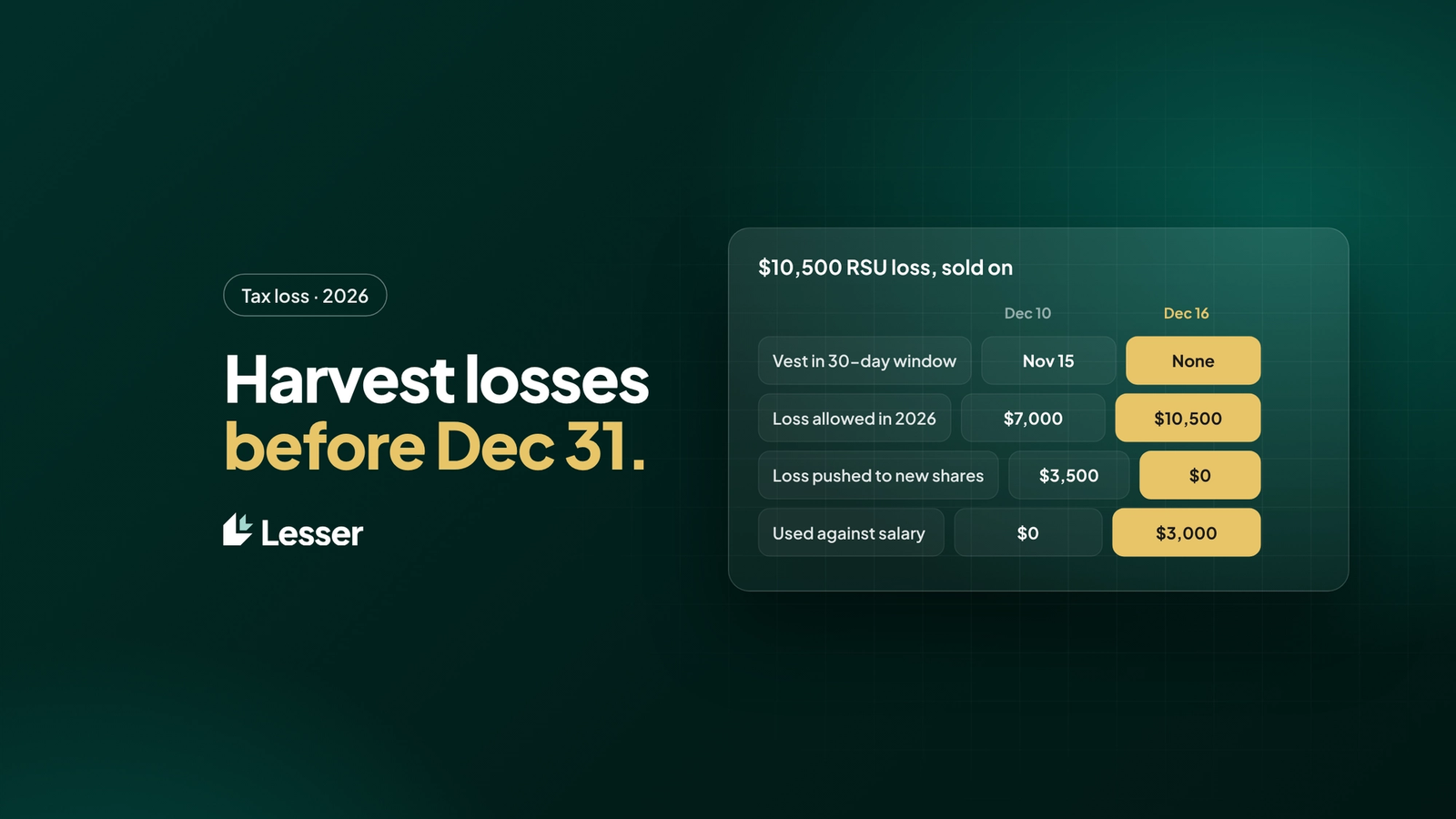
Worked example: one sale, two dates (illustrative)
Arjun is a made-up H-1B engineer in Texas, a US tax resident, single, with a $160,000 salary. These are simple, illustrative numbers, not a real client.
- In March 2026, 150 RSU shares vested at $200. His cost basis is $30,000.
- The stock is now $130, so those shares carry a $10,500 loss.
- Earlier this year he sold other shares for a $7,000 short-term gain.
- His RSUs vest quarterly: November 15, 2026, then February 15, 2027. 50 shares vested on November 15. He is not in the ESPP and dividend reinvestment is off.
Selling on December 10
The 30 days before December 10 reach back to November 10, so the November 15 vest is inside the window. The loss on 50 of his 150 shares is a wash sale: 50 x $70 = $3,500 is disallowed and added to the cost of the November shares. He can use $7,000 of loss in 2026. It cancels his $7,000 gain and nothing is left for his salary.
Selling on December 16
November 15 is now 31 days back, outside the window, and the next vest is February 15, 2027, more than 30 days after the sale. The full $10,500 loss counts in 2026:
- $7,000 cancels his short-term gain.
- $3,000 is deducted against his salary.
- $500 carries forward to 2027.
After the $16,100 standard deduction for 2026, Arjun's taxable income sits in the 24% bracket (over $105,700 for single filers in 2026). So waiting six days moves roughly $2,400 of federal tax savings into 2026 ($10,000 x 24%) instead of about $1,680 ($7,000 x 24%). His income is under the $200,000 threshold, so the 3.8% net investment income tax does not apply. Same shares, same price; only the date changed.
How do Indian mutual funds change the picture?
Indian mutual funds are usually passive foreign investment companies (PFICs) for US tax purposes. Our guide to Form 8621 for Indian mutual funds explains why. For harvesting, three things matter.
Gains are not regular capital gains
Under the default PFIC rules, the Instructions for Form 8621 say the entire gain from selling a section 1291 fund is treated as an excess distribution. It is spread over each day you held the fund. The part for the current year is taxed as ordinary income. The parts for earlier years are hit with a separate tax plus an interest charge. A capital loss from your RSU shares does not cancel that separate tax, and against the ordinary income part it is limited by the same $3,000 cap. So selling an Indian fund at a gain in December "because I have RSU losses" often does not work the way people expect.
Losses depend on your election
If you made the mark-to-market election, each year's increase in value is already in your income. Treasury regulation 1.1296-1 treats a later loss as an ordinary loss only up to the gains you included in earlier years (called unreversed inclusions). A loss beyond that falls under the general rules and can be a capital loss. Under the default rules, how a loss is treated is less settled, so get advice before you count on it.
SIPs can trigger a wash sale
A monthly SIP buys new units of the same fund. If you sell units of that fund at a loss and the SIP buys again within 30 days, you can run into the same wash sale problem as an RSU vest. Pause the SIP or switch funds before selling.
Remember the India side too. A redemption can be taxed in India, with tax deducted at source for NRIs, and you may then claim a foreign tax credit on Form 1116. Run both countries' numbers before you sell.
Which holdings harvest cleanly? A quick table
| Holding | A loss is treated as | Can it shelter other gains? | Wash sale trap to check |
|---|---|---|---|
| RSU or ESPP shares of your employer | Capital loss (short or long term) | Yes: gains first, then $3,000 of salary, rest carried forward | Any vest or ESPP purchase within 30 days before or after |
| US index fund or ETF in a brokerage account | Capital loss | Yes, same rules | Buying the same fund in your IRA, or reinvested dividends |
| Indian mutual fund, mark-to-market election | Ordinary loss up to past included gains, then capital loss | Its yearly gains are ordinary income, which capital losses offset only within $3,000 | A SIP buying the same fund within 30 days |
| Indian mutual fund, default PFIC rules | Not settled; get advice | Gains face ordinary income tax plus a separate tax and interest that capital losses do not cancel | A SIP buying the same fund within 30 days |
What to do this week
- By November 30, 2026: download your vest schedule and ESPP purchase dates from your equity portal for November 2026 through January 2027. Mark every date.
- By November 30, 2026: turn off automatic dividend reinvestment on anything you might sell at a loss, and pause SIPs in Indian funds you plan to sell.
- Early December: pick a sale date that is at least 31 days after your last vest or ESPP purchase and at least 31 days before the next one. Check your spouse's accounts and both IRAs for the same holdings.
- By Thursday, December 31, 2026: place the sale. That is the last trading day of 2026.
- Through January 30, 2027: do not buy the same stock or fund back, in any account, if your sale was on December 31. Count 30 days from your actual sale date.
- January 15, 2027: if your gains for 2026 are bigger than your withholding covers, make the fourth-quarter estimated payment. See the January 15 estimated tax payment and the 110% safe harbor.
For the wider picture on vesting, withholding and visas, read RSU taxes on an H-1B. If you have RSUs, ESPP and Indian funds in the same year, Lesser Tax does tax planning for tech equity and can check your dates before you sell. This post is general information, not personal tax advice.