
Lesser Tax
7 min read
Want an expert to handle this? Get your NRI taxes done right
Since January 1, 2026, the US charges a 1% federal excise tax on money sent abroad, but only when you pay the transfer service with cash, a money order, a cashier's check or a similar physical instrument. Transfers funded from a US bank account or with a US-issued debit or credit card are exempt. So if you send $500 a month to your parents from your bank account through a bank wire or an app, you owe $0. Pay $500 in cash at a counter instead and the provider adds $5 each time.
What is the 1% remittance tax?
The One Big Beautiful Bill Act added Section 4475 to the Internal Revenue Code. It puts a 1% tax on the amount of certain remittance transfers that occur after December 31, 2025. A remittance transfer is an electronic transfer of money that a person in the US asks a provider (a bank, a money transfer company or an app) to send to someone in another country. The IRS published proposed regulations on April 13, 2026, and they explain how the tax works in practice.
Three points matter for most readers:
- It is a tax on the sender, not on the person who receives the money in India. Your parents do not owe anything on the India side because of it.
- The provider collects it from you at the time of the transfer and pays it to the IRS. You do not report it on your own Form 1040.
- It applies only to personal transfers by an individual. The definitions come from the consumer remittance rules (Regulation E), which cover transfers made primarily for personal, family or household purposes, so business payments are outside it.
Which transfers are taxed and which are exempt?
The tax depends on how you pay the provider, not on who you are or where the money goes. Your visa, green card or citizenship does not change the answer.
Taxed at 1%
- Cash handed to a transfer company or its agent, such as a counter at a grocery store or a money transfer shop.
- Money orders, cashier's checks and, under the proposed rules, traveler's checks. These count as physical instruments even if you bought them with money from your bank account.
- A check cashed by the provider or its agent where the cash then funds the transfer. The proposed rules treat this as cash, even if you never hold the cash yourself.
Exempt
- Transfers funded with money withdrawn from an account at a US financial institution, such as a checking account linked to a bank wire, Wise, Remitly or Xoom.
- Transfers paid with a debit card or credit card issued in the United States.
- Small transfers of $15 or less, which fall outside the Regulation E definition of a remittance transfer.
The proposed rules also include an anti-abuse rule. If a transaction is set up with a principal purpose of avoiding the tax, for example using cash to buy a prepaid card and immediately funding a transfer with it, the IRS can disregard or recharacterize it.
How much is it? A worked example
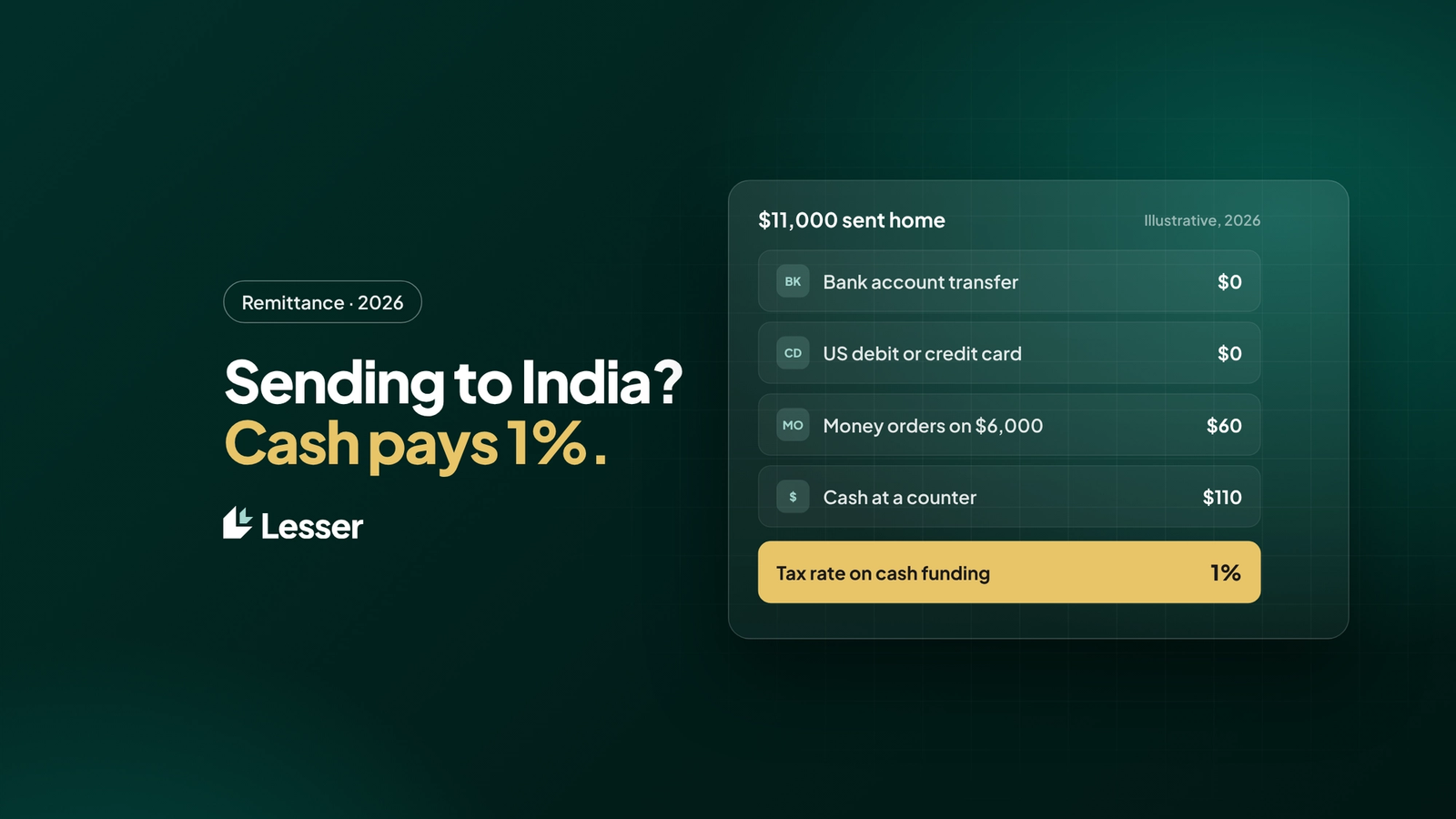
This example is illustrative, not a real client. Arjun works in New Jersey on an H-1B. In 2026 he sends his parents in Pune $500 every month, $6,000 for the year, and in December he sends another $5,000 toward his sister's wedding. Here is what the remittance tax costs him depending on how he pays:
| How Arjun pays for $11,000 sent in 2026 (illustrative) | Remittance tax | Why |
|---|---|---|
| Bank account linked to a transfer app | $0 | Funded from a US bank account |
| US-issued debit or credit card | $0 | Card exemption in Section 4475 |
| Cash at a transfer counter | $110 | 1% of $11,000 |
| Money orders for the monthly $500 only | $60 | 1% of $6,000; the wedding transfer from his bank is $0 |
The tax is calculated on the amount that will reach the recipient, not on the fees. If you hand over cash to send $1,000 and the provider charges a $20 fee, the tax is $10 (1% of $1,000), not $10.20. Fees, state taxes and charges for anything not transferred are left out. A promotional bonus that the provider adds to the amount sent is included.
For most salaried tech workers, the honest answer is that this tax costs nothing, because their transfers already come out of a bank account. The people who pay it are those who send cash: relatives visiting on a B-2 visa who use a counter service, workers paid partly in cash, students who use money orders, and anyone who cashes a paycheck at the same counter that sends the money.
Who is responsible if the tax is not collected?
The law makes the sender liable and the provider the collector. If the provider does not collect the tax when the transfer is made, the provider must pay it. Providers report the tax on Form 720, the quarterly federal excise tax return, and make semimonthly deposits. The IRS gave providers penalty relief for deposit mistakes in Notice 2025-55 and extended that relief in Notice 2026-52 while the rules are being finalized.
If a transfer you paid for is canceled or expires and the provider refunds you, the proposed rules let the sender claim a refund of the tax. Keep the receipt that shows the 1% line.
Does this change anything on the India side?
No. The remittance tax is a US excise tax charged at the time of sending. It does not change how India treats money you send to your parents. Gifts from a relative remain outside income tax in India, and nothing about this tax creates a filing for your family.
On the US side, the usual gift rules still apply. Money you send to your parents is a gift, and the 2026 annual exclusion is $19,000 per recipient. If your total to one person goes above that, read sending money to your parents in India every month for when Form 709 comes in. If your parents are sending money the other way, see what the US wants to know when parents send money and Form 3520 for gifts from parents in India.
Common myths about the remittance tax
- Myth: every NRI now pays 1% on money sent to India. Fact: only cash-type funding is taxed. Bank and US card transfers are exempt.
- Myth: the tax is 3.5% or 5%. Fact: earlier drafts of the bill proposed higher rates. The law that passed set it at 1%.
- Myth: green card holders and US citizens are exempt. Fact: status does not matter. Only the funding method does.
- Myth: you have to report it on your tax return. Fact: the provider collects it and files Form 720.
What to do this week
Wedding season and December trips mean bigger transfers in the next six weeks. Before your next one:
- By Friday, November 27: open your transfer app or bank and check how your next transfer is funded. Choose bank account or US debit card, not cash or a money order.
- Before you hand cash to a counter: if the money is already in your bank account, send it from there instead. Depositing cash first and sending later is not addressed in the proposed rules, so do not set up a transaction only to avoid the tax.
- Tell visiting parents or relatives who send money from the US that counter cash now costs 1% more, and help them fund it from a bank account or card if they have one.
- By December 31, 2026: add up what you sent to each person this year. If one person received more than $19,000, plan for Form 709.
- Keep receipts for any transfer that showed the 1% tax, in case it is canceled and you need a refund.
If you want a CPA to look at your full US and India picture, including gifts, FBAR and income from India, see how Lesser Tax works with NRIs.
This is general information, not personal tax advice. The regulations are still proposed and may change when finalized.