
Lesser Tax
8 min read
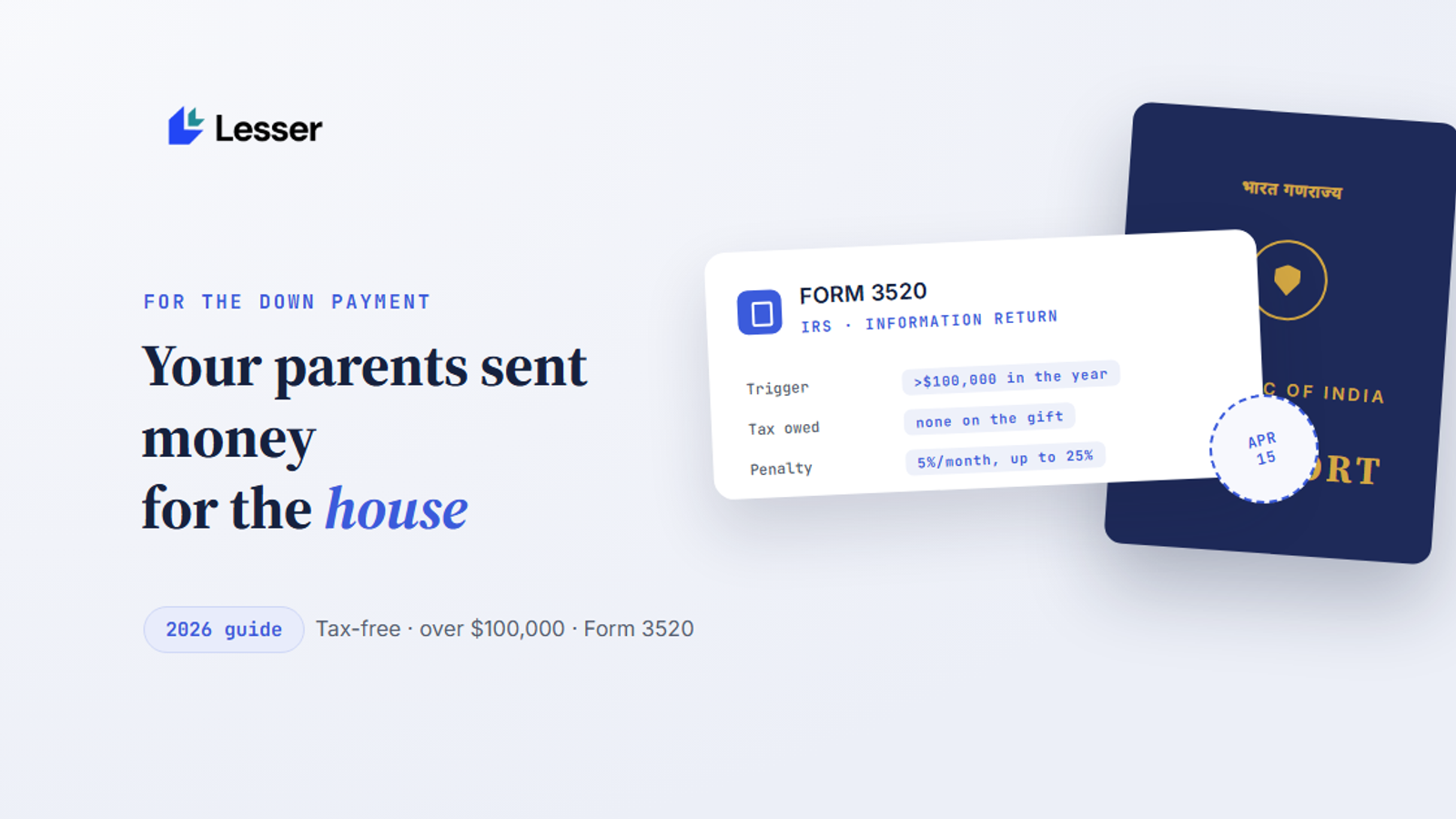
Quick answer: Your parents can wire money from India to help you buy a US house without creating any US income tax for you — a gift from a foreign person is not income to the recipient. The catch is reporting. If the total you receive from your parents (and anyone related to them) crosses $100,000 in one calendar year, the IRS wants to know about it on Form 3520. The money is not taxed; you just have to disclose it. Miss the form and penalties start at 5% of the gift per month, up to 25%.
Key takeaways
- Gifts from a nonresident parent are not US income to you — no tax on the gift itself. (IRS)
- You cross the reporting line when gifts from one foreign person — or related foreign persons combined — exceed $100,000 in a tax year. (IRS Form 3520 instructions)
- The form is Form 3520, filed separately from your 1040, due the 15th day of the 4th month after your tax year ends (April 15 for most people). (IRS)
- Late filing penalty is 5% of the gift per month, up to 25% — unless you can show reasonable cause. (IRS)
- On the India side, your parents can each send up to USD 250,000 per financial year under the RBI Liberalised Remittance Scheme. (RBI LRS)
Want an expert to handle this? Get your NRI taxes done right
Why did my parents send money for the house instead of co-signing?
For most Indian families, this is the simpler path. Your parents can't easily co-borrow on a US mortgage from India — US lenders need US credit, US income, and usually a US co-signer who lives here. So they do what works: they wire the down payment as a gift. The lender gets a cleaner file, you get the keys, and nobody has to untangle an Indian income statement for a Dallas underwriter.
The money typically moves out of their NRO or regular savings account in India through the RBI's Liberalised Remittance Scheme, which lets each resident Indian send up to USD 250,000 per financial year abroad for permitted purposes, including gifts to family. Two parents can collectively send up to USD 500,000 in one Indian financial year (April to March).
Do I owe US tax on money my parents gift me?
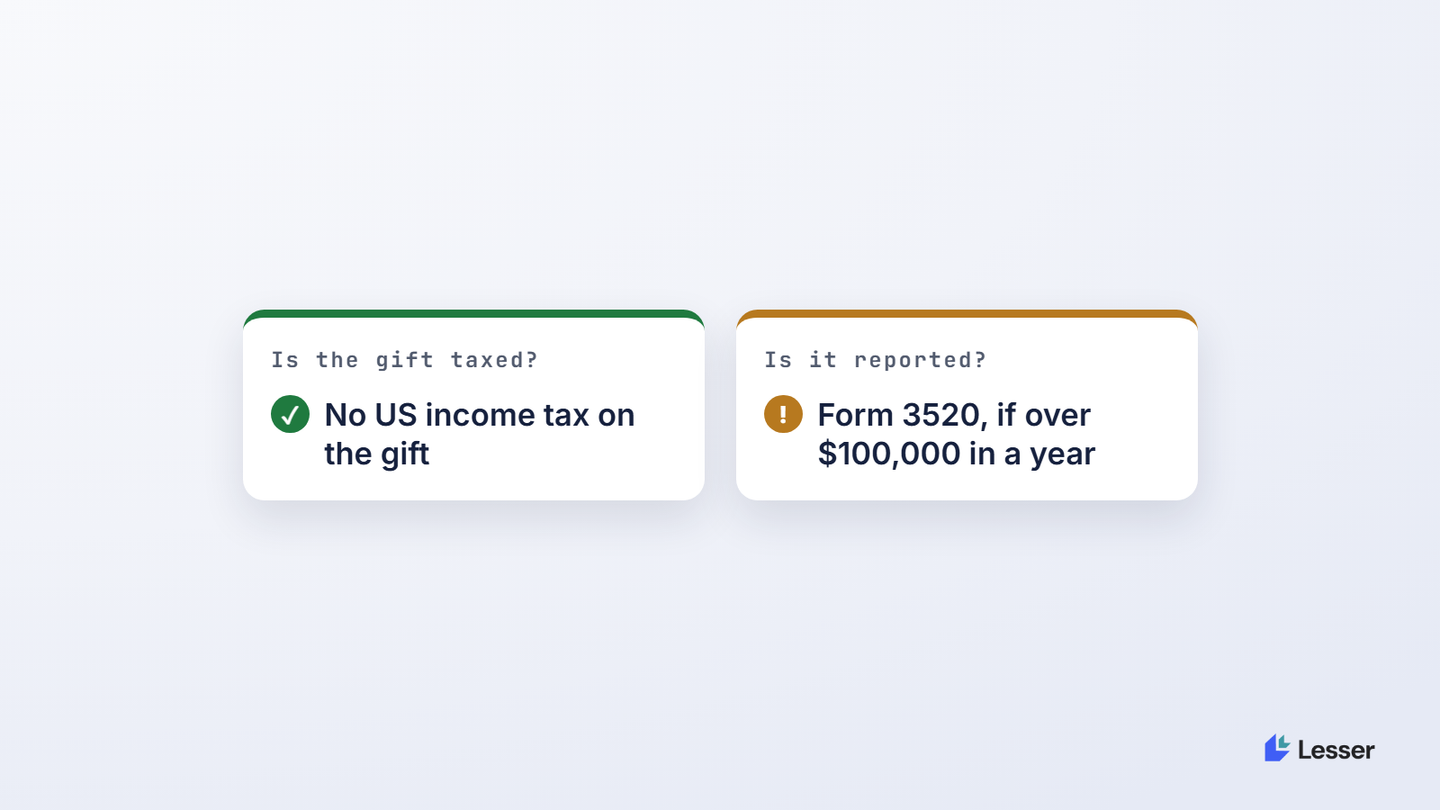
No. The US tax rule here is simple: a gift from a foreign person is not income to you. You don't put it on your 1040, you don't pay income tax on it, and your mortgage lender treating it as a down payment doesn't change that. The gift tax, where it exists, is paid by the giver — and your parents in India are not US persons, so there is no US gift tax either.
What you do owe is a disclosure. That's it. The money is tax-free; the paperwork is not optional.
When does Form 3520 come in?
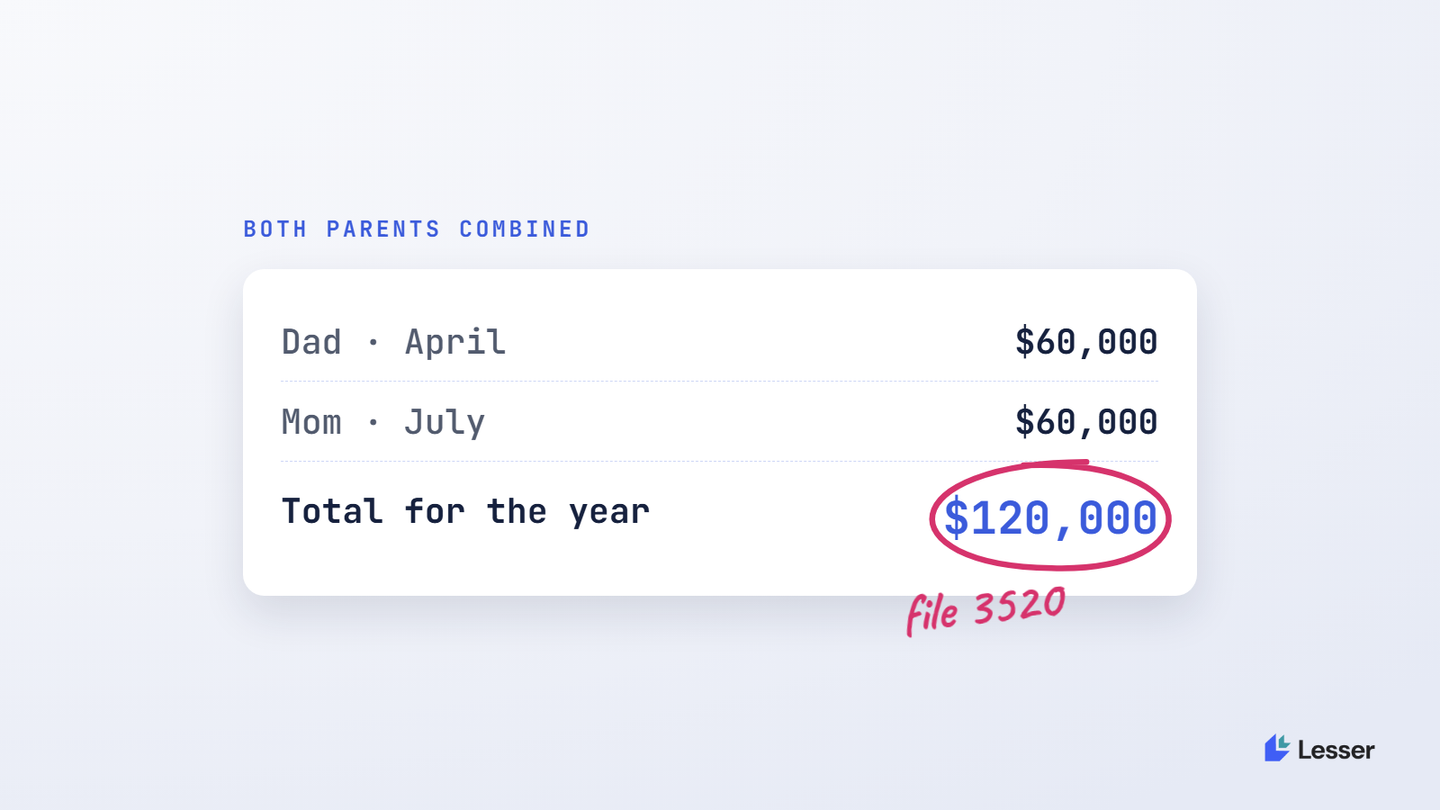
When the total you received from your foreign parents (and anyone related to them, counted together) crosses $100,000 in one tax year. The threshold applies to the total, not to a single wire. If your dad sends $60,000 in April and your mom sends $60,000 in July, you've crossed the line even though no single transfer did.
A few things that often surprise people:
- It's the calendar year total that matters for most individual filers, not the Indian financial year.
- Both parents combined count toward the same $100,000 line, because they are related.
- The character of the money doesn't matter — down payment, closing cost help, "take care of yourself" — it's all a gift for this rule.
- The gift still gets reported in the year you received it, even if the house closes the next year.
If the total stays under $100,000, no Form 3520 is required for the foreign-gift reason. If it crosses, the full amount gets reported — not just the piece above $100,000.
What is Form 3520 and what does it do?
Form 3520 is an information return. It tells the IRS "I received a large gift from a foreign person" and shows the dates, amounts, and that the giver was a nonresident. There is no tax calculation at the end. You file it separately from your 1040 — not attached — and mail it to the IRS service center in Ogden, Utah.
You still file your regular 1040 the normal way. Form 3520 just rides alongside it, due the same April 15 (with the same six-month extension available).
Deep guide: Form 3520 for gifts and inheritance from parents in India walks through exactly which boxes to tick, how to list each wire, and what to attach.
Does it matter if the money sat in an NRE/NRO account first, or came through a service like Wise?
Not for the US side. What matters is who the giver is (a nonresident parent) and how much you received during the year. Whether the money cleared through Wise, a wire from HDFC, your parents' NRO account, or a joint NRE account you share with them doesn't change the reporting rule.
What it can change is proof. Keep a simple paper trail: the SWIFT confirmations, bank statements showing the deposit into your US account, and a short gift letter from your parents saying it is a gift (not a loan). The lender will ask for that letter anyway for the mortgage. Save a copy for your own file; if the IRS ever asks, it's the easiest thing to produce.
If your parents' accounts in India are in your name too, or you have signature authority over them, that may trigger separate FBAR and Form 8938 reporting — different form, different threshold. And if the gift is part of a bigger first-year checklist, our NRI tax checklist for the US walks through the full set.
What happens if I didn't file Form 3520 last year?
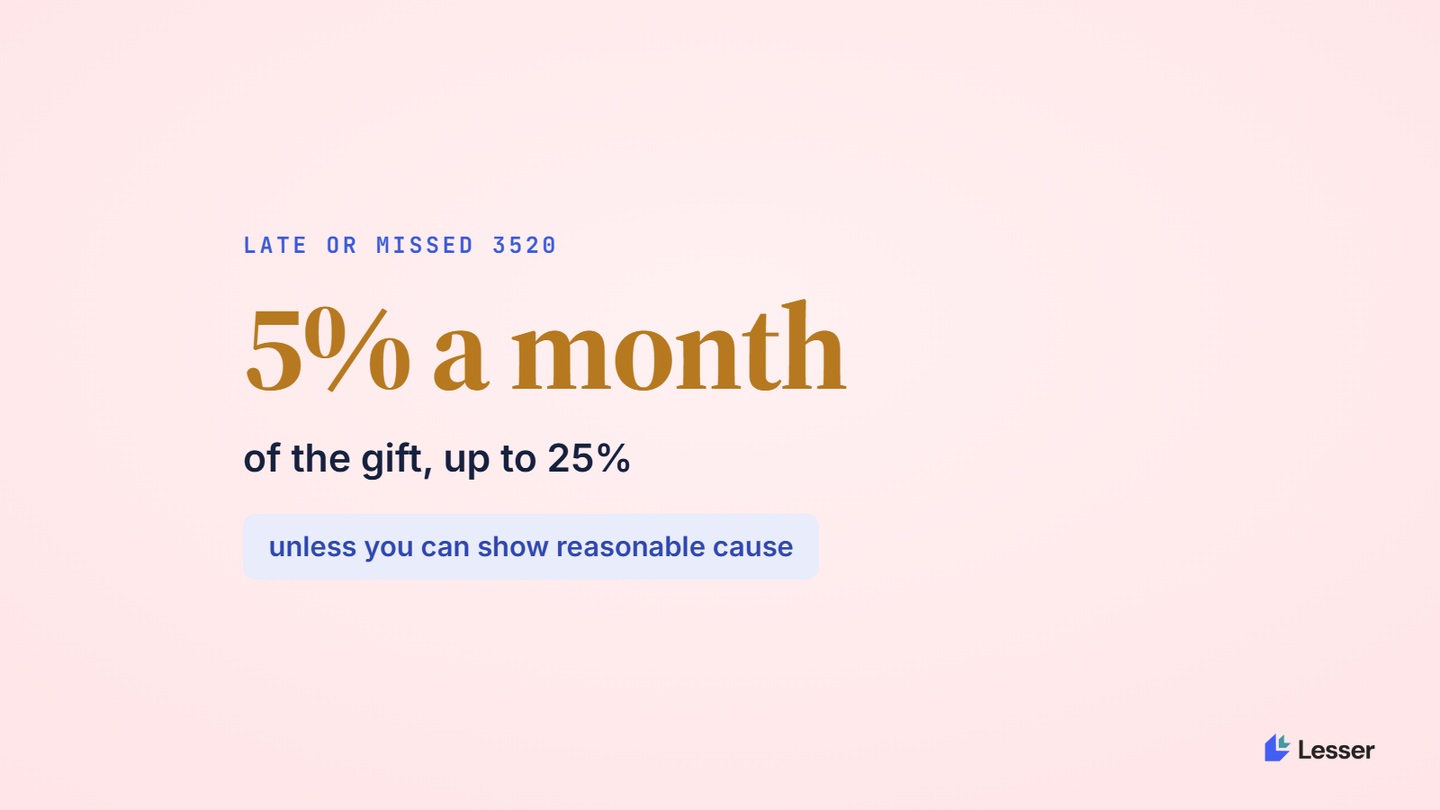
This comes up constantly — the house closed, life moved on, and nobody mentioned a form. The penalty for a late or missing Form 3520 is 5% of the gift value for each month you don't file, up to a maximum of 25%. On a $200,000 gift that's up to $50,000 in penalties if the IRS catches it before you fix it.
The good news: the penalty can be waived if you can show reasonable cause — a genuine, documented reason you missed it, not just "I didn't know." File the late Form 3520 with a short reasonable-cause statement attached. The sooner you do it, the better the facts look.
What does this mean for your taxes?
Two things, in order:
- The gift itself is tax-free. You don't owe income tax on money your parents sent for the house, no matter how big the wire.
- If the year's total crosses $100,000, Form 3520 is due with your tax return, filed separately to Ogden. This is a disclosure, not a tax — but skipping it is expensive.
If you're close to the line, or you've already received the money and nobody has mentioned a form, this is exactly the work a US tax CPA does every spring for Indian families. See how we handle it at Lesser for NRIs.
FAQ
Does the $100,000 line reset each year?
Yes. It's a per-tax-year test. If your parents gift you $90,000 in 2026 and another $90,000 in 2027, neither year crosses the line, so Form 3520 is not required for the foreign-gift reason in either year. Keep records anyway.
My parents sent money through a cousin's account. Does that still count as a gift from them?
If the real source of the money is your parents and the cousin was just a conduit, it's still a gift from your parents, and still counts toward the $100,000 line. The IRS looks at who really gave the money, not whose account it passed through. This is also why clean documentation matters.
Do I report the money if I'm on an H-1B or a green card, or only if I'm a US citizen?
Form 3520 applies to US persons — that includes US citizens, green card holders, and residents under the substantial presence test (which most H-1B holders meet after their first full year). If you file a Form 1040, you're almost certainly a US person for this rule.
What if the gift is to my spouse, not to me?
It's the recipient who files, not the household. If the wire landed in your spouse's name and only in their name, the reporting sits with them. If it's a joint account you own together, treat it as received by both of you.
Does the mortgage lender's gift letter satisfy the IRS too?
No. The gift letter is for the lender. Form 3520 is a separate IRS filing with its own form and its own instructions. Both are needed, for different reasons.