
Lesser Tax
13 min read
Quick answer: If you are a US citizen or green card holder who has moved to India, you still file a US 1040 on your worldwide income — but you have two tools to avoid paying US tax twice on the same salary. The foreign earned income exclusion (Form 2555, FEIE) lets you exclude up to $130,000 of foreign salary for 2025 ($132,900 for 2026), but only if you pass either the bona fide residence test or the 330-day physical presence test. The foreign tax credit (Form 1116, FTC) credits the Indian income tax you actually paid against your US tax, dollar for dollar. For most Indian tech salaries, the FTC wipes out more US tax than the FEIE and keeps the IRA/401(k) and child tax credit doors open. The FEIE is better in your first partial year abroad when Indian tax is still low, and when your salary is well under $130,000. You can use both in the same year on different income (FEIE on salary up to the cap, FTC on everything above), but once you elect FEIE and later revoke it, you cannot elect it again for 5 years without IRS permission.
Key takeaways
- The 2025 FEIE cap is "$130,000" per qualifying person; the 2026 cap is $132,900 (IRS, Figuring the Foreign Earned Income Exclusion; IRS, Instructions for Form 2555, 2025).
- To use the FEIE you must have a tax home in a foreign country AND meet either the bona fide residence test (an uninterrupted period that includes "an entire tax year") or the physical presence test ("at least 330 full days during any period of 12 consecutive months") (IRS, Foreign Earned Income Exclusion).
- The FTC lets you credit Indian income tax against US tax if you "paid or accrued foreign taxes to a foreign country or U.S. possession and are subject to U.S. tax on the same income" (IRS, Foreign Tax Credit).
- You cannot credit Indian tax on income you already excluded under the FEIE — the two cannot double-dip on the same rupee (IRS, Foreign Tax Credit).
- If you revoke an FEIE election, "you can't claim the exclusion(s) for your next 5 tax years without the approval of the IRS" (IRS, Instructions for Form 2555, 2025).
- Unused FTC in a category carries back 1 year and forward 10 years (IRS, Instructions for Form 1116).
Want an expert to handle this? Get your NRI taxes done right
Why you still owe a US return after moving to India
A US citizen or lawful permanent resident is "subject to tax on worldwide income from all sources and must report all taxable income and pay taxes according to the Internal Revenue Code" (IRS, US Citizens and Resident Aliens Abroad). Moving to Bengaluru does not change that. You get an automatic 2-month extension to June 15 if you are abroad on the regular due date, but interest still accrues on anything unpaid after April 15.
What changes is where your salary is sourced. Work physically performed in India is foreign-source income under US rules. India will also tax it under its own rules once you become an Indian tax resident. Two countries, one paycheck, one potential double hit — unless you use the FEIE or the FTC.
The FEIE in one page: Form 2555
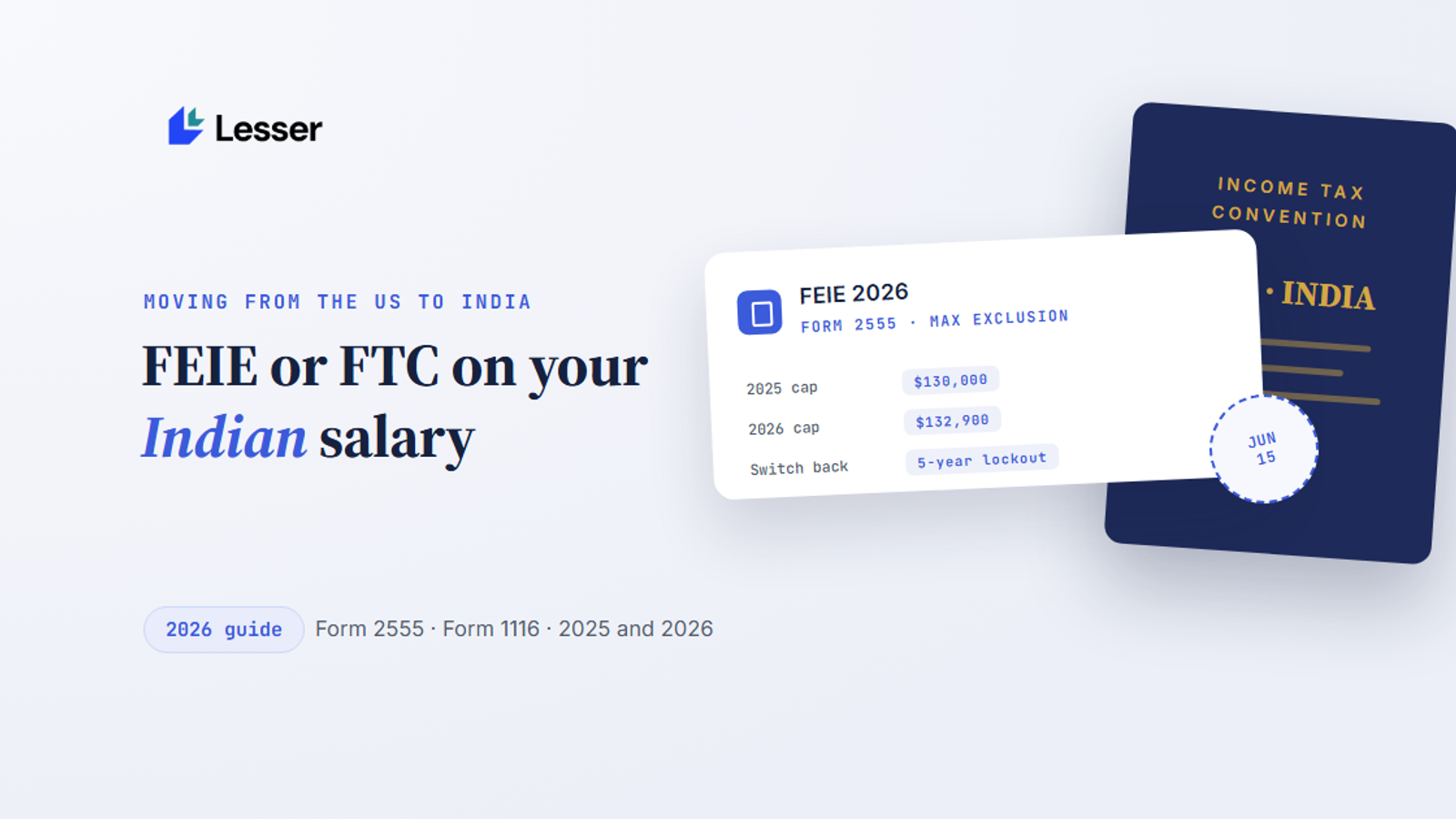
The FEIE lets you exclude foreign salary (and self-employment income) from your US gross income up to an annual cap. For 2025, "the maximum exclusion amount has increased to $130,000" (IRS, Instructions for Form 2555, 2025). For 2026 the cap is $132,900.
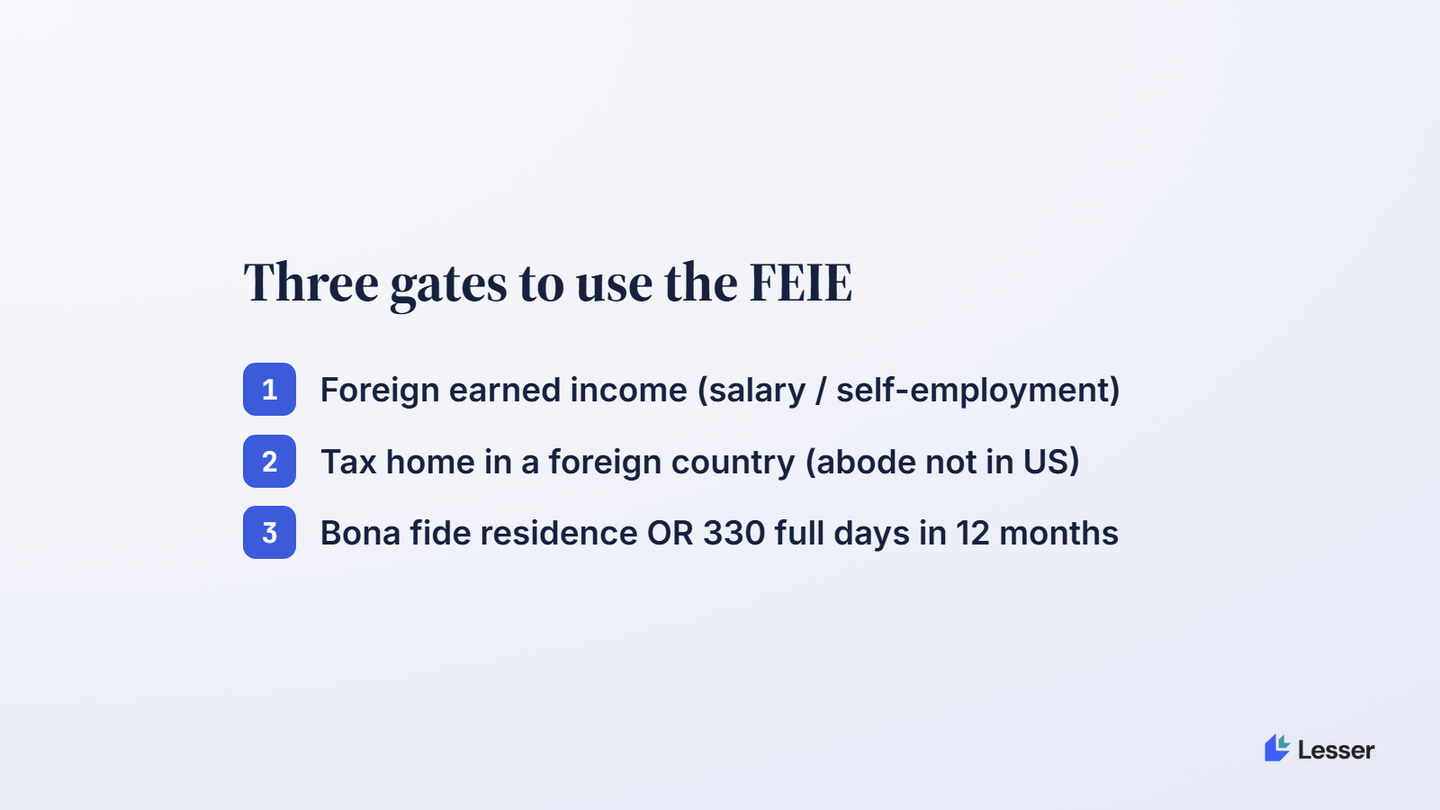
To qualify you need three things (IRS, Foreign Earned Income Exclusion):
- Foreign earned income — salary or self-employment income for work performed in a foreign country. Dividends, interest and capital gains do not qualify.
- A tax home in a foreign country — your "regular or principal place of business, employment, or post of duty" is in India, not the US. The IRS also says: "you aren't considered to have a tax home in a foreign country for any period during which your abode is in the United States" (IRS, Instructions for Form 2555, 2025).
- Either bona fide residence or physical presence:
- Bona fide residence test: a US citizen (or treaty-country resident alien) who is "a bona fide resident of a foreign country, or countries, for an uninterrupted period that includes an entire tax year." Intent matters: "your acts carry more weight than your words."
- Physical presence test: "physically present in a foreign country or countries for at least 330 full days during any period of 12 consecutive months." A full day is "the 24-hour period that starts at midnight."
The housing exclusion sits on top
Beyond the salary exclusion, you can also exclude certain foreign housing costs. The base amount is "generally 30% of the maximum foreign earned income exclusion" — for 2025 that is "$39,000 (30% of $130,000)" for most locations; the 2026 base is $39,870. The actual cap "will vary depending upon the location of your foreign tax home and the number of qualifying days" (IRS, Figuring the Foreign Earned Income Exclusion).
The FTC in one page: Form 1116
The FTC credits foreign income tax you actually paid against the US tax on the same income. "If you paid or accrued foreign taxes to a foreign country or U.S. possession and are subject to U.S. tax on the same income, you may be able to take either a credit or an itemized deduction for those taxes" (IRS, Foreign Tax Credit). "In most cases, it is to your advantage to take foreign income taxes as a tax credit" (IRS, Foreign Tax Credit).
A few mechanics that matter when the foreign country is India:
- Separate category baskets. You file a separate Form 1116 for each category. Passive category income is "dividends, interest, royalties, rents, annuities." General category income is "wages, salary, and overseas allowances of an individual as an employee" (IRS, Instructions for Form 1116). Indian salary tax goes in the general basket; TDS on NRO interest goes in passive.
- The limit. The credit cannot exceed "the smaller of (a) your total foreign tax, or (b) your regular tax," calculated as (foreign source taxable income ÷ worldwide taxable income) × US tax liability (IRS, Instructions for Form 1116). If your Indian tax rate is higher than your effective US rate on that income, the excess is unused.
- Carryover. Unused FTC in a category carries back 1 year and forward 10 years (IRS, Instructions for Form 1116).
- $300/$600 skip-the-form election. You can skip Form 1116 if all your foreign tax is passive, is on a qualified 1099, and totals under "$300 ($600 if married filing a joint return)" (IRS, Instructions for Form 1116). Rarely applies to someone who moved to India and has salary there.
FEIE vs FTC: which one actually saves more?
For a US citizen on an Indian salary, the honest answer is almost always: the FTC, once you are a full-year Indian tax resident. India's slab rates on ₹20L+ salaries end up higher than the effective US rate on the same income, so the Indian tax usually wipes out all the US tax and leaves a carryforward too.
Three places the FEIE wins instead:
- Partial first year. You moved to India mid-year, you aren't yet an Indian tax resident for Indian purposes, and Indian tax on your short India salary period is small. The FEIE (pro-rated — see below) can zero out that slice of US tax faster than the FTC.
- Low total salary. If your Indian salary is under the FEIE cap and you have no US-source income to speak of, the FEIE excludes it in one line without the Form 1116 math.
- You want to keep a very low AGI for an unrelated reason — but note the FEIE's downsides below before you reach for it.
A worked example (2026)
Priya is a US citizen who moved from Seattle to Hyderabad on 2 Jan 2026. She works for an Indian employer and earns ₹60,00,000 (about $72,000 at the IRS average rate). India withholds roughly ₹14,00,000 (about $16,800) of income tax at source after standard deduction. She has no US-source income.
- Under the FEIE: she passes the 330-day physical presence test over her first 12 months in India, excludes the full $72,000, and her US tax on the salary is $0. But she cannot credit the $16,800 of Indian tax against US tax on that same salary (IRS, Foreign Tax Credit). Her earned income for IRA purposes is also $0.
- Under the FTC: she reports the full $72,000 on her 1040, calculates US tax on it (roughly $5,800 for a single filer in 2026 before credits), and credits her $16,800 of Indian tax. Her US tax on the salary is $0, and she has about $11,000 of unused general-category FTC that carries forward 10 years. She still has $72,000 of earned income for IRA/401(k) contribution purposes and can claim the refundable portion of the child tax credit.
For Priya, the FTC is clearly better. The FEIE wipes out the same US tax, but the FTC keeps more doors open.
The downsides of the FEIE people miss
The FEIE looks clean on paper. The costs are quieter:
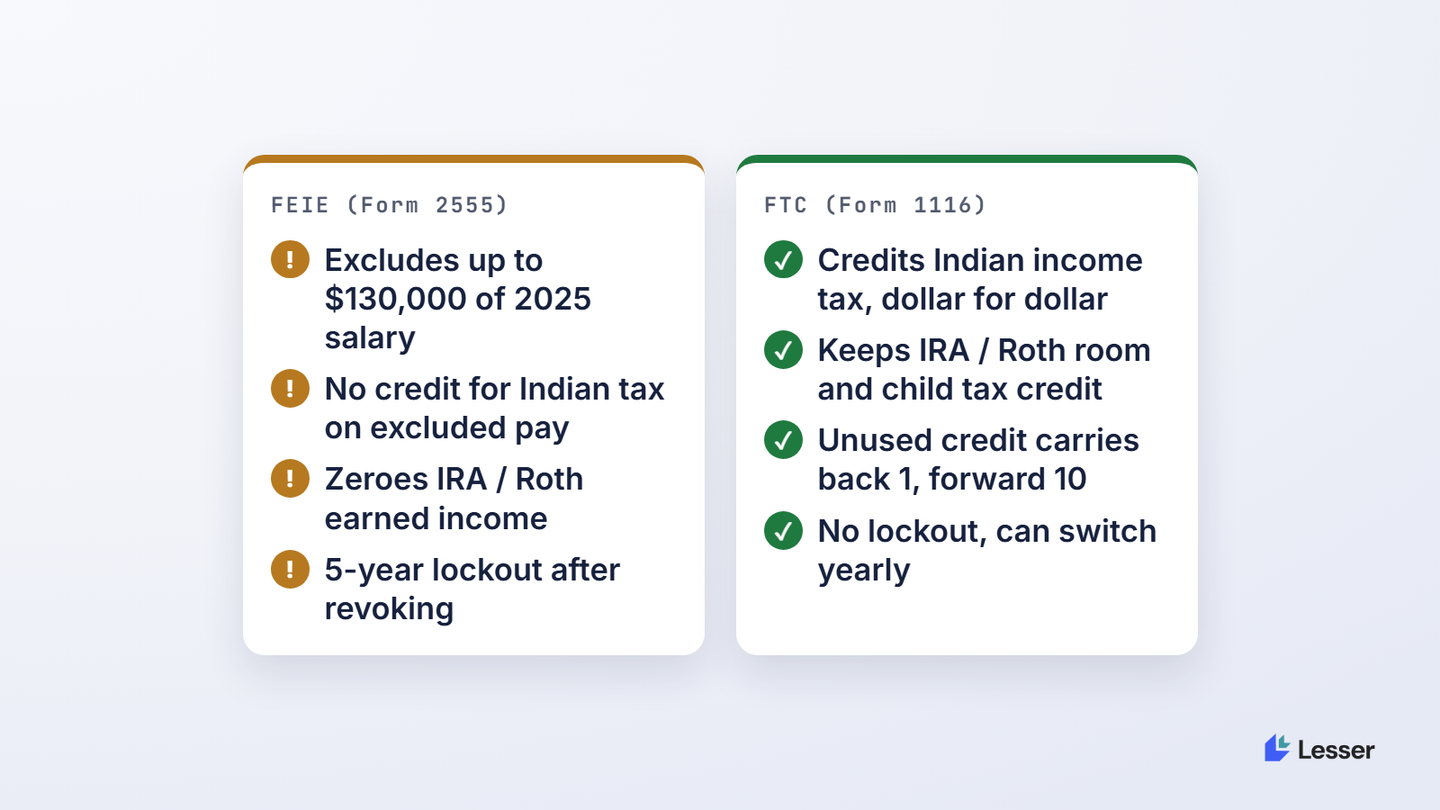
- It zeros out your earned income for US tax, so it zeros out your IRA/Roth IRA contribution room. The contribution limit is tied to taxable compensation. Excluded income is not compensation.
- It blocks the refundable child tax credit on excluded income. Form 8812 explicitly backs out FEIE income when computing the refundable portion.
- You cannot credit the Indian tax on excluded income. This is the big one — if India taxes you at a higher rate than the US would, you lose the extra forever on the excluded slice.
- The 5-year lockout. If you revoke, "you can't claim the exclusion(s) for your next 5 tax years without the approval of the IRS" (IRS, Instructions for Form 2555, 2025). Switching from FEIE to FTC is a one-way door for 5 years.
- The 330-day test is strict. A full day is "the 24-hour period that starts at midnight." Transit days don't count. A single week-long US business trip during your qualifying 12 months can blow it.
When to use both in the same year
You can stack the FEIE on your first $130,000 (2025) / $132,900 (2026) of foreign salary and use the FTC on everything else — any excess salary, bonus, RSU vest income, Indian interest, Indian capital gains. The arithmetic rule is one-way: no credit on tax attributable to excluded income (IRS, Foreign Tax Credit).
| Scenario | What usually wins |
|---|---|
| First (partial) year in India, Indian salary < $100K | FEIE (pro-rated) |
| Full year Indian resident, Indian salary < $130K, no US-source | FTC (keeps IRA room) |
| Full year Indian resident, Indian salary > $130K | Stack: FEIE on first $130K + FTC on the rest |
| You plan to come back to the US in <5 years | FTC (avoid the 5-year lockout) |
| High TDS on NRO interest/capital gains | FTC (passive basket) |
The table assumes you qualify for the FEIE in the first place; many partial-year movers do not meet bona fide residence and must rely on physical presence over a 12-month window. If you have an open 401(k) or IRA in the US and are moving back, see US 401(k) when moving back to India; for RSU timing before the move, see selling RSUs before moving back to India.
How the pro-rata rule works in a partial year
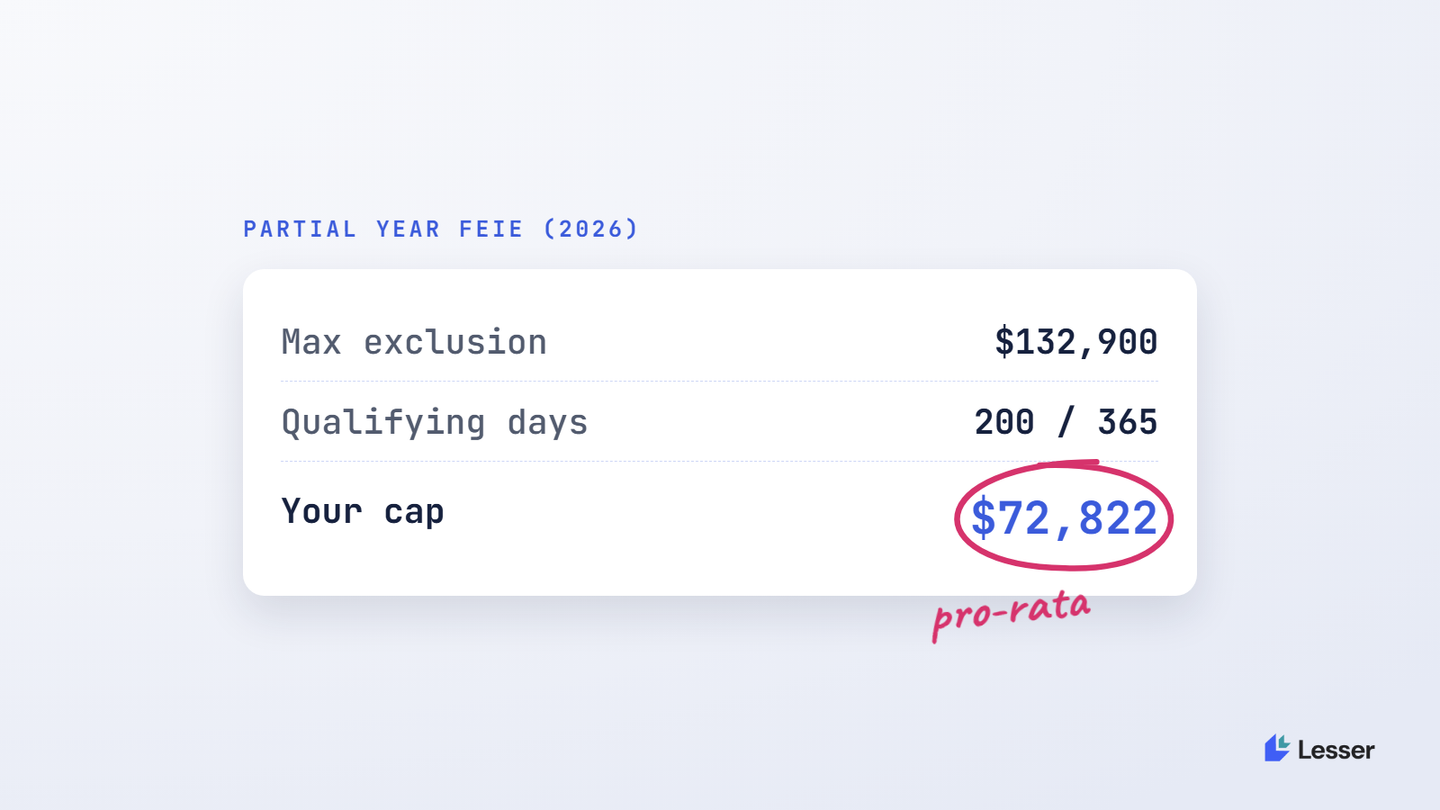
If you qualify only part of the year, the FEIE cap is reduced. The IRS says: "multiply the maximum exclusion amount for the year by the number of your qualifying days in the year, and then divide the result by the 365 (366 if a leap year)" (IRS, Figuring the Foreign Earned Income Exclusion).
Example: you qualify under the physical presence test for the last 200 days of 2026. Your maximum exclusion is $132,900 × 200 / 365 = $72,822.
How to actually make and revoke the election
- Elect. The election "must be made on a timely filed return (including extensions) or on a return amending a timely filed return" (IRS, Instructions for Form 2555, 2025). You attach Form 2555 to your 1040.
- Keep it. Once made, the election stays in force every year you qualify, until you revoke it.
- Revoke. You revoke by not claiming the exclusion on a return, or by attaching a statement. After revocation, the 5-year lockout kicks in.
If you expect to switch to the FTC within the next few years (common when your Indian salary grows past the cap and the FTC becomes mathematically better), think twice before electing the FEIE in the first place.
FAQ
Can I use the FEIE and FTC in the same year?
Yes, on different income. You can exclude up to the FEIE cap of your foreign salary and claim the FTC on everything else. You just cannot credit foreign tax that is attributable to the income you excluded (IRS, Foreign Tax Credit).
I moved to India in October. Can I use the FEIE this year?
Usually not for the current year's return filed in April — you have not yet met either the bona fide residence test (needs an entire tax year) or the 330-day physical presence test. The standard move is to file an extension (Form 4868, and then Form 2350 if you need more time to meet the physical presence test), wait until you clear 330 days, and then file claiming a pro-rated exclusion (IRS, Instructions for Form 2555, 2025).
Does the FEIE reduce my self-employment tax?
No. The FEIE "will reduce your regular income tax but will not reduce your self-employment tax" (IRS, Foreign Earned Income Exclusion). India's totalization agreement with the US is still not in force as of 2026, so Indian self-employed US citizens often owe US SE tax even on excluded income.
Is Indian TDS on NRO interest creditable?
Yes, up to the treaty cap, as a passive-category FTC on Form 1116. See our deep dive on Form 1116 for TDS on NRO interest.
What happens to my FEIE if I take a 3-week trip back to the US?
Days physically present in the US do not count toward the 330. If your 12-month window still clears 330 full foreign days, you still qualify; if it does not, you must re-slide the window or fall back on the FTC for that year (IRS, Instructions for Form 2555, 2025).
Does the FEIE help if I am a green card holder, not a citizen?
Only if your country of citizenship has a US income tax treaty and you qualify as a bona fide resident of a foreign country under that treaty's residency rules. Most green card holders moving to India use the FTC and (if they are leaving permanently) also need to think about US exit tax.