
Lesser Tax
6 min read
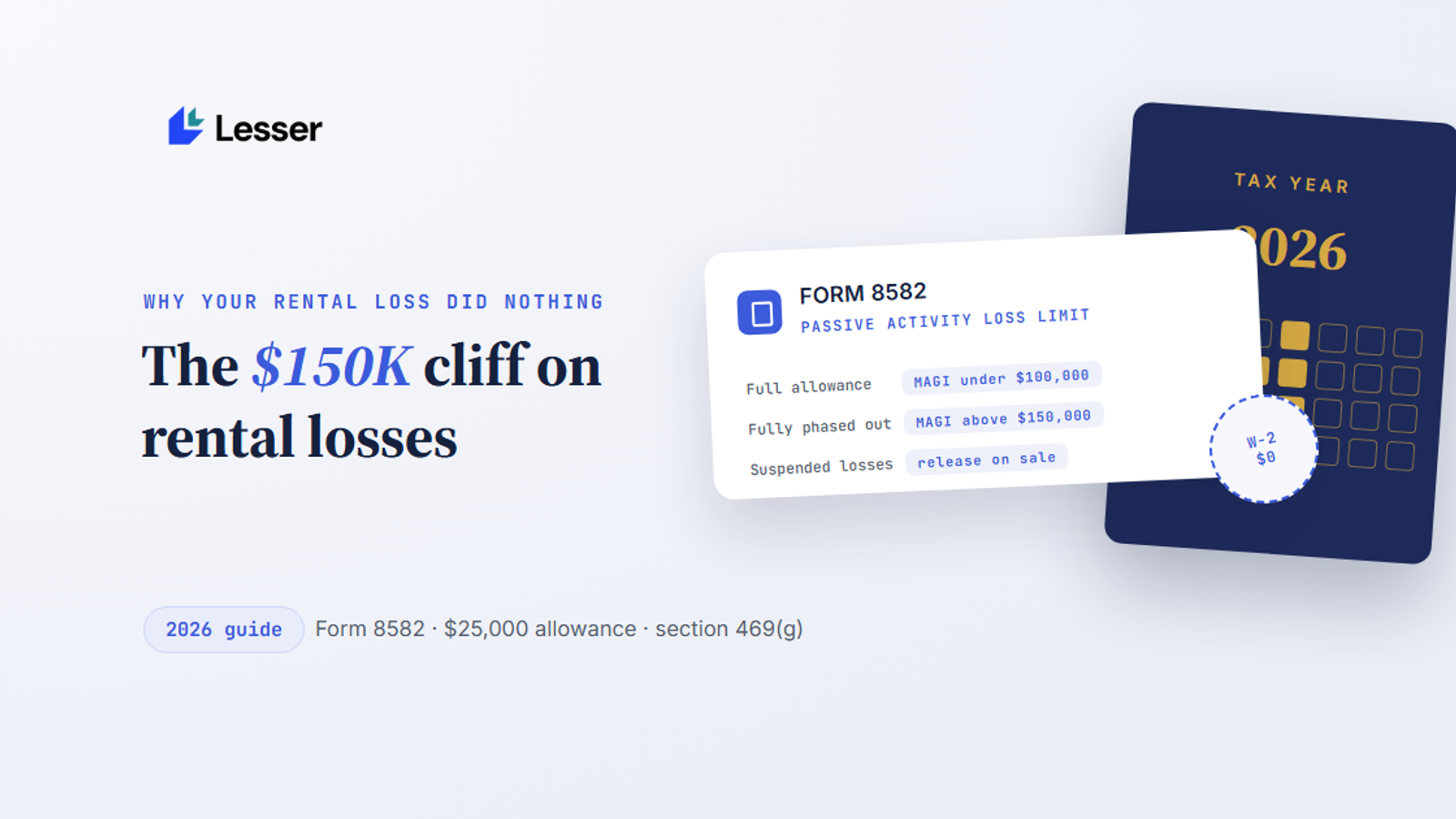
Quick answer: The rental loss on your Schedule E does not reduce your W-2 tech salary tax if your modified AGI is above $150,000. By default, rental real estate is a passive activity. Passive losses only offset passive income — not your salary. There is a safety valve called the $25,000 special allowance for active participants, but it fully phases out between $100,000 and $150,000 of MAGI (married jointly and single alike; half those numbers if MFS). A single H-1B engineer earning $180,000 who bought a rental and shows a $12,000 Schedule E loss gets $0 of it against the W-2 in the current year. The loss is not gone — it suspends on Form 8582 and carries forward indefinitely, releasing in full when you sell the property in a fully taxable disposition (section 469(g)).
Want an expert to handle this? Get your NRI taxes done right
Situations you'll recognise
- Your TurboTax refund did not change after you added the rental and its $9,000 depreciation.
- You expected the rental loss to drop your W-2 taxable income; it did not.
- Form 8582 appeared in your return with a scary disallowed-losses number.
- Your CPA said "your MAGI is too high" and you did not know what that meant.
- You hear colleagues talk about "real estate professional status" and wonder if that is the fix.
- Your rental made money on paper (positive cash flow) but shows a tax loss because of depreciation.
Why this happens
Under Internal Revenue Code section 469, rental activities are passive "even if you materially participated in that activity, unless you materially participated as a real estate professional" (IRS, Publication 925). Passive losses can only offset passive income — not wages, not interest, not capital gains.
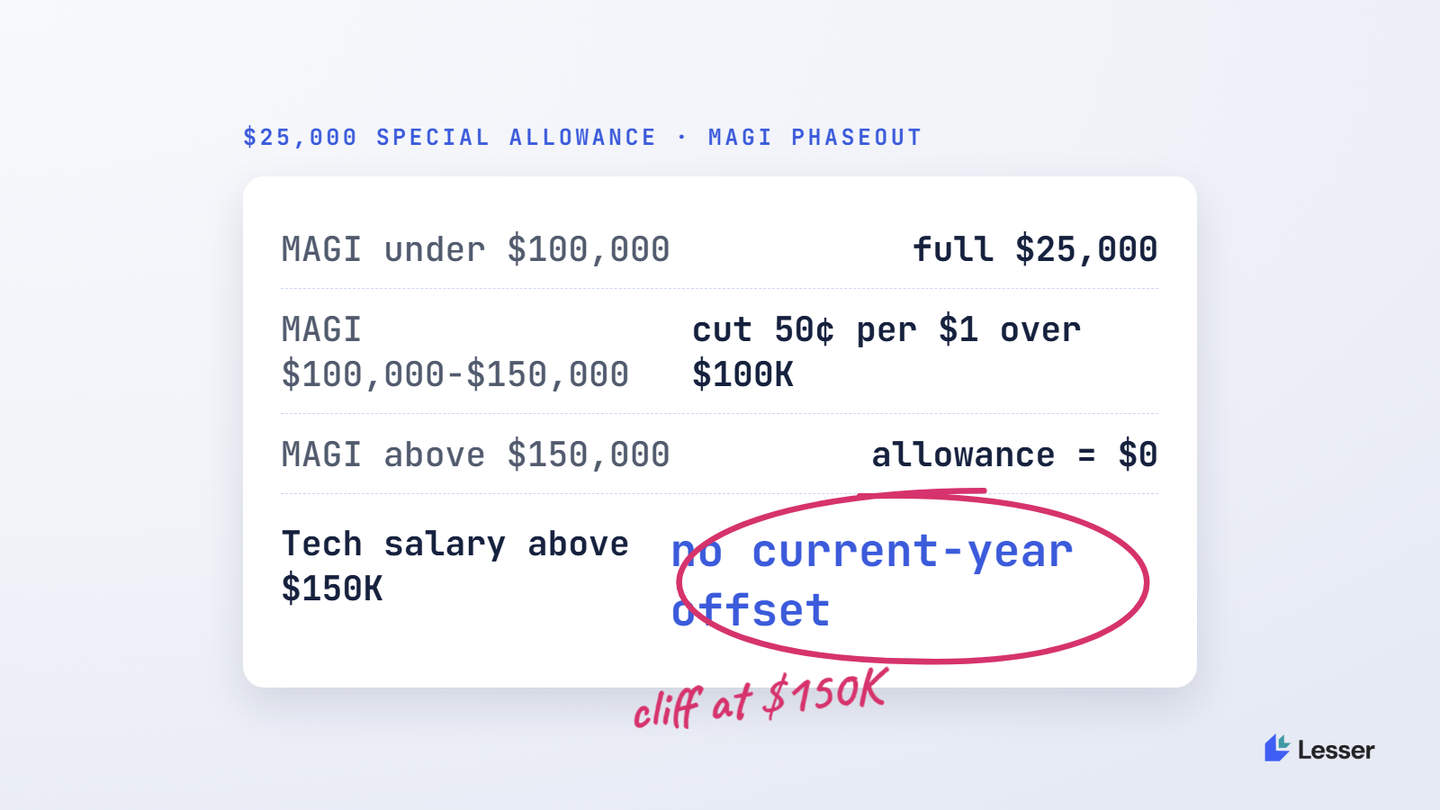
Congress built one carve-out for small landlords: the $25,000 special allowance. If you "actively participate" (a lighter test than material participation — "approving new tenants," "deciding on rental terms," "approving capital or repair expenditures," and holding at least a 10% interest), you can deduct up to "$25,000 of loss from the activity from your nonpassive income" (IRS, Instructions for Form 8582).
The catch is the MAGI phaseout. The allowance "decreases by 50% of MAGI exceeding $100,000," and "once MAGI reaches $150,000 (or $75,000 for married filing separately), the allowance typically disappears entirely" (IRS, Publication 925). A tech salary above $150K wipes it out.
A real example
Priya, single, is an engineer on H-1B earning $180,000 base. In 2026 she buys a $500,000 condo in Austin and rents it out. After mortgage interest, HOA, insurance, property tax and depreciation, her Schedule E shows a $12,000 loss.
- Her MAGI is well above $150,000. The $25,000 special allowance is zero.
- She has no other passive income (no other rentals, no limited partnership income).
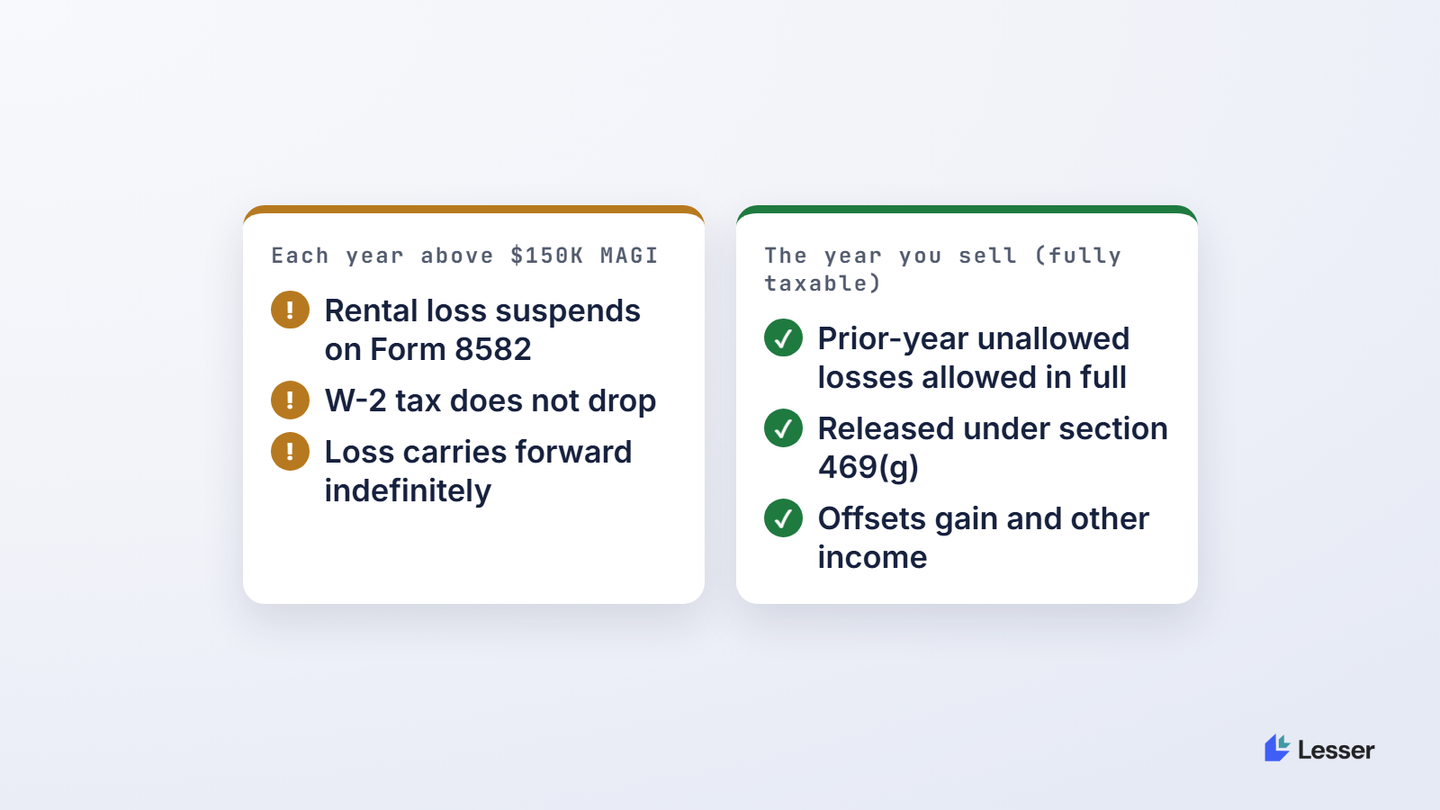
- Form 8582 disallows the full $12,000. It carries forward.
- Her W-2 tax does not drop at all.
- When she sells the condo in a fully taxable transaction, the suspended $12,000 (plus any further years' suspended losses) is "allowed in full" against the sale gain and against other income under section 469(g) (IRS, Instructions for Form 8582).
What getting it right gives you
- No surprise at refund time. You understand that a Schedule E loss above $150K MAGI is a bookkeeping entry, not a current-year tax cut.
- A real plan for the loss. Suspended losses carry forward indefinitely and are allowed in full when you dispose of the property in a fully taxable transaction (IRS, Instructions for Form 8582).
- A clean Form 8582. The carryforward amount is tracked year by year so nothing is lost between CPAs.
- A sharper question to ask. "Can my spouse qualify as a real estate professional?" is a specific, answerable planning question — not a vague wish.
What this does and does not do
| Scenario | Does the rental loss cut your W-2 tax? |
|---|---|
| Single/MFJ, MAGI below $100,000, active participation | Yes, up to $25,000 |
| MAGI $100,000-$150,000, active participation | Partially (allowance phases out 50¢ per $1 over $100K) |
| MAGI above $150,000, no real estate professional | No — losses suspend, Form 8582 |
| MFJ, one spouse qualifies as real estate professional (750+ hours) and materially participates in the rental | Yes — the rental is no longer passive for that year |
| You have other passive income (another rental's profit, a syndication K-1 profit) | Yes — passive losses offset passive income first |
The table is for individual taxpayers. Rental real estate is passive by default; the only ways out are the $25,000 allowance (gone above $150K MAGI), the real estate professional rules (750+ hours and more than half of personal services in real property trades), or grouping with other passive income.
What's next
Lesson 3 covers the real estate professional election itself: how the IRS counts the 750 hours, what counts as a "real property trade or business," and why a spouse's time is the usual answer for a tech couple. For the mechanics of the depreciation that creates most of these paper losses, see depreciating rental property on your US return.
Further reading
FAQ
My rental has positive cash flow but Schedule E shows a loss. Does the loss still suspend?
Yes. The passive loss rules look at the tax result on Schedule E, not your cash flow. Depreciation often turns a cash-positive rental into a tax-loss rental, and that tax loss is subject to the same passive-activity limits (IRS, Publication 925).
What exactly is "active participation"?
A lighter test than material participation. The IRS lists examples: "Approving new tenants," "Deciding on rental terms," "Approving capital or repair expenditures." You must also hold at least a 10% interest in the activity (IRS, Instructions for Form 8582).
If I am married filing jointly, is the $150,000 cliff per person or per return?
Per return. "$150,000 (or $75,000 for married filing separately)" is the MAGI level at which the $25,000 allowance fully disappears (IRS, Publication 925).
Can my spouse qualify as a real estate professional while I keep my W-2?
Potentially. Real estate professional status requires that more than half of personal services be in real property trades, and "more than 750 hours of services during the tax year in real property trades or businesses in which you materially participated" (IRS, Publication 925). A spouse who runs the rentals full-time can qualify while the other spouse keeps a W-2.
What happens to the suspended losses when I sell?
On "entire disposition of your entire interest in a passive activity or a former passive activity to an unrelated person in a fully taxable transaction," all "losses (including prior-year unallowed losses) are allowed in full" (IRS, Instructions for Form 8582). That is section 469(g).