
Lesser Tax
8 min read
Want an expert to handle this? Get your NRI taxes done right
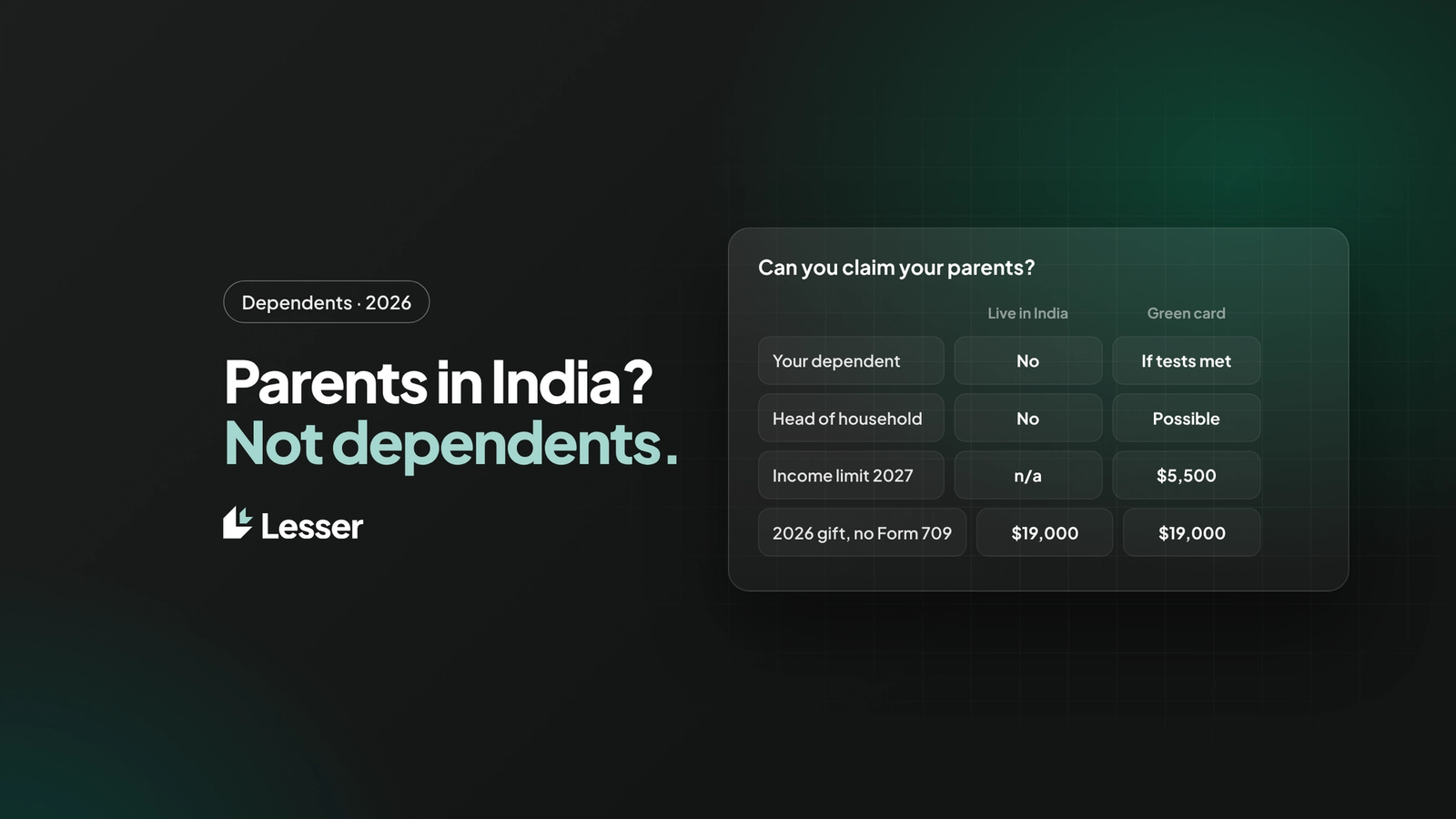
If your parents live in India, you cannot claim them as dependents on your US tax return, even if you pay for everything and they visit you every year. The IRS rule is that a dependent must be a US citizen, US national, US resident alien, or a resident of Canada or Mexico. Parents can only qualify once they are US residents for tax purposes (for example, after they get green cards), and even then their worldwide income must stay under a small limit: $5,200 for 2025 and $5,500 for 2027. What you can do instead is plan your gifts: up to $19,000 per parent in 2026 and $20,000 in 2027 with no gift tax return.
Why can't I claim my parents from India as dependents?
Because of one test that most people never hear about until their tax software asks. IRS Publication 501 says you generally can't claim a person as a dependent unless that person is a US citizen, US resident alien, US national, or a resident of Canada or Mexico. This is called the citizen or resident test.
Parents who live in India are none of these. It does not matter how much money you send, whether you pay their medical bills, or whether they spend the summer in your apartment. A visit on a B-2 visitor visa does not by itself make them US residents; only the day-count test described below can.
The other tests feel like they should help, and that is where the myth comes from:
- Relationship: a parent does not have to live with you. Pub 501 lists your father, mother, grandparent or other direct ancestor as a relative who qualifies without living in your home.
- Support: you must provide more than half of the person's total support for the year. Many sons and daughters in the US easily do.
- Gross income: the parent's gross income must be under a yearly limit: $5,200 for 2025 and $5,500 for 2027 (Rev. Proc. 2026-35). The limit is adjusted for inflation every year.
Passing the support and relationship tests is not enough. If the citizen or resident test fails, the answer is no.
What would claiming them actually be worth?
Less than most people think. The personal exemption is $0 for 2025 and 2026, and the 2025 tax law made that permanent (IRS IR-2025-103). So a dependent parent no longer lowers your taxable income by itself. Two benefits are left:
- The credit for other dependents. It is figured on Schedule 8812. The Form 1040 instructions add a stricter rule here: the qualifying relative must be a US citizen, US national or US resident alien. A parent living in Canada or Mexico can be a dependent but does not get you this credit. Both you and the parent need an SSN or ITIN issued by the due date of the return.
- Head of household filing status. If you are single, a dependent parent can let you file as head of household, which has a larger standard deduction and wider brackets than single. Pub 501 allows this even if your parent doesn't live with you, but you must be able to claim the parent as a dependent and pay more than half the cost of keeping up the parent's main home for the whole year.
Both depend on the parent being your dependent first. For parents living in India, neither is available.
When can I claim my parents as dependents?
When they become US residents for tax purposes. There are two common ways:
- Green card. A parent who becomes a lawful permanent resident is a US resident alien for tax purposes.
- Day count. A parent can also become a resident alien by passing the substantial presence test, which counts days spent in the US over a three-year window. Our guide to the substantial presence test walks through the day counts, and resident alien vs nonresident alien explains what changes once someone is a resident.
Becoming a resident has a cost that people miss. A US resident alien reports worldwide income. So the parent's Indian pension, FD interest and rent all count toward the gross income test. A parent with $6,000 a year of Indian pension and interest fails that test in every recent year, no matter how much you support them. Residents may also have to report their Indian bank accounts: see your India accounts crossed $10,000.
Which situations qualify? A quick table
| Your parent's situation | Your dependent? | Head of household through them? | Credit for other dependents? |
|---|---|---|---|
| Lives in India, visits you on a B-2 visa | No | No | No |
| Lives in Canada or Mexico | Possible, if support and income tests are met | Possible | No |
| US resident alien (green card or substantial presence) | Yes, if support and income tests are met | Yes, if you pay more than half the cost of their main home | Yes, if they have an SSN or ITIN |
| US citizen | Yes, if support and income tests are met | Same as above | Yes, with an SSN |
Every row assumes you also meet the other rules: the parent is not filing a joint return with someone else and nobody else claims them.
Worked example: two families (illustrative)
These are made-up people with simple numbers, not real clients.
Karthik: parents in India who visit every summer
Karthik is on an H-1B in Seattle and is a US tax resident. In 2026 he sends his mother $1,500 a month, $18,000 for the year, and his parents stay with him for July and August on B-2 visas, as they do every year.
- Dependent? No. His parents live in India, so they fail the citizen or resident test.
- Head of household? No. Without a dependent parent, he files as single.
- Gift tax return? No. $18,000 to his mother is under the $19,000 annual exclusion for 2026.
- If he had sent her $24,000, he would be $5,000 over and would file Form 709, usually with no tax owed. Sending $12,000 to each parent instead keeps both under the line.
Meera: parents on green cards living with her
Meera is single and lives in Texas. Her parents got green cards in 2025 and lived with her all of 2026. She pays the rent, food and medical costs for the household, well over half of their support and over half the cost of the home.
- Her father has $6,000 a year of Indian pension and FD interest. That is over the gross income limit, so she cannot claim him.
- Her mother has $1,800 of FD interest. She passes the citizen or resident test, the support test and the gross income test, so Meera can claim her as a qualifying relative, as long as her mother has an SSN or ITIN by the return's due date.
- Because her mother is her dependent and lives in the home Meera pays for, Meera can file as head of household instead of single, and can claim the credit for other dependents for her mother.
The difference between the two families is not how much money they spend on their parents. It is where the parents live for tax purposes.
What can I do instead if my parents live in India?
- Plan your gifts, not a deduction. Money you send to parents is a gift. It is not deductible, but it is also not taxable to them in the US. Stay at or under $19,000 per parent for 2026 ($20,000 for 2027) and no gift tax return is needed. Our guide to sending money to your parents in India every month covers the details.
- Split gifts between both parents. The exclusion is per recipient, so two parents means two exclusions.
- Use the higher 2027 figures. The 2027 inflation numbers raise the exclusion to $20,000 per recipient from January 1, 2027.
- Do not list them on your return. Some tax software lets you type in a parent's name and an ITIN. Listing a parent who fails the citizen or resident test is an error that can lead to the credit and filing status being denied.
What to do this week
- By December 31, 2026: add up what you sent each parent in 2026. If one parent is above $19,000, plan for Form 709 or send future amounts to the other parent.
- By December 31, 2026: if your parents moved to the US on green cards this year, start a simple support log: rent, food, utilities and medical costs you paid.
- January 1, 2027: the gift exclusion rises to $20,000 per recipient for 2027 gifts.
- Before you file your 2026 return: if a parent who lives in the US with you needs an ITIN, apply early. The credit for other dependents requires the SSN or ITIN to be issued by the return's due date, including extensions.
- Before you file: check your parents' Indian income in US dollars against the gross income limit.
If your parents split their time between India and the US, or just got green cards, this is a common question in our tax filing for NRIs work at Lesser Tax. This post is general information, not personal tax advice.