
Lesser Tax
8 min read
Want an expert to handle this? Get your NRI taxes done right
Most SpaceX employees and early shareholders can sell all of their remaining locked-up shares once the IPO lock-up ends 180 days after the prospectus, which works out to around December 8, 2026. Selling is not taxed like a vest: you pay capital gains tax only on the rise above the value already taxed on your W-2. Shares you have held more than one year get 0%, 15% or 20%; shares from 2026 vests are short-term and taxed like salary. A December sale lands on your 2026 return and the January 15, 2027 estimated payment; a January sale moves the bill to 2027.
When does the SpaceX lock-up end?
SpaceX priced its IPO at $135 a share on June 11, 2026 and began trading on Nasdaq under the ticker SPCX on June 12, according to CBS News. The lock-up terms in the company's registration statement (Form S-1/A filed with the SEC) say shareholders who signed lock-up agreements cannot sell until "180 days after the date of this prospectus", with staged early releases before that. Counting 180 days from June 11 gives December 8, 2026, the date most market coverage uses.
The early releases in the S-1/A were:
- After the second-quarter results: up to 20% of locked shares, plus another 10% if the stock had closed at least 30% above the IPO price on enough trading days. News reports say about 911.5 million shares were released on August 6.
- Timed releases: up to an additional 7% each at 70, 90, 105, 120 and 135 days after the prospectus.
- After the third-quarter results: up to an additional 28%.
- Day 180: everything still locked up, for most holders.
Some holders are on a longer schedule that runs into 2027, and Elon Musk's shares are locked for 366 days with no early release. Your own lock-up agreement and the company's notices decide your date, not this post. Even after the lock-up ends, employees can only trade in open windows under the company's insider trading policy.
How are SpaceX shares taxed when you sell?
Selling is a separate tax event from vesting. When an RSU vests, the full value is wages: it is on your W-2 and payroll withholds tax on it. That value becomes your cost basis. When you sell, you report only the difference between the sale price and that basis as a capital gain or loss.
The S-1/A says none of the RSUs vested because of the IPO itself, and that RSUs vesting after March 31, 2026 were net settled, with the company paying about $460 million of employee taxes in cash. If your shares came from those vests, your basis is the share value on each vest date, not $0. Check the cost basis on your broker's 1099-B against your vest records: brokers often report RSU basis as zero or leave it blank, and fixing that is your job on Form 8949.
Short-term vs long-term
IRS Topic 409 sets the line: hold a share more than one year before you sell and the gain is long-term; one year or less and it is short-term. The clock starts at vest (for RSUs) or at exercise (for options), not at the IPO.
- Shares from 2026 vests: short-term if sold in December 2026. The gain is taxed at your ordinary rates. For 2026 the 24% bracket starts at $105,700 of taxable income for single filers, 32% at $201,775, 35% at $256,225 and 37% at $640,600 ($211,400, $403,550, $512,450 and $768,700 for married couples filing jointly).
- Shares held since 2025 or earlier: long-term, taxed at 0%, 15% or 20% depending on income. At the incomes in this post, the rate is usually 15%.
- Net investment income tax: an extra 3.8% on investment income once modified adjusted gross income passes $200,000 (single) or $250,000 (married filing jointly), per IRS Topic 559. These thresholds are not indexed to inflation.
A worked example with 2026 figures
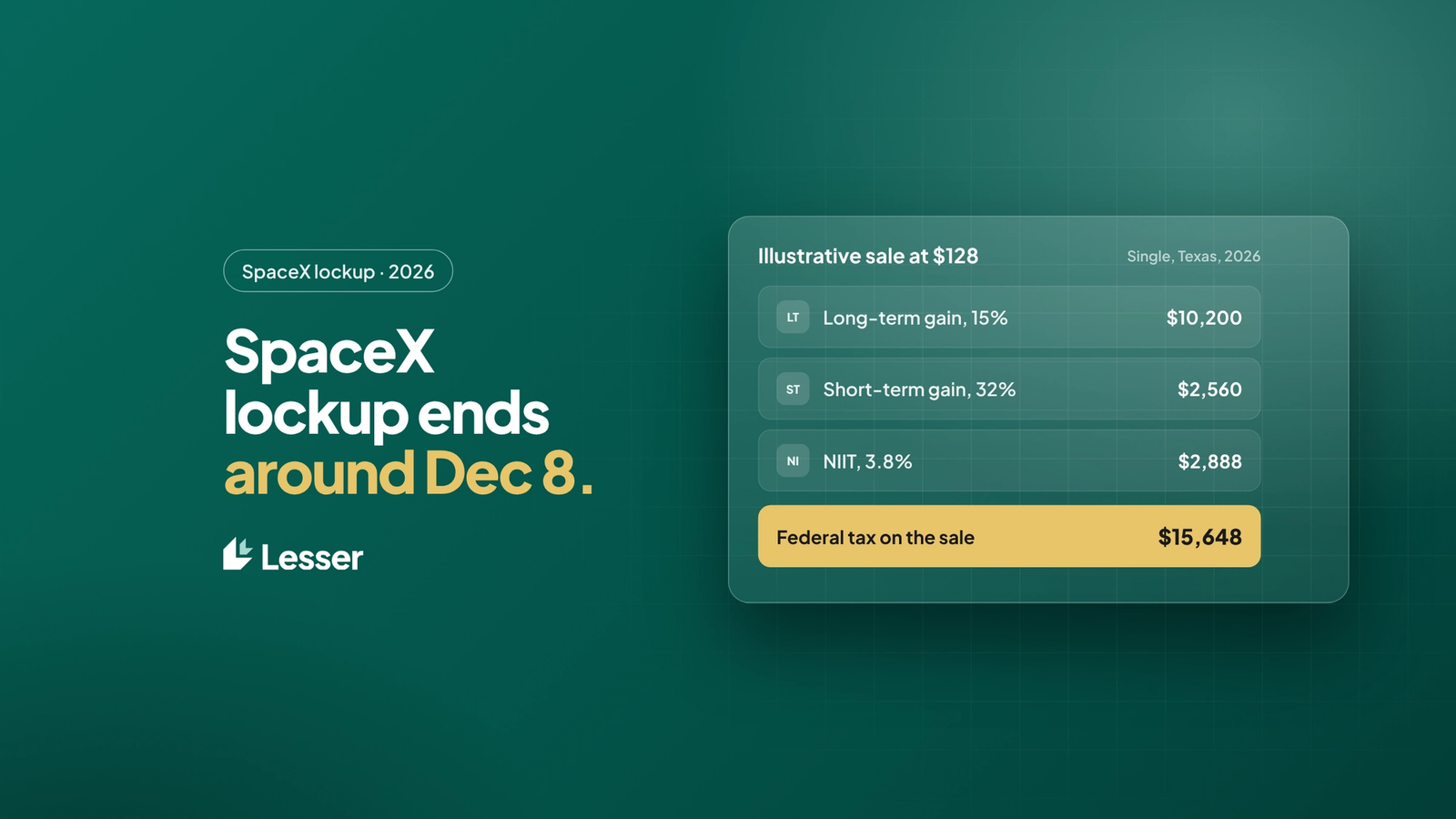
This example is illustrative, not a real client, and the cost basis figures are made up for the math. Arjun is single, lives in Texas, earns a $220,000 salary and takes the $16,100 standard deduction. On December 9 he sells two lots of SpaceX stock at an assumed $128 a share (SPCX closed at $127.79 on November 20, as reported by The Motley Fool):
- Lot A: 1,000 shares vested in 2024 with a basis of $60. Long-term gain: $68,000.
- Lot B: 1,000 shares vested in September 2026 with a basis of $120. Short-term gain: $8,000.
His 2026 taxable income becomes $279,900. The ordinary part, $211,900 including Lot B, reaches the 32% bracket, so:
- Lot B short-term gain: $8,000 at 32% = $2,560.
- Lot A long-term gain: $68,000 at 15% = $10,200.
- NIIT: his modified AGI of $296,000 is $96,000 over the $200,000 threshold, so the 3.8% applies to the smaller figure, his $76,000 of gains: $2,888.
Total federal tax on the sale: about $15,648. Texas has no state income tax. If Arjun held Lot B until more than a year after its September 2026 vest, its gain would be long-term and the federal tax on it would fall from $2,560 to $1,200, a saving of $1,360. But a 10% drop in the share price on those 1,000 shares would cost him $12,800. The holding period matters; it rarely matters more than the price.
Selling in December vs January: what changes
| Item | Sell December 8 to 31, 2026 | Sell in January 2027 |
|---|---|---|
| Tax year | 2026 | 2027 |
| Return due | April 15, 2027 | April 15, 2028 |
| Estimated payment for the gain | January 15, 2027 (Q4 2026) | April 15, 2027 (Q1 2027) |
| Brackets used | 2026 (32% starts at $201,775 single) | 2027, adjusted upward for inflation |
| 2026 lots still short-term? | Yes | Yes, until one year after each vest |
| Price risk | Lowest: you sell as soon as you can | About a month more market risk |
January is not automatically better. It buys a year to pay, and it helps if your 2026 income is unusually high and 2027 will be lower. If 2027 will be higher, perhaps because more RSUs vest at a public price, December can be cheaper. The 2027 brackets and standard deduction show how far the thresholds move.
What if your shares are below what you paid in tax?
SPCX opened at $150 and closed its first day at $160.95, per CBS News, and closed at $127.79 on November 20, below the $135 IPO price. If some of your shares vested at a higher value than today's price, selling them creates a capital loss. Losses first offset gains, and up to $3,000 of net loss a year can offset salary, with the rest carried forward.
Watch the wash sale rule. If you sell at a loss and acquire substantially identical shares within 30 days before or after the sale, the loss is not deductible on that sale. A December RSU vest or ESPP purchase can count as that acquisition. Our guide to wash sales between RSU vests walks through how to sequence sales around vest dates.
Does where you live change the bill?
- Texas and Florida: no state income tax on the gain.
- California: the Franchise Tax Board says California has no lower rate for capital gains; all gains are taxed as ordinary income, short-term or long-term.
- Washington: a 7% tax on long-term capital gains above a standard deduction ($278,000 for 2025, adjusted each year), with an extra 2.9% on taxable gains above $1 million from 2025. Short-term gains are outside this tax.
If you moved states while your RSUs were vesting, the wage income at vest can still be partly taxable in the old state. The sale gain generally follows where you live when you sell, but check before you move in December.
H-1B, green card or moving back to India?
If you are a US tax resident, which covers green card holders and most H-1B workers who pass the substantial presence test, the sale is taxed exactly as above. If you plan to move back to India, the timing of the sale against your Indian residential status (including the RNOR window) can change which country taxes the gain and how much credit you get. Our post on selling RSUs before or after moving back to India covers the trade-offs.
What to do this week
- By November 30: download your vest history and the cost basis for every lot from the equity portal. Mark which lots are long-term on December 8 and which are not.
- Before December 8: read the company's lock-up release notice and the insider trading policy to confirm your exact date and whether a trading window is open. If you want a 10b5-1 trading plan, the S-1/A allows adopting one during the lock-up, but it cannot sell until the lock-up ends.
- Before you sell: list any RSU vests or ESPP purchases from 30 days before to 30 days after the planned date, so a loss sale is not wiped out as a wash sale.
- By December 31: decide which lots to sell in 2026 and which to hold. Trades must execute by December 31 to count for 2026.
- By January 15, 2027: pay a fourth-quarter estimated payment for gains withholding will not cover. Our guide to the January 15 payment and the 110% safe harbor shows how to size it.
For how another newly public company handled settlement and withholding, see Anthropic IPO taxes for employees. If you want help choosing which lots to sell and when, Lesser Tax does tax planning for tech employees with RSUs, ISOs and ESPP. This post is general information, not personal tax or securities advice; for questions about your lock-up or trading window, read the company's notices or ask a securities attorney.