
Lesser Tax
7 min read
Want an expert to handle this? Get your NRI taxes done right
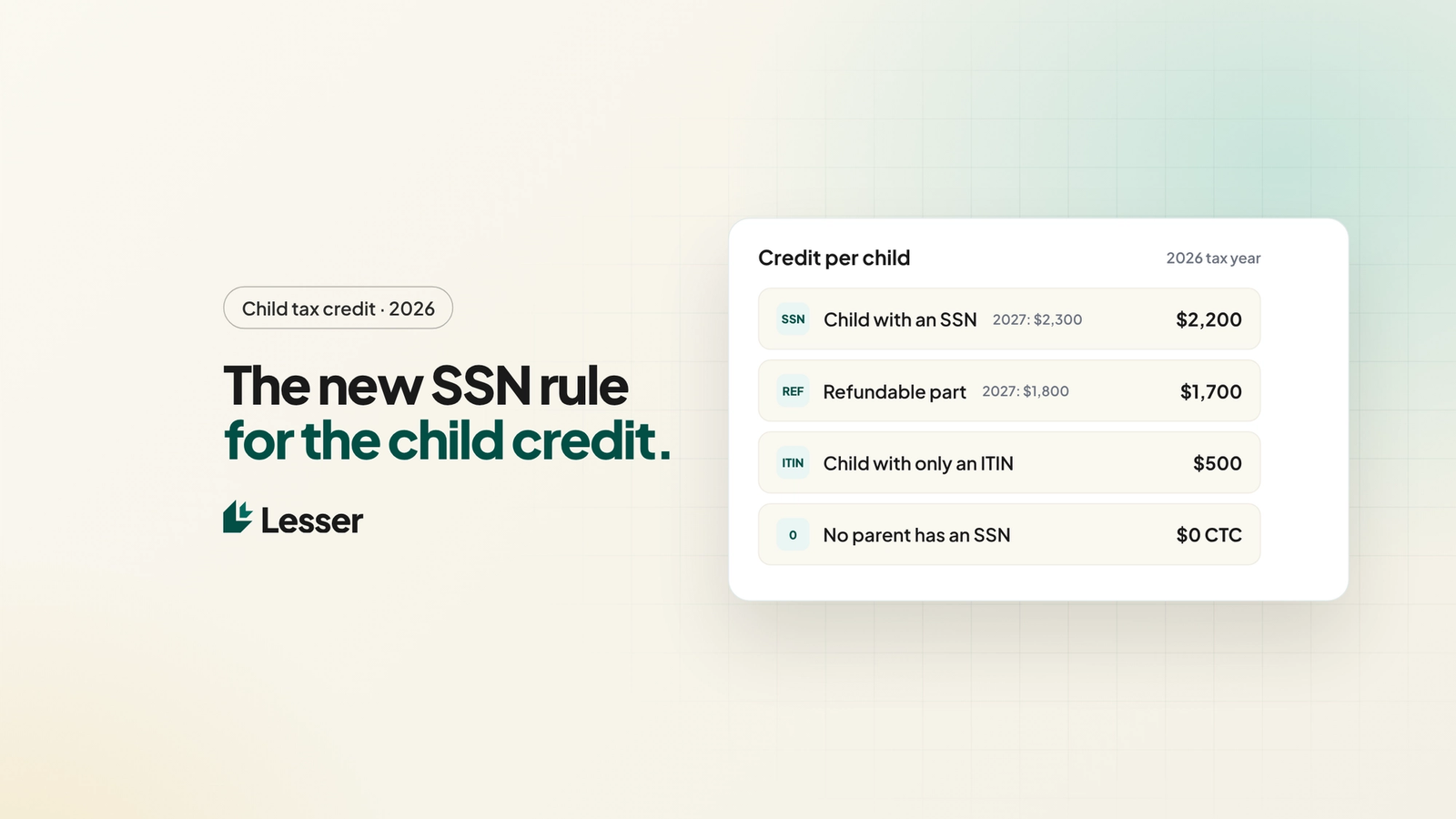
Starting with 2025 returns, you need a valid Social Security number (SSN) to claim the child tax credit, and so does your child. On a joint return only one parent needs the SSN; the other can use an ITIN issued by the return's due date. For 2026 the credit is up to $2,200 per child (up to $1,700 refundable), rising to $2,300 ($1,800 refundable) for 2027. A child who has only an ITIN gets the $500 credit for other dependents instead.
What changed in the child tax credit rules?
The One Big Beautiful Bill Act, signed in July 2025, raised the child tax credit and added a new identity test for the parent. The 2025 Instructions for Schedule 8812 put it plainly: beginning in tax year 2025, you must have a valid SSN to claim the child tax credit (CTC) or the additional child tax credit (ACTC).
The ACTC is the refundable part of the credit. If your tax is lower than the credit, the ACTC can still pay you the difference, up to a cap.
There are now two SSN checks, not one:
- The child must have an SSN that is valid for employment and issued before the due date of your return, including extensions. This rule is not new.
- The parent must also have a valid SSN. This rule is new from 2025. If you file jointly, only one of you needs the SSN. The other spouse needs an SSN or an ITIN issued on or before the return's due date.
An ITIN (individual taxpayer identification number) is the tax ID the IRS gives people who cannot get an SSN, such as many H-4 spouses without work authorization and children who came to the US on H-4 visas.
How much is the credit for 2026 and 2027?
The amounts come from IRS Revenue Procedure 2025-32 (for 2026) and IRS news release IR-2026-133 of November 5, 2026 (for 2027).
- 2026 tax year (the return you file in 2027): up to $2,200 per qualifying child, of which up to $1,700 can be refundable.
- 2027 tax year: up to $2,300 per qualifying child, of which up to $1,800 can be refundable.
- Credit for other dependents: $500 per dependent, not refundable.
The child must be under 17 at the end of the year and must be your dependent. The credit starts to phase out once modified AGI passes $400,000 on a joint return or $200,000 for every other filing status, so many two-income tech households get only part of it, or none.
Who gets what? A quick table
This table covers the common situations in H-1B, H-4 and green card families. It assumes the child is your dependent, under 17, and income is below the phase-out.
| Your situation | 2026 credit per child | 2027 credit per child |
|---|---|---|
| Child has an SSN, at least one parent has an SSN, joint return | Up to $2,200 CTC (up to $1,700 refundable) | Up to $2,300 CTC (up to $1,800 refundable) |
| Child has only an ITIN and is a US resident for tax | $500 credit for other dependents | $500 credit for other dependents |
| Child has an SSN, but neither parent has a valid SSN | No CTC or ACTC | No CTC or ACTC |
| Spouse has no SSN and no ITIN issued by the due date, joint return | No credit until the spouse's ITIN is in place | Same rule |
| Child lived in India all year and is not a US citizen or resident | No CTC and no $500 credit | Same rule |
The last row trips up many families. Both credits require the child or dependent to be a US citizen, US national or US resident alien. A child who stays with grandparents in India is usually none of these.
Worked example: one H-1B family, two kids, two different credits
This is an illustrative example, not a real client.
Arjun works in Seattle on an H-1B and has an SSN. His wife Meera is on an H-4 without an EAD, so she has an ITIN. They file a joint 2026 return with $210,000 of income, well below the $400,000 joint phase-out.
- Riya, 4, was born in the US. She is a US citizen with an SSN.
- Kabir, 9, was born in India and lives in the US on an H-4. He has an ITIN, not an SSN. He was in the US all of 2026, so he passes the substantial presence test and counts as a US resident for tax.
Here is how the credits work out for 2026:
- Arjun has a valid SSN, so the joint return passes the new parent test. Meera's ITIN is enough for the second spouse.
- Riya has a valid SSN, so she qualifies for the full child tax credit: up to $2,200.
- Kabir has only an ITIN, so he cannot qualify for the child tax credit. He does qualify for the $500 credit for other dependents.
- Total: up to $2,700 off the family's 2026 federal tax.
Now change one fact. Meera's ITIN application was never filed, and the family files without it. The Schedule 8812 instructions say the second spouse on a joint return needs an SSN or ITIN issued on or before the due date. Until that is fixed, the family can lose the whole $2,700. The usual fix is to file Form W-7 for Meera with the return. The instructions treat an ITIN applied for by the due date (including extensions) as issued in time once the IRS issues it from that application.
For 2027, the same family would get up to $2,300 for Riya and still $500 for Kabir, or $2,800 in total, if nothing else changes.
Which families are most at risk?
Both parents on ITINs
If neither spouse has a valid SSN, the child tax credit is gone, even for a US citizen child with an SSN. This is rare in H-1B families, because the H-1B worker has an SSN, but it can happen when neither parent has ever had US work authorization. Ask your preparer how the $500 credit for other dependents applies in your case.
Married filing separately
The "only one spouse needs an SSN" rule applies to joint returns. If the parent with the ITIN files a separate return and claims the child, that return fails the new parent test. Married filing separately also halves the phase-out threshold to $200,000.
Kids who came from India
A child who arrived on an H-4 usually has an ITIN, not an SSN, so the best you can get is the $500 credit. That changes when the child gets an SSN, for example after a green card. Use the SSN on the first return filed after it is issued, as long as it is issued before the due date.
A baby born in December
A baby born on December 31, 2026 counts for the whole 2026 tax year. The SSN must be issued before the due date of your 2026 return, including extensions. Apply for it right away; the birth itself does not give you the credit.
First year in the US
If you were a nonresident for part or all of 2026, your filing status decides what you can claim. IRS Publication 519 has special dependent rules for residents of Canada, Mexico and South Korea and for students and business apprentices from India. Most other nonresident filers on Form 1040-NR cannot claim these credits, so check your status first with our guide to resident and nonresident aliens.
What about parents visiting from India?
Parents are not qualifying children, so the child tax credit never applies to them. The $500 credit for other dependents can, but only if your parents are your dependents and are US citizens, nationals or residents. Parents visiting on a B-2 visa usually fail that test. Our guide on claiming parents from India as dependents explains when it can work.
What to do this week
- By Friday, November 27, 2026: write down each family member's tax ID (SSN or ITIN) and immigration status. Note who has an SSN that is valid for employment.
- By Monday, November 30, 2026: if your spouse or a child needs an ITIN, gather the documents for Form W-7. Our guide to an ITIN for an H-4 spouse covers the steps.
- In December: if a baby is due, plan to apply for the SSN as soon as the baby is born.
- If your spouse or child got an SSN in 2026 (for example with an EAD or a green card), make sure your preparer uses it instead of the old ITIN.
- Before you file in 2027: check whether your income is near the $400,000 joint or $200,000 single phase-out. Our 2027 tax brackets guide shows the other numbers that change next year.
Lesser Tax prepares US returns for Indian families in the US, including joint returns with an H-4 spouse, W-7 applications and Schedule 8812. Immigration questions about EADs or visas belong with an immigration attorney. This article is general information, not personal tax advice.