
Lesser Tax
7 min read
Want an expert to handle this? Get your NRI taxes done right
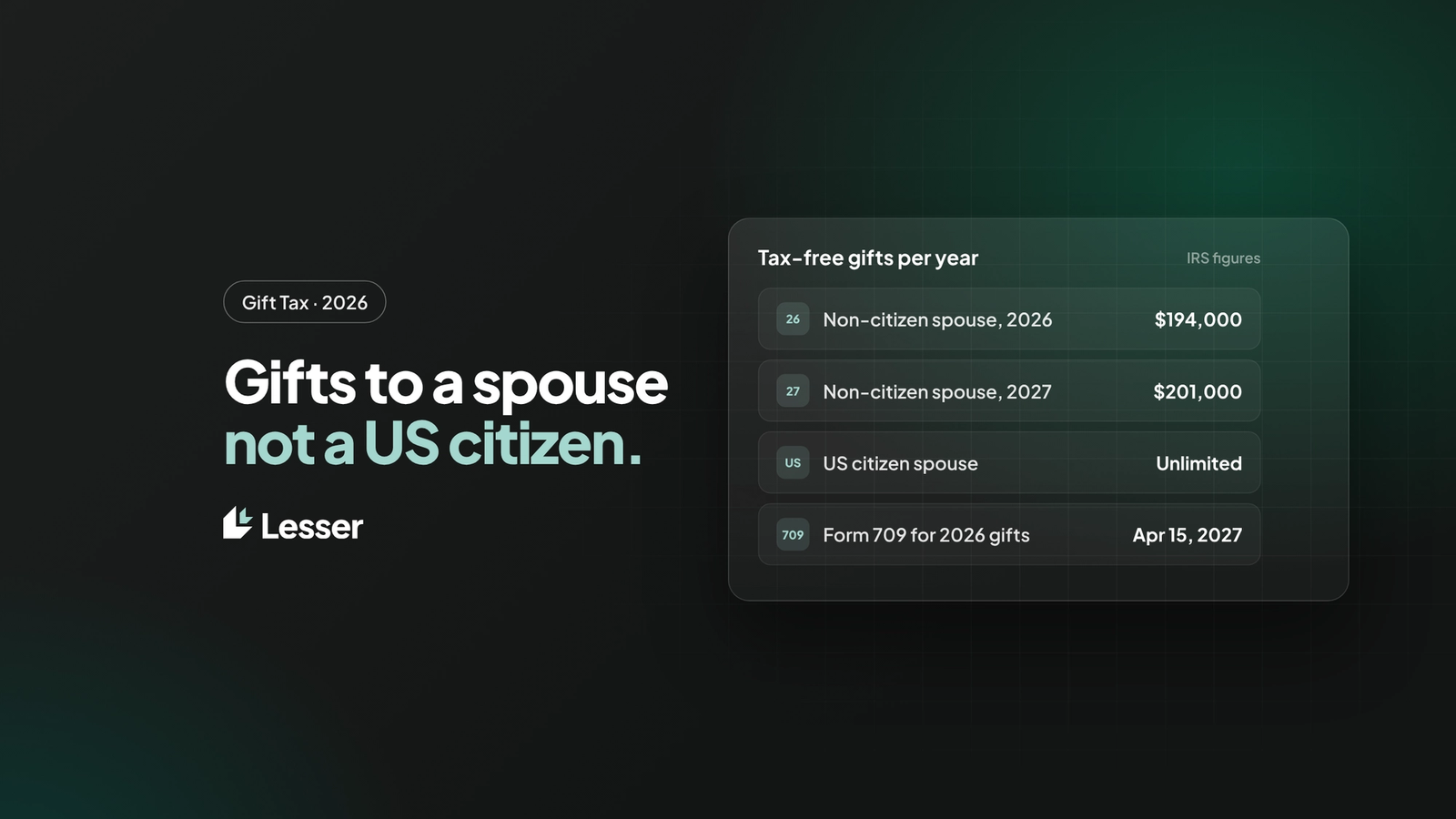
Marriage does not make every gift tax-free. If your spouse is not a US citizen, including a spouse with a green card, H-1B or H-4, only the first $194,000 of gifts you make to them in 2026 is excluded from gift tax, and $201,000 in 2027. Give more and you file Form 709 by April 15 of the next year. If you are a US citizen or resident, the excess usually costs no tax: it uses part of your lifetime exclusion, which is $15,000,000 in 2026.
Is a gift to your spouse always tax-free?
Only if your spouse is a US citizen. The IRS says that if your spouse is a US citizen, direct gifts generally qualify for the unlimited marital deduction. If your spouse is not a US citizen, that deduction is replaced by a special annual exclusion under section 2523(i) of the tax code. Rev. Proc. 2026-35 sets it at $201,000 for 2027, up from $194,000 for 2026.
The test is citizenship, not residence or visa status. A green card holder is not a US citizen. Neither is a spouse on an H-1B, H-4, L-1 or F-1. The limit applies until the day your spouse becomes a citizen; gifts after that date fall under the unlimited rule.
The rule looks at the spouse who receives the gift. A green card holder giving to a US citizen spouse gets the unlimited marital deduction. If both of you are non-citizens, for example both on H-1B visas, the limit applies to gifts in either direction.
The limit is per year and per spouse, and it covers only gifts of a present interest: money or property your spouse can use right away. A gift of a future interest, such as most gifts into a trust, needs a Form 709 whatever its size.
Which couples does this affect?
- A US citizen married to a green card holder: gifts from the citizen are capped at the annual amount. Gifts from the green card holder to the citizen are unlimited.
- Both spouses on H-1B, H-4 or green cards: capped in both directions.
- A giver who is a nonresident and not a US citizen, for example a spouse still living in India: US gift tax generally reaches only gifts of US real estate and tangible property located in the US, and in some cases intangible property, according to the IRS. Those gifts go on Form 709-NA, and the IRS notes there is no lifetime credit to offset the tax. Whether you count as a resident is a tax test, not a visa test; see resident alien vs nonresident alien for Indians in the US.
A family with one US citizen spouse and one green card spouse is common among Indian professionals, and it is the setup where large one-way transfers happen: a down payment on a home in one name, paying off a loan, or moving shares before a sale.
What counts as a gift to your spouse?
These generally count toward the $194,000:
- Transferring money into an account in your spouse's name only.
- Paying for a home, or your spouse's share of one, that is titled to your spouse.
- Moving RSU or ESPP shares into your spouse's brokerage account. The gift is valued at the shares' fair market value on the day you transfer them.
- Paying off a loan that is only in your spouse's name, in the US or in India.
These do not use the limit:
- Putting money into a joint bank account you can withdraw from without your spouse's consent. The Form 709 instructions say the gift happens only when your spouse draws on the account for their own benefit.
- Tuition paid directly to a school, and medical bills paid directly to the provider. These are separate exclusions, on top of the annual amount. Handing your spouse cash to pay the bill does not qualify.
Jointly titled real estate and other joint property have their own rules. Ask your preparer before you sign, because the way the title is written can change who made a gift and when.
Citizen spouse vs non-citizen spouse: what changes?
| Rule | Spouse is a US citizen | Spouse is not a US citizen |
|---|---|---|
| Tax-free gifts per year | Unlimited (marital deduction) | $194,000 in 2026, $201,000 in 2027 |
| Form 709 needed for outright gifts | Generally no | Yes, if the year's total is over the limit |
| Gift of a future interest (most trusts) | Form 709 rules apply | Form 709 needed at any amount |
| Tuition or medical bills paid directly | Excluded | Excluded |
| Amount over the limit | Not applicable | Uses the giver's lifetime exclusion, if a US citizen or resident |
| Joint bank account | Not a gift | Gift only when the spouse withdraws for their own use |
The same citizen vs non-citizen split shows up again at death, where leaving assets to a non-citizen spouse generally needs a special trust to defer estate tax. Our post on US estate tax on US stocks and property for Indians covers that side.
A worked example: $300,000 for a home
This example is illustrative, not a real client. Rahul is a US citizen. His wife Meera holds a green card. They are buying a condo that Meera will own alone, and Rahul plans to give her $300,000 for the down payment. He has made no other gifts to her this year.
Option A: all $300,000 in December 2026
The first $194,000 is excluded. The other $106,000 is a taxable gift. Rahul files Form 709 by April 15, 2027. He pays no gift tax: the $106,000 is subtracted from his $15,000,000 basic exclusion for 2026, which leaves $14,894,000 before later inflation increases. The cost is a return to prepare, plus records to keep for life.
Option B: split the gift across December 31
Rahul gives $194,000 by December 31, 2026 and $106,000 on or after January 1, 2027. Each year's total stays under that year's limit, so no Form 709 is needed for either year, as long as his other 2027 gifts to Meera keep the 2027 total at or under $201,000. If the closing date allows it, this is the simplest route.
Option C: use the tuition exclusion too
Meera also starts an MBA with $40,000 of tuition. If Rahul pays the university directly, that $40,000 is excluded and does not use any of the $194,000. If he sends Meera the money and she pays, it counts toward the limit, and in Option A his taxable gift would grow to $146,000.
The 2027 increases to this limit and to the $20,000 regular annual exclusion are part of the IRS inflation update; see 2027 tax brackets and what changes for H-1B and green card paychecks.
Why file Form 709 if no tax is due?
The return is how the IRS tracks how much of your lifetime exclusion you have used. Skipping it does not make the gift disappear; it leaves the record incomplete for later gifts and for your estate. Key points from the Form 709 instructions:
- Due date: no earlier than January 1 and no later than April 15 of the year after the gift. For 2026 gifts, that is April 15, 2027.
- Extension: extending your income tax return with Form 4868 also extends Form 709. If you are not extending your income tax return, Form 8892 gives an automatic 6-month extension. Neither extends the time to pay any gift tax.
- Each spouse files their own return. Spouses cannot file a joint gift tax return.
Gifts to anyone else, such as parents in India, use the regular annual exclusion instead: $19,000 per person in 2026 and $20,000 in 2027. Our guide to sending money to your parents in India every month explains how those add up.
What to do this week
- By November 30: add up every 2026 transfer to your non-citizen spouse: money into accounts in their name, payments on property or loans in their name, and shares moved to them. Count joint-account money only where your spouse withdrew it for their own use.
- Before December 31, 2026: if you are close to $194,000, hold the rest until January 1, 2027, when the $201,000 limit starts.
- For any tuition or medical bill: pay the school or provider directly instead of giving your spouse the cash.
- Keep a record of each gift: date, amount, and for shares, the value on the transfer date.
- By April 15, 2027: file Form 709 if your 2026 gifts to your spouse went over $194,000, or file Form 8892 for more time if you are not extending your income tax return.
- If your spouse is naturalizing soon: note the oath date. Large gifts made after it fall under the unlimited marital deduction.
If you need help adding up the year or filing the return, Lesser Tax prepares US returns and gift tax filings for Indian families in the US. This post is general information, not personal tax advice; immigration questions belong with an immigration attorney.