
Lesser Tax
8 min read
Want an expert to handle this? Get your NRI taxes done right
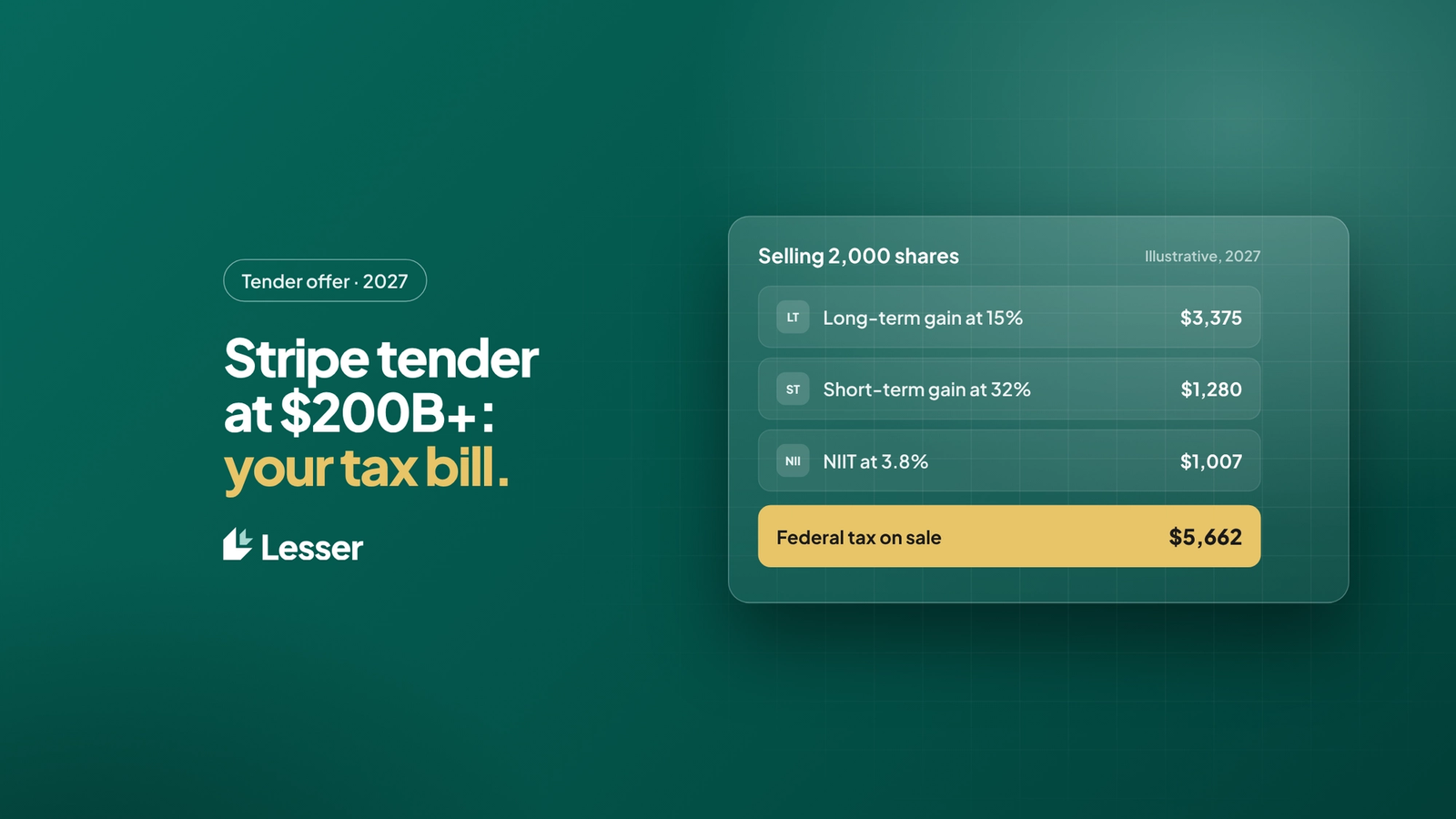
Stripe is reportedly negotiating an employee tender offer that would value the company at more than $200 billion, likely closing in early 2027. If you sell shares you already own, you pay capital gains tax only on the price above your cost basis (for RSU shares, the value already taxed on your W-2), at 0%, 15% or 20% if you held them more than a year. Generally no tax is withheld on that gain, and a sale that closes in 2027 lands on your 2027 return, due April 15, 2028. In our illustrative example, selling 2,000 shares costs about $5,662 in federal tax.
What has been reported about the Stripe tender offer?
The Wall Street Journal reported on November 24, 2026, citing people familiar with the talks, that Stripe is discussing a tender offer that would let employees sell some of their shares at a valuation above $200 billion. Tech Funding News and Dataconomy, summarizing the reports, say the deal would likely close in early 2027 and the final valuation may change. Stripe has not announced the offer, and no per-share price has been reported. Treat the details as reported, not confirmed.
The previous round set the bar: in February 2026 Stripe's tender offer valued it at $159 billion, with Thrive Capital, Coatue and a16z providing most of the money and Stripe buying back some shares itself, according to the same reports. The new talks would put the valuation at least 25% higher. Stripe has bought back employee shares most years, and in March 2023 it raised more than $6.5 billion partly to "address employee withholding tax obligations related to equity awards", according to its own announcement.
This post covers the tax on selling in a tender offer, at Stripe or any private company. The offer documents decide who can sell, how much and when.
How is selling in a tender offer taxed?
Two separate events get taxed. When your RSUs vest and settle into shares, their full value is wages on your W-2, and payroll withholds on it. That value becomes your cost basis. When you sell those shares in a tender, you report only the difference between the tender price and your basis as a capital gain or loss, on Form 8949 and Schedule D.
The holding period sets the rate. IRS Topic 409 says a share held more than one year gives a long-term gain; one year or less is short-term. For RSUs the clock starts when the shares vest and are delivered to you, not at grant.
- Long-term gains: 0%, 15% or 20%. For 2027, Rev. Proc. 2026-35 sets the 0% rate up to $51,050 of taxable income for single filers ($102,100 joint) and starts the 20% rate above $563,200 ($633,600 joint).
- Short-term gains: taxed at your ordinary rates. For 2027 the 32% bracket starts at $208,325 of taxable income for single filers and the 37% bracket at $661,375 ($793,650 joint).
- Net investment income tax (NIIT): an extra 3.8% on gains once modified adjusted gross income passes $200,000 for single filers or $250,000 for married couples filing jointly (IRS Topic 559).
Generally no income tax is withheld when you sell shares you already own, because the gain is not wages. The tender payment arrives in full, and the tax bill comes later.
What if you sell options in the tender?
Some tender offers let you exercise options and sell the shares in the same transaction. That changes the tax:
- NSOs: the spread between the tender price and your exercise price is wages on your W-2, withheld like a bonus: 22% federal, and a mandatory 37% on supplemental wages above $1 million from one employer in a year (IRS Publication 15). See the 37% withholding on income over $1 million.
- ISOs: selling within two years of grant or one year of exercise is a disqualifying disposition. IRS Publication 525 says you then have ordinary income, which the employer should report as wages on your W-2, instead of the long-term treatment ISOs can otherwise get.
The offer documents should say how the company will report each kind of payment. Check that against your W-2 and Form 1099-B when they arrive, and make sure the basis on the 1099-B is not blank or zero.
Tender offer vs selling after an IPO: what is different?
Employees at private companies often ask whether to sell now or wait for an IPO. The tax rule on shares you own is the same. What changes is how much control you have over price, timing and amount.
| Question | Tender offer | Selling after an IPO |
|---|---|---|
| Who sets the price | The buyer, in the offer | The market, trade by trade |
| When you can sell | Only during the offer window | After the lock-up, in open trading windows |
| How much you can sell | Usually limited by the offer terms | No limit once the lock-up ends |
| Tax on shares you own | Capital gain over your basis | Capital gain over your basis |
| Long-term if held | More than 1 year from vest or exercise | More than 1 year from vest or exercise |
| Tax withheld on the gain | Generally none | Generally none |
| Choosing which lots to sell | Depends on the offer terms | You can name lots with your broker |
For how the IPO route plays out, see our post on the SpaceX lock-up and the tax on selling in December vs January.
A worked example with 2027 figures
This example is illustrative, not a real client, and the share price is made up; it is not Stripe's price. Neha is single, lives in California and earns a $250,000 salary in 2027. She takes the $16,600 standard deduction. In February 2027 she sells 2,000 shares in a tender at an assumed $40 a share, for $80,000:
- Lot A: 1,500 shares that vested in 2024 with a basis of $25. Long-term gain: $22,500.
- Lot B: 500 shares that vested in October 2026 with a basis of $32. Short-term gain: $4,000.
Her taxable income before the gains is $233,400, already in the 32% bracket. So:
- Lot B short-term gain: $4,000 at 32% = $1,280.
- Lot A long-term gain: $22,500 at 15% = $3,375. Her total taxable income of $259,900 is far below the $563,200 where 20% starts.
- NIIT: her modified AGI of $276,500 is $76,500 over $200,000, so the 3.8% applies to the smaller figure, her $26,500 of gains: $1,007.
Federal tax on the sale: about $5,662, roughly 7% of the $80,000 payment, because most of the payment is basis that was already taxed when the RSUs vested. California taxes the $26,500 gain as well: the Franchise Tax Board says California has no lower rate for capital gains, so the gain is taxed like salary at her California rate.
If the offer let Neha keep Lot B and sell more long-term shares instead, that $4,000 gain would be taxed at 15% instead of 32%, saving $680. Small here, but the 17-point gap scales: on $400,000 of short-term gain it is $68,000.
When is the tax due?
Tax follows the year the sale closes. If the tender settles in early 2027, the gain belongs on your 2027 return, due April 15, 2028. But the IRS expects tax to be paid during the year: a first-quarter 2027 sale points to the April 15, 2027 estimated payment (IRS Publication 505). If your withholding and estimates for 2027 cover at least 100% of your 2026 tax (110% if your 2026 adjusted gross income was over $150,000), you generally avoid the underpayment penalty even if more is due when you file. Our guide to estimated tax payments and the 110% safe harbor walks through the math.
On an H-1B, a green card, or moving back to India?
If you are a US tax resident, which covers every green card holder and most H-1B workers who pass the substantial presence test, the sale is taxed exactly as above. If you have moved back to India and are a nonresident alien for US tax when the tender closes, the US generally does not tax your capital gain unless you were in the US for 183 days or more that year (IRS Publication 519), but India may tax it. The wage income from earlier RSU vests stays US income. Our post on selling RSUs before or after moving back to India covers the RNOR window and foreign tax credits.
What to do this week
- By November 30: download your vest history from the equity portal: the date, number of shares and value per share for each lot. Mark which lots will be more than one year old in February and March 2027.
- By December 31: if you have losing positions elsewhere, consider tax-loss harvesting before year end. Net capital losses above the $3,000 you can deduct each year carry forward and can offset a 2027 tender gain.
- When the offer documents arrive: note the election deadline, the limit on how much you can sell, whether you can choose lots, and how the company will report the payment.
- Before you elect: estimate the tax with the figures above and set aside cash for the federal and state bill.
- By April 15, 2027: make a first-quarter estimated payment if the sale closed in the first quarter and the safe harbor does not already cover you.
If you want help deciding what to sell and when, Lesser Tax does tax planning for tech employees with RSUs, ISOs and ESPP. This post is general information, not personal tax or securities advice; for questions about the offer itself, read the company's tender documents or ask a securities attorney.