
Lesser Tax
7 min read
Want an expert to handle this? Get your NRI taxes done right
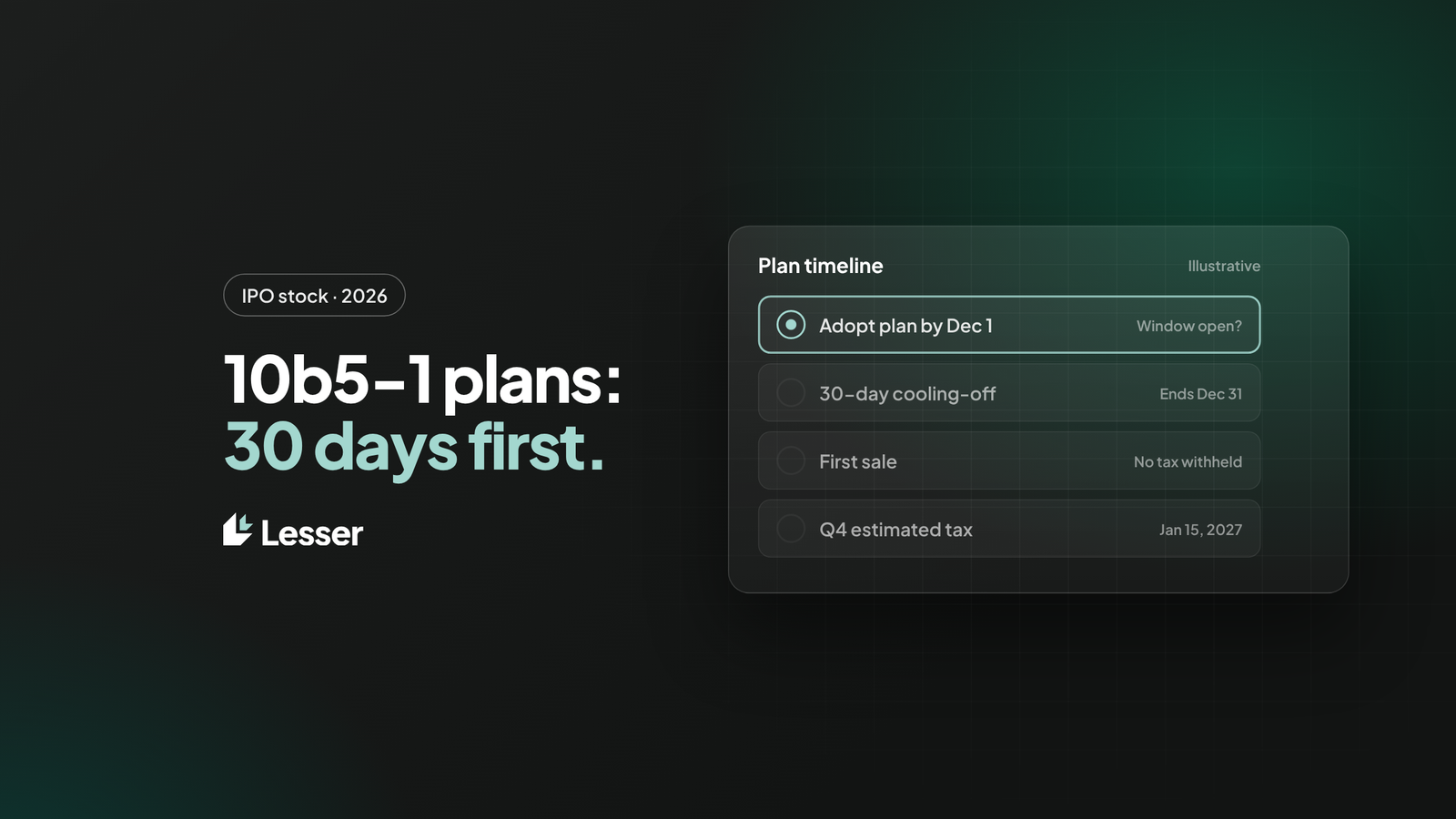
A 10b5-1 plan lets you schedule stock sales in advance so you can sell even when you might hold inside information. The catch for 2026: if you are an employee who is not a director or officer, SEC rules make you wait 30 days after you adopt the plan before the first sale. Adopt one after about December 1 and nothing can sell until 2027. And every sale is a normal capital gain sale with no tax withheld, so you plan the tax yourself.
What is a 10b5-1 plan, in one paragraph?
It is a written instruction to your broker, set up through your company's equity plan administrator, that says in advance how many shares to sell and when (for example, "sell 500 shares on the 15th of each month if the price is above $40"). Because the decisions are locked in before you learn anything new, the plan can give you an affirmative defense against insider trading claims under SEC Rule 10b5-1. That is why newly public companies push employees with large holdings toward them: the plan can keep selling through blackout periods when you otherwise could not trade.
This post covers the tax side. Whether you need a plan, and what your company allows, is a securities question: read your company's insider trading policy and ask its legal team or a securities attorney.
What did the SEC change, and what applies to you?
The SEC tightened Rule 10b5-1 in amendments adopted in December 2022 (Release 33-11138). The parts that matter most to employees:
- Cooling-off period: for anyone other than the company or its directors and officers, 30 days after you adopt or change a plan before any trade can happen under it.
- Changing the plan restarts the clock: a modification is treated like a new plan, with a new cooling-off period.
- One single-trade plan per 12 months: a plan built to sell in one trade can be used once in any consecutive 12-month period.
- No stacking: people other than the company are limited in using multiple overlapping plans.
- Good faith: everyone must act in good faith with respect to the plan, including while it runs, not just when signing.
Many companies add their own rules on top, such as adopting plans only while the trading window is open, or a longer wait. Your company's policy wins if it is stricter.
Employees vs directors and officers
| Rule | Most employees | Directors and officers |
|---|---|---|
| Cooling-off before first sale | 30 days | Later of 90 days, or 2 business days after the next 10-Q or 10-K, capped at 120 days |
| Certification in the plan | Not required | Must state no inside information and good faith |
| Single-trade plans | One per 12 months | One per 12 months |
| Overlapping plans | Limited | Limited |
| Plan use disclosed by the company | No | Yes, in quarterly reports |
The December 1 cutoff for 2026 sales
Count 30 days forward from adoption. A plan adopted on December 1, 2026 ends its cooling-off on December 31, the last trading day of the year. Adopt it any later and the first sale lands in 2027, which also puts the gain on your 2027 return.
That can be good or bad. If your 2026 income is already high from IPO vests, pushing sales into January can mean lower brackets and a tax bill due a year later. If you want losses or gains in 2026, you are short on time, and if your company only allows adoption in an open window, the practical cutoff may already have passed.
How each sale under the plan is taxed
A plan changes when you sell, not how the sale is taxed. Each sale is reported on Form 8949 and Schedule D like any other stock sale.
Your basis is the value already taxed at vest
When an RSU vests, the full value is wages on your W-2, and payroll withholds on it (often 22% for supplemental wages, and a mandatory 37% on the part above $1 million; see our post on the 37% withholding on RSUs over $1 million). That value is your cost basis. When the plan sells, only the difference between the sale price and that basis is a gain or loss.
Short-term or long-term depends on each lot
IRS Topic 409: hold a share more than one year and the gain is long-term; one year or less and it is short-term. The clock starts at each vest date. A plan that sells monthly will often sell some lots short-term and some long-term, so tell your broker which lots to sell first (specific identification, if your broker supports it with the plan) before the plan starts.
No tax is withheld on the sale
Vesting is wages; selling is not. The broker withholds nothing on a plan sale. If a plan sells $200,000 of stock at a gain, the tax on that gain is yours to pay through estimated payments or higher W-4 withholding. Our guide to the January 15 estimated payment and the 110% safe harbor shows how to size it.
A worked example with 2026 figures
This example is illustrative, not a real client. Neha is single, lives in Texas (no state income tax), earns a $210,000 salary and takes the $16,100 standard deduction for 2026. Her company went public this year. 1,000 shares vested in March 2026 at $40, so her basis is $40,000. Her plan is set to sell those shares at an assumed $50.
- Sale on December 31, 2026 (short-term): gain of $10,000. Her taxable income goes from $193,900 to $203,900, past the $201,775 line where the 32% bracket starts. Tax: $7,875 at 24% ($1,890) plus $2,125 at 32% ($680), so $2,570. Net investment income tax adds 3.8% on the $10,000 because her modified AGI of $220,000 is over the $200,000 threshold: $380. Total: $2,950.
- Sale in April 2027, after more than one year (long-term): same gain, taxed at 15% because her taxable income is far below the $545,500 line where 20% starts (2026 thresholds used for simplicity; 2027 thresholds are higher). Tax: $1,500 plus the same $380 of NIIT. Total: $1,880.
Waiting saves $1,070 and moves the bill to the 2027 return. But a 10% drop in the share price on 1,000 shares at $50 costs $5,000. The plan is a tool for selling on schedule; do not let a holding period alone decide it.
Watch for wash sales between plan sales and vests
If the plan sells shares at a loss and you acquire the same stock within 30 days before or after, through an RSU vest or an ESPP purchase, the loss is disallowed on that sale and added to the basis of the new shares. Newly public stock that fell after the IPO makes this common. See how wash sales work between RSU vests before you set a price floor or a monthly schedule.
Lock-ups, H-1B and moving back to India
A plan can usually be adopted during an IPO lock-up but cannot sell until the lock-up ends. Our post on the SpaceX lock-up and the December vs January sale walks through that timing with real dates.
If you are a US tax resident, which includes green card holders and most H-1B workers who pass the substantial presence test, plan sales are taxed exactly as above. If you might move back to India while the plan is running, sales after the move can be taxed differently in each country. Read selling RSUs before or after moving back to India before you set the schedule. Immigration questions belong with an immigration attorney.
What to do this week
- By November 30: download your vest history and the cost basis of every lot. Mark the date each lot turns long-term.
- By December 1: if you want any 2026 sales, check whether your window is open and adopt the plan now. Later than that, plan for 2027.
- Before you sign: list every RSU vest and ESPP purchase in the plan period and space loss sales at least 31 days away from them.
- Before the first sale: set your broker's lot selection method so long-term lots go first when that is what you want.
- By January 15, 2027: make a fourth-quarter estimated payment for any December plan sales. For 2027 sales, use the quarterly dates starting April 15, 2027, or raise your W-4 withholding.
If you want help shaping a sale schedule around your brackets, Lesser Tax does tax planning for tech employees with RSUs, ISOs and ESPP. This post is general information, not personal tax or securities advice.