
Lesser Tax
8 min read
Want an expert to handle this? Get your NRI taxes done right
On November 24, 2026 the IRS announced that the interest rate on unpaid individual tax rises to 8% a year, compounded daily, from January 1, 2027, up from 7% in the last quarter of 2026. The same rate drives the penalty for not paying enough tax during the year. If your RSU vests, bonus or IPO shares were withheld at 22% and you now owe more, every month you wait costs more than it did last quarter. Extra withholding from your December paychecks is still the cheapest fix.
What did the IRS announce?
In news release IR-2026-144 the IRS set its interest rates for the quarter that starts January 1, 2027. For individuals, both the overpayment rate (what the IRS pays you on a late refund) and the underpayment rate (what you pay on tax you owe) will be 8% per year, compounded daily. The formal notice is Revenue Ruling 2026-25.
The rate is not set by Congress each year. By law it is the federal short-term rate plus 3 percentage points, and the IRS resets it every quarter. The January rate is based on the federal short-term rate from October 2026. Large corporate underpayments go to 10%, but that does not affect individuals.
This is the highest individual rate on the IRS table for 2025 or 2026. Here is how it has moved:
| Quarter | IRS rate on unpaid individual tax | What it means for $40,000 owed for a year |
|---|---|---|
| Every quarter of 2025 | 7% | About $2,800 |
| January to March 2026 | 7% | About $2,800 |
| April to June 2026 | 6% | About $2,400 |
| July to December 2026 | 7% | About $2,800 |
| January to March 2027 | 8% | About $3,200 |
The last column is simple interest for comparison only. Real IRS interest is compounded daily, so the true cost is slightly higher. The rate for April 2027 onward has not been set yet.
Who does this hit?
Two groups of people pay this rate, and many tech workers are in both:
- People who did not pay enough during 2026. The estimated tax penalty on Form 2210 is figured with the same quarterly underpayment rate. Any part of the shortfall that is still unpaid after January 1, 2027 is charged at 8%.
- People who file but do not pay in full by April 15, 2027. Interest runs on the unpaid balance from the due date until you pay, compounded daily, plus a separate failure to pay penalty of 0.5% of the unpaid tax for each month or part of a month, up to 25%.
The usual cause is equity. Many employers withhold federal tax on RSU income at a flat 22% until your supplemental wages for the year pass $1 million, and only then at 37%. If your marginal rate is 32%, 35% or 37%, each vest leaves a gap. Our guide to the mandatory 37% withholding on RSUs and bonuses over $1 million explains why even people above that line can still owe. Newly public company employees, such as those selling after the SpaceX lockup ends, can also owe on gains from share sales that had no withholding at all.
How do you avoid the penalty completely?
The IRS does not charge the estimated tax penalty if any of these is true:
- You owe less than $1,000 after your withholding and credits.
- You paid at least 90% of your 2026 tax through withholding and estimated payments.
- You paid at least 100% of the tax shown on your 2025 return. If your 2025 adjusted gross income was over $150,000 ($75,000 if married filing separately), the figure is 110%.
The prior-year rule is the one that saves most people with a big equity year. If 2025 was a smaller year, paying 110% of last year's tax can be far less than 90% of this year's. Our post on RSU withholding and the January 15 estimated payment walks through both safe harbors with numbers.
Note what the safe harbor does not do. It removes the penalty. It does not remove the tax. You still pay the full balance by April 15, 2027, and anything left unpaid after that date is charged interest at the IRS rate for each quarter until you pay.
Why December withholding beats a January payment
This is the part most people miss. Under the IRS rules for Form 2210, federal income tax withheld from your pay is treated as paid in equal amounts on each of the four due dates, unless you choose to use the actual dates. Estimated payments count only on the day you make them.
So $40,000 of extra withholding taken from your last December paycheck is treated as if a quarter of it was paid in April, June and September 2026 and January 2027. A $40,000 estimated payment on January 15, 2027 only counts from January 15. The earlier quarters stay late.
You can ask for extra withholding on a new Form W-4 (line 4(c), extra withholding per pay period), or through your equity plan if it lets you choose a higher rate on the last vest of the year. Payroll cutoffs are often a week or more before payday, so ask now.
A worked example: a $40,000 shortfall
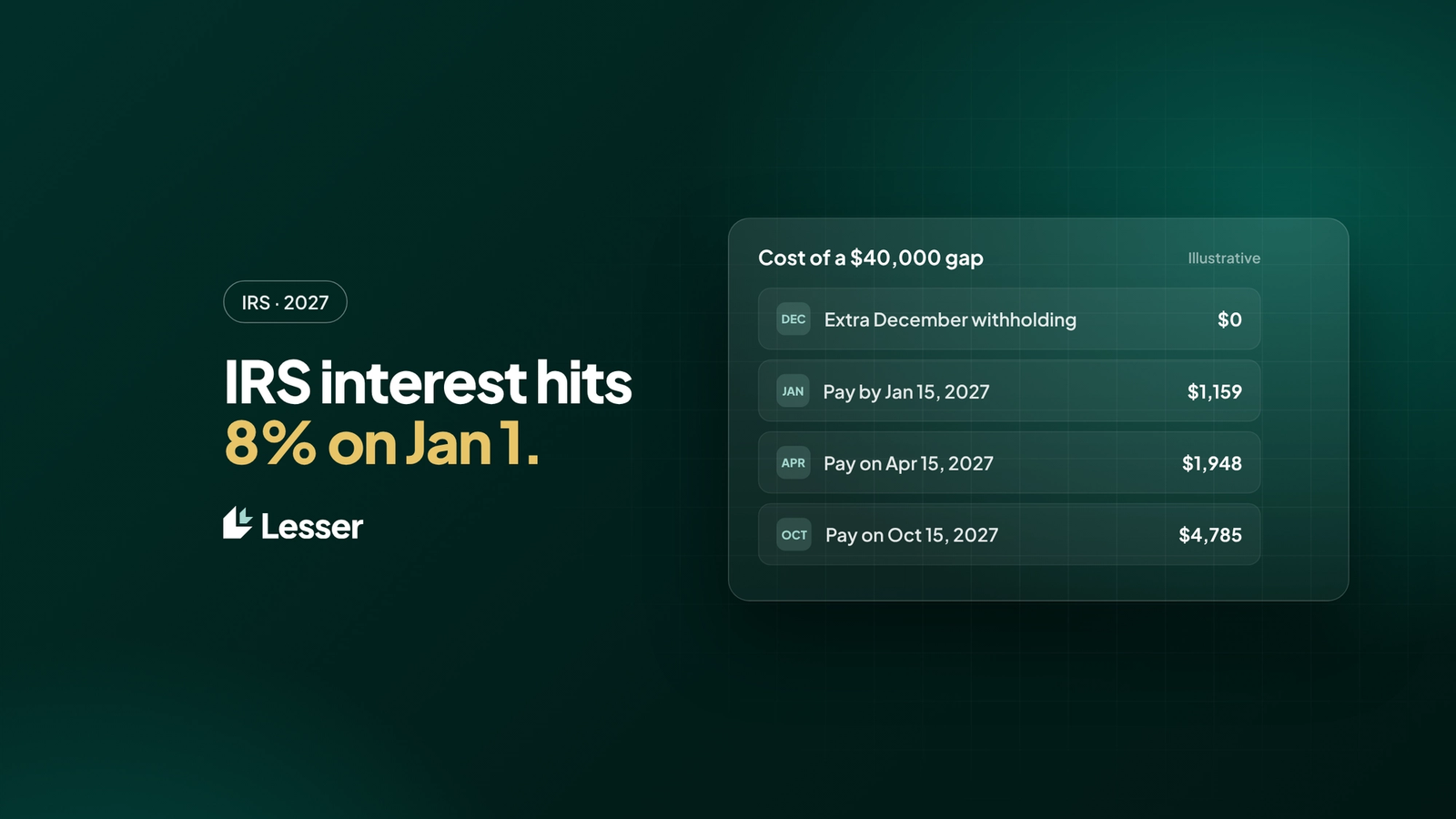
This example is illustrative, not a real client. Arjun's 2026 federal tax will be $40,000 more than what was withheld from his salary and RSU vests, and he is $40,000 short of the safe harbor. He has made no estimated payments. Under the regular Form 2210 method, that leaves $10,000 short on each of the four due dates. We use the IRS rates above and assume the rate stays at 8% after March 2027, which the IRS has not yet confirmed.
Option A: extra withholding in December 2026
He raises withholding on his December paychecks by $40,000. Because withholding is spread across all four due dates, every installment counts as paid on time. Estimated tax penalty: about $0.
Option B: a $40,000 estimated payment on January 15, 2027
The fourth installment is on time, but the first three stay unpaid until January 15. Penalty: about $1,159, most of it from the 2026 months.
Option C: pay everything with the return on April 15, 2027
All four installments are late, and every day from January 1 to April 15 is charged at 8%. Penalty: about $1,948.
Option D: file on April 15, 2027, pay on October 15, 2027
He owes the $1,948 penalty from Option C, plus about $1,637 of interest on the $40,000 for six months at 8% compounded daily, plus a $1,200 failure to pay penalty (0.5% a month for six months). Total: about $4,785, before interest on the penalties themselves.
The gap between Option A and Option D is almost $4,800 on the same $40,000 of tax. Everything here depends on your own income, rates and dates, so treat the numbers as a guide, not a calculation of your bill.
What if most of your income came late in the year?
If a large vest, IPO settlement or share sale happened in the fourth quarter, the regular method can overstate your penalty, because it assumes the income was earned evenly. Form 2210 Schedule AI, the annualized income installment method, matches each installment to the income you actually had by that date. It takes more work, and you attach Form 2210 to your return, but it can cut the penalty for late-year income. Ask your preparer to run both methods.
One more option from Publication 505: if you file your 2026 return by January 31, 2027 and pay all the tax you owe, you do not need to make the January 15 payment. Few people with RSUs have their final forms that early, so most will use December withholding or a January payment instead.
What to do this week
- By November 30, 2026: open your latest paystub and equity plan statement. Add up 2026 federal withholding and estimate your 2026 tax. If you are short of 110% of your 2025 tax (or 100% if your 2025 AGI was $150,000 or less), you have a gap to close.
- Before your December payroll cutoff: submit a new Form W-4 with extra withholding on line 4(c) for the last one or two paychecks, or raise the withholding rate on a December vest if your plan allows it.
- December 31, 2026: last day for withholding to count for 2026. Remember to reset your W-4 in January, or the extra amount keeps coming out of 2027 pay.
- January 15, 2027: if you could not withhold enough, make a fourth-quarter estimated payment through IRS Direct Pay or your IRS online account. Sooner is cheaper, since it stops the 8% clock.
- April 15, 2027: pay any balance with your return or extension. An extension gives more time to file, not to pay.
Planning for 2027 too? The 2027 tax brackets and $16,600 standard deduction change what your W-4 should say next year. If you want someone to run the numbers on your equity, Lesser Tax does tax planning for tech workers with RSUs, ISOs and ESPP. This post is general information, not personal tax advice.