
Lesser Tax
7 min read
Want an expert to handle this? Plan your equity taxes with a CPA
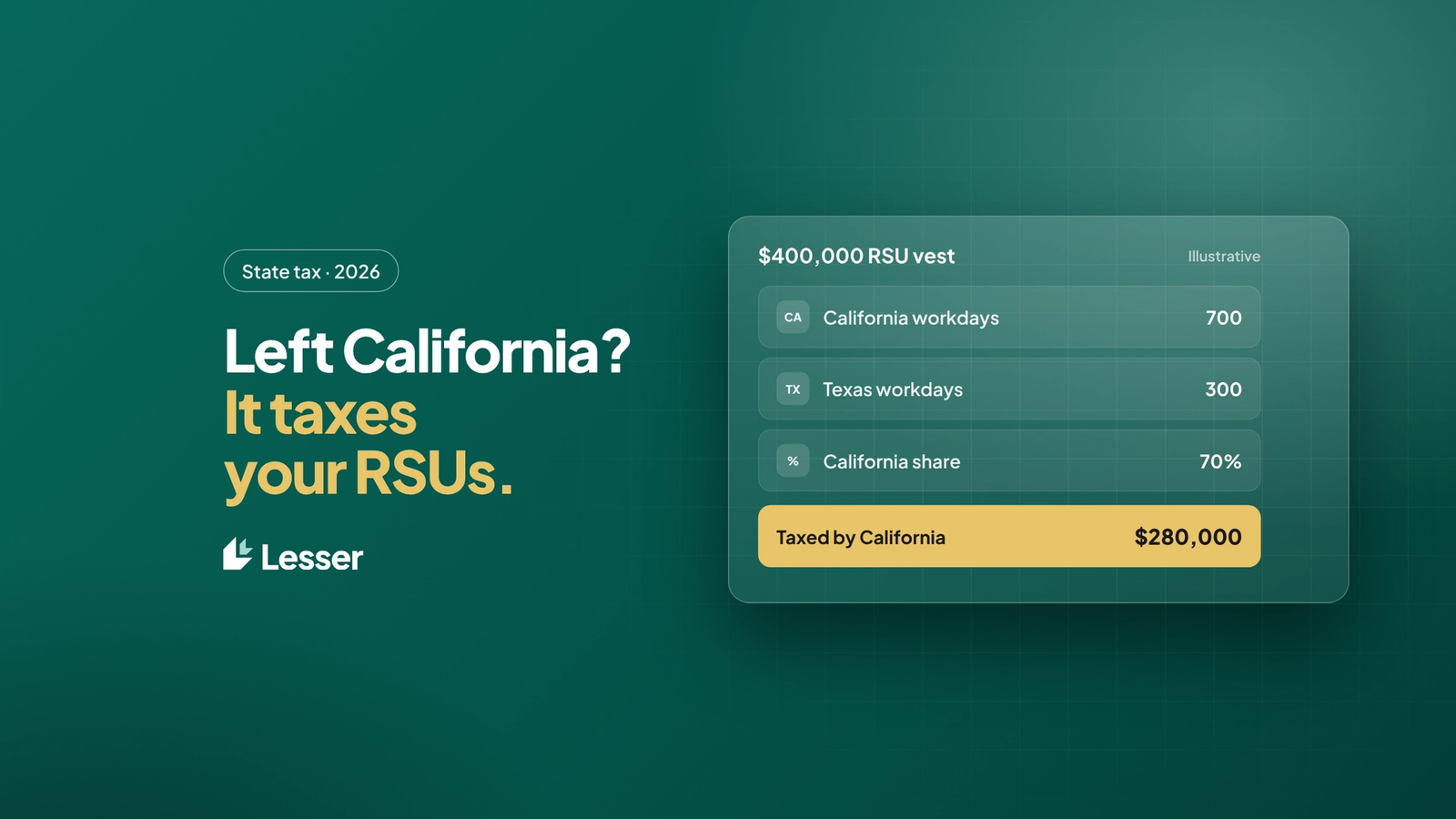
Moving out of California does not end California tax on the RSUs you earned while you worked there. California splits each vest by workdays: California workdays between grant and vest, divided by all workdays in that period. If 700 of 1,000 workdays were in California, 70% of the vest is California income, even if you live in Texas or Washington on vest day. If you are still a California resident on the vest date, all of it is.
Does moving out of California before an IPO stop California tax on my RSUs?
Only partly. FTB Publication 1004 says that for someone who is a nonresident on the vesting date, California taxes RSU wage income "to the extent services were performed in California from the grant date to the vesting date." Your move date cuts the grant-to-vest period in two. The California part stays California income. Only the workdays after you leave are outside it.
This matters most around an IPO, because tranches that waited for the listing can settle on one day. One W-2 can carry several years of grants, and the California share can be most of it. Your federal tax does not change at all when you move. This is only about the state.
If you are still a California resident on the vest date, there is no split. Pub 1004 says California then taxes the full value of the shares on the vesting date. So a move planned for "right after the IPO" saves nothing on a tranche that settles before you go.
How do I work out the California share of a vest?
Pub 1004 uses one ratio for each tranche:
- Count your California workdays from the grant date to the vest date.
- Divide by your total workdays over the same period.
- Multiply the vest income on your W-2 by that ratio. The result is your California-source income.
Count working days, not calendar days, and keep a record of where you worked each day, including work trips. Your employer's payroll split may not match your own records. Every grant has its own grant date, so each tranche gets its own ratio.
Stock options use a different end date
For NSOs, Pub 1004 runs the period from grant to exercise, or to the date your employment ended if that is earlier. ISOs sold in a disqualifying disposition are treated as if you exercised an NSO, so the same grant-to-exercise period applies. The table sums it up.
| Equity income | California period | If you have moved out |
|---|---|---|
| RSU vest | Grant to vest | California taxes the California workday share |
| RSU vest while still a resident | No split | All of it is California income |
| NSO exercise | Grant to exercise (or end of job) | California taxes the California workday share |
| ISO, disqualifying sale | Grant to exercise | California workday share of the wage part |
| ISO, qualifying sale as a nonresident | None | California will not tax the capital gain |
| Option shares sold after you move | None | California will not tax the capital gain |
Worked example: a $400,000 IPO settlement after a move to Austin
These figures are illustrative, not a real client. An engineer at a Bay Area company works 1,000 days between her RSU grant and the IPO settlement date. She works 700 of those days in California, moves to Austin, and works the last 300 days remotely from Texas. On settlement day the tranche is worth $400,000.
- Federal: all $400,000 is W-2 wages, exactly as if she had never moved.
- California: 700 ÷ 1,000 = 70%, so $280,000 is California-source income on Form 540NR.
- Texas: no state income tax on the other $120,000.
- If she had moved after settlement: all $400,000 would be California income.
California's flat withholding rate for stock options and bonuses is 10.23% (EDD form DE 231PS). If her employer applies it to the $280,000 California share, that is $28,644 withheld. Whether that covers the bill depends on her total income, because of how Form 540NR sets the rate (next section).
Six months later she sells the shares for $500,000 while living in Texas. The $100,000 rise after vest is a capital gain, not wages. For option shares, Pub 1004 says California will not tax a nonresident's capital gain on the sale. Its restricted stock section does not address the gain, so confirm the RSU treatment with a CPA before you rely on it.
Why does California use my Texas income to set the rate?
Form 540NR does not give you a low rate just because only part of your income is from California. The FTB's 540NR booklet says: "You determine your California tax by multiplying your California taxable income by an effective tax rate." That rate is "the tax on total taxable income, taken from the tax table, divided by total taxable income", with total income worked out as if you lived in California all year.
In the example, the $280,000 California share is taxed at the average rate California would charge on her whole year, including the $120,000 earned in Texas and her salary. A big IPO year pushes that average rate up.
Two more lines matter in a large year:
- The 1% tax over $1 million. The Behavioral Health Services Tax (formerly the Mental Health Services Tax) adds 1% on taxable income above $1,000,000. The FTB's 2026 Form 540-ES instructions apply it when "nonresident California source taxable income is more than $1,000,000" too. An illustrative $1,500,000 settlement with an 80% California share gives $1,200,000 of California-source income, so about 1% of $200,000, or $2,000, before deductions.
- SDI has no cap. California SDI applies to all wages since 2024, at 1.3% for 2026 and 1.4% for 2027 (EDD). If SDI is withheld on the California share of a large vest, 1.3% of $280,000 is $3,640.
For the federal side of a settlement this size, see why RSUs over $1 million get mandatory 37% withholding.
When does California stop treating me as a resident?
When you actually move, not when you decide to. The FTB's residency manual says a person "is a resident for tax purposes until there are sufficient indicia of an actual change of such residence." It looks at where your closest connections are: your home, where your spouse and children live, your children's school, driver's license, car registration, voter registration, bank accounts and where you work.
Keeping the California house while renting in Austin, leaving the kids in a California school, or keeping a California license all point back to California. In a year with a large vest, those details carry real money.
A few related cases:
- Moving to India works the same way for California. The California workday share of each later vest stays California income. The US and India side is in our guide to RSU taxes on an H-1B, including vests after you leave.
- Moving between two taxing states, such as California to New York, means two part-year returns. Our guide to the two-state return after a mid-year move covers it.
- Double-trigger RSUs that settle only at the IPO are not addressed directly in Pub 1004. Ask your CPA which dates set the allocation period before you rely on a number.
What to do this week
- Before December 31, 2026: download your grant dates and vest or settlement dates from your stock plan portal, and rebuild where you worked each day since each grant: calendar, travel bookings, office badge records.
- If you have not moved yet: compare your planned move date with your next settlement date. A tranche that settles while you are still a California resident is 100% California income.
- If you moved out during 2026: you file Form 540NR as a part-year resident for 2026, with the workday split for every vest.
- January 15, 2027: California's fourth 2026 estimated payment is due. California splits estimated payments 30%, 40%, 0% and 30%, so this one is 30% of the year. The federal fourth-quarter payment is due the same day; our guide to the January 15 payment and the 110% safe harbor explains how much to send.
- April 15, 2027: file the 2026 returns. If your W-2's California wages do not match your own workday count, be ready to show your records.
If the California share of an IPO year is large, a planned move date and a correct workday split are worth getting right before the money settles. Lesser Tax prepares multi-state returns for tech employees with RSUs and options; see how Lesser Tax handles tech equity tax planning.
This is general information, not personal tax advice.